-
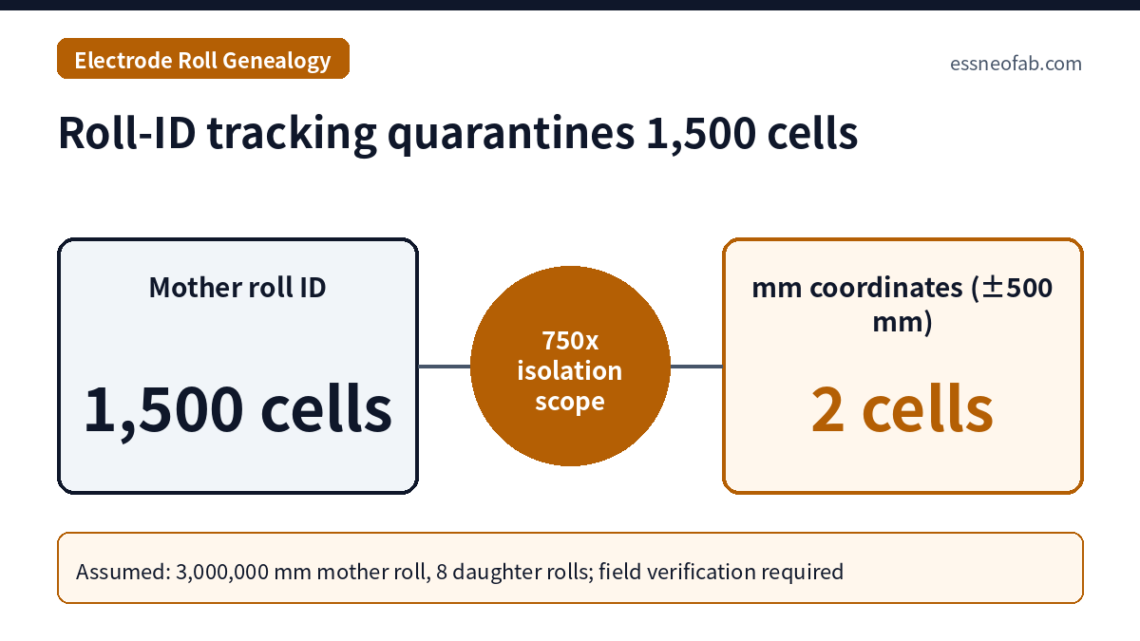
Electrode Roll Genealogy: How Key Reissue at Slitting and Stacking Shrinks Defect Isolation from 1,500 Cells to 2
When traceability resolution in the electrode R2R section stops at the "roll ID," a 5,000 mm coating defect in one mother roll expands the isolation scope to every cell derived from that mother roll. Assuming a 3,000,000 mm mother roll, 4 lanes, 8 daughter rolls, and 8,000 mm of cathode web per cell, the isolation scope is 1,500 cells at mother-roll-ID resolution, 188 cells at daughter-roll-ID resolution, and 2 cells at encoder-based mm-coordinate resolution (±500 mm), a difference of up to 750 times. This resolution is preserved only when a key consisting of "parent ID + parent coordinate interval + direction bit + transform coefficient" is reissued at every split…
You May Also Like
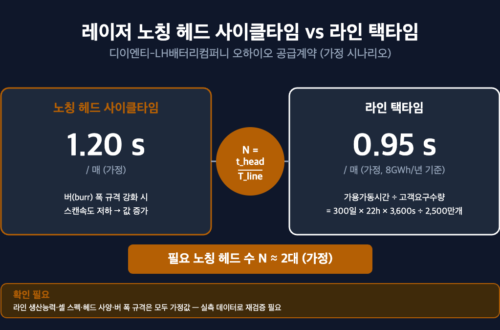
The Interface Between Laser Notching Cycle Time and Line Takt Time — The Head-Count Sizing Problem Revealed by DI ENT’s Ohio Supply Contract
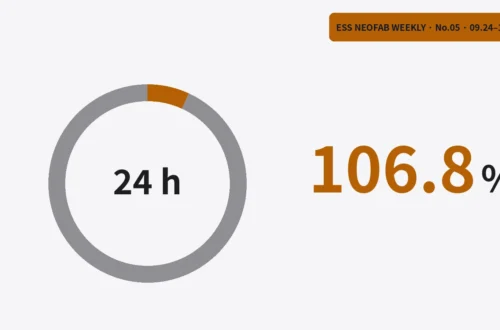
Two Cycles a Day Take 106.8 % of a Day, and the Retention Tier Shifts Cell Volume by 1.47 GWh
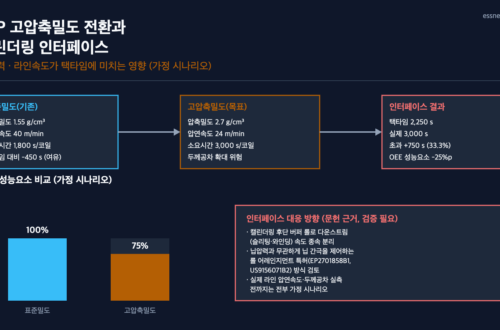
LFP High-Compaction-Density Conversion and the Calendering Interface: How Nip Pressure and Line Speed Affect Takt Time
-
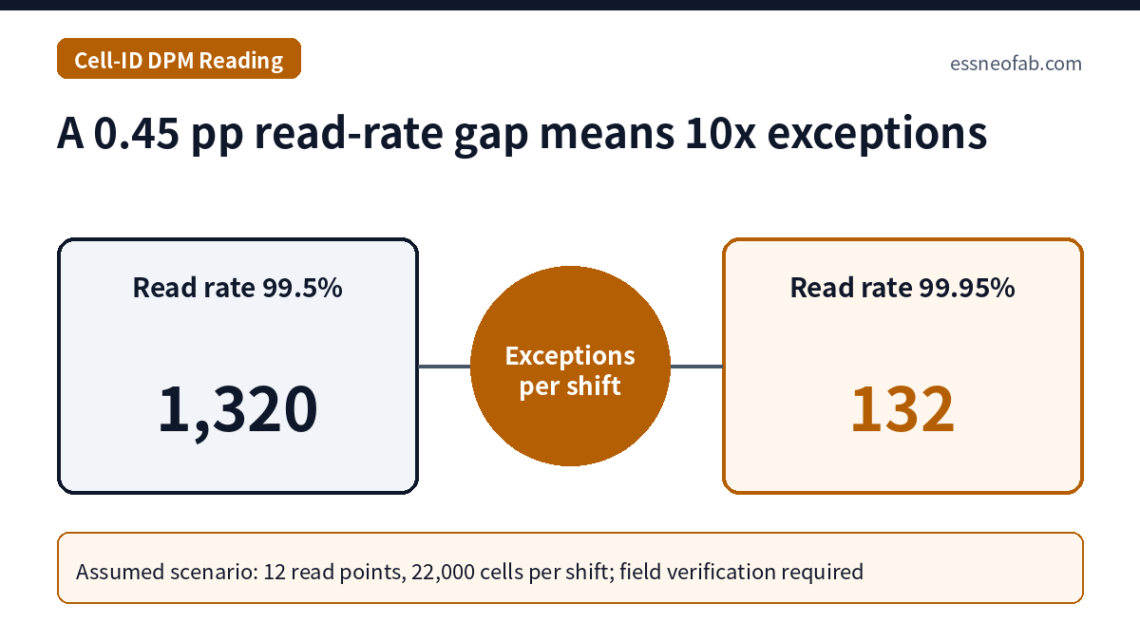
Cell-ID Laser DPM Read Rate 99.5% vs 99.95%: How No-Reads Drive Exceptions per Shift and OEE
The read rate of a cell-ID direct part mark (DPM) is a probability defined at a single read point, but the line experiences it raised to the power of the number of read points each cell passes. Assuming 12 read points and 22,000 cells per shift, a 99.5% read rate generates 1,320 No-Read exceptions per shift, while 99.95% generates 132. Under the same assumptions, OEE falls from a baseline of 84.64% to 75.50% at 99.5% (−9.14 pp), but only to 84.13% at 99.95% (−0.51 pp). A DPM specification should therefore be defined not as "read rate X%" but by three items: verification grade immediately after marking (ISO/IEC 29158), allowable exceptions…
You May Also Like
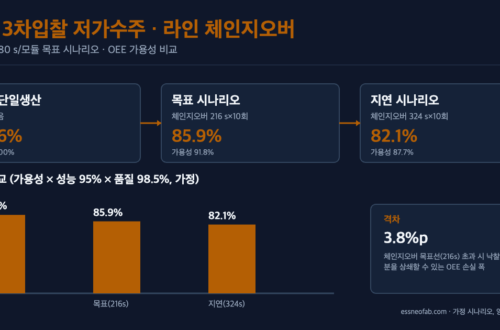
Line Changeover Design in the Era of Low-Price ESS Round-3 Bidding — Flexible Assembly Viewed Through Takt Time and OEE
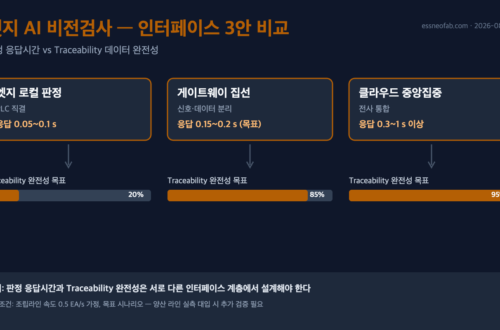
Edge AI Vision Inspection and Battery-Pack Leak Testing: How Gateway Aggregation Affects Traceability Completeness
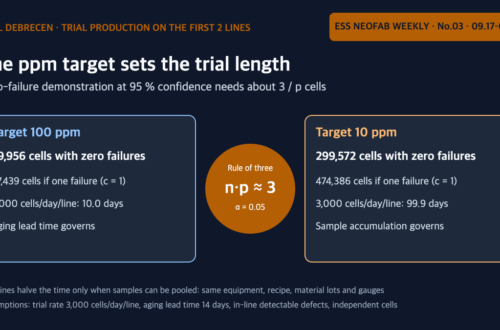
CATL Starts Trial Production in Debrecen — The Digits of the Defect-Rate Target, Not the Equipment, Set the Length of a Trial Run
-
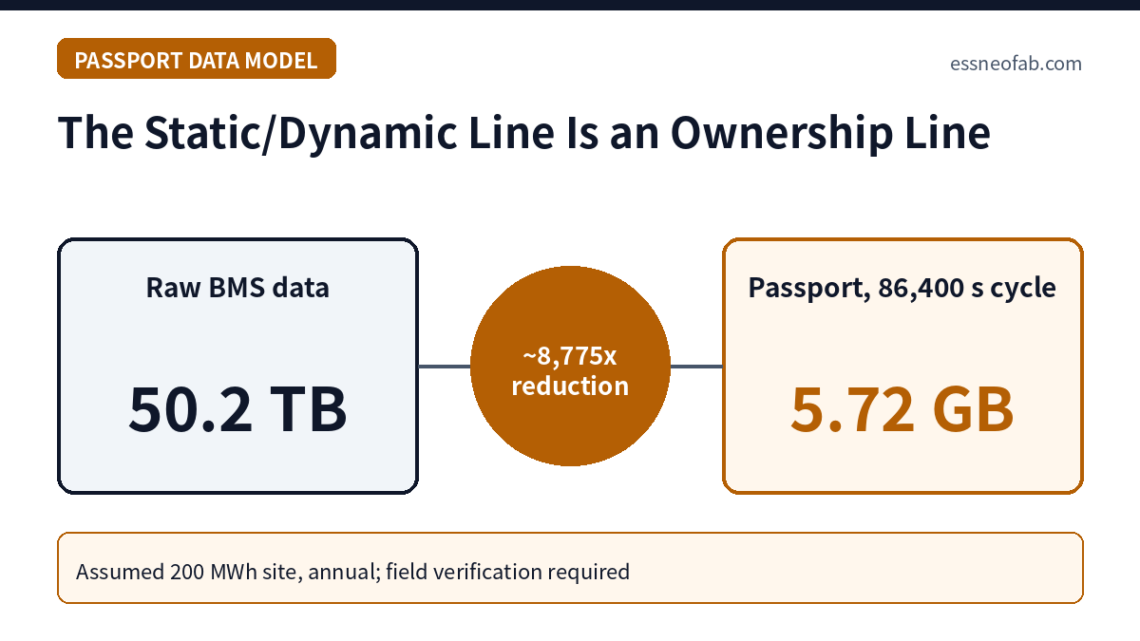
Battery Passport Static vs Dynamic Data: Ownership and Update Interfaces Across ESS Layers
The split between "static data" and "dynamic data" in the battery passport data model looks like a classification of data characteristics, but mapped onto ESS system layers it functions as the boundary where data ownership and legal responsibility diverge. Regulation (EU) 2023/1542 places responsibility for the accuracy and up-to-dateness of passport information on the operator placing the battery on the market (usually the pack or system integrator), yet the 16 dynamic attributes (mandatory for the stationary category) are generated after placing on the market in the BMS and EMS run by the asset owner, and the BMS read access right under Article 14 is granted to the purchaser, not the…
You May Also Like
Two Cycles a Day Take 106.8 % of a Day, and the Retention Tier Shifts Cell Volume by 1.47 GWh
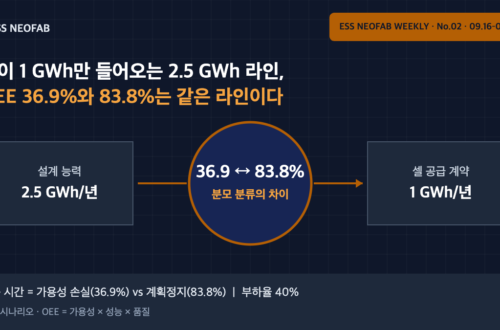
A 2.5 GWh Line Fed Only 1 GWh of Cells — OEE of 36.9% and 83.8% Describe the Same Line
Line Changeover Design in the Era of Low-Price ESS Round-3 Bidding — Flexible Assembly Viewed Through Takt Time and OEE
-
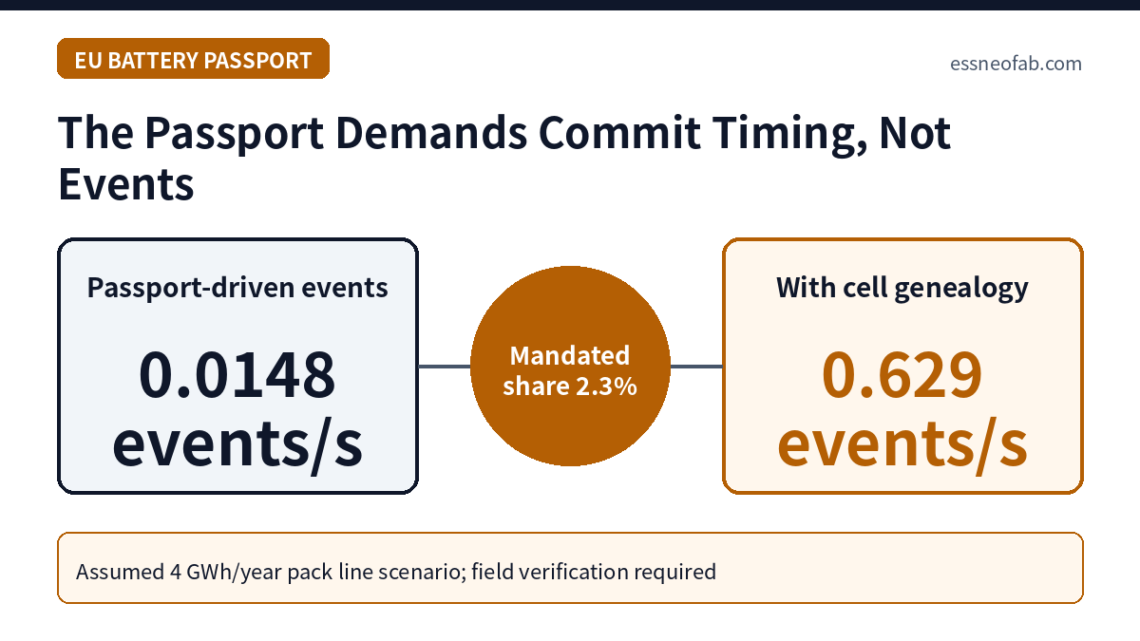
EU Battery Passport 2027: Which Station on an ESS Pack Line Commits What
Under Article 77 of the EU Batteries Regulation (Regulation (EU) 2023/1542), industrial batteries above 2 kWh require a battery passport from 18 February 2027, and as of September 2026 no legislative proposal changing that date has been identified. Breaking down the passport data attribute list (the version aligned with DIN DKE SPEC 99100) for the stationary ESS category shows that, of 80 mandatory attributes, only 5 static attributes must be recorded on the line at individual-battery level; the remaining static attributes are fixed once at battery-model level. In an assumed scenario (4 GWh/year pack line, pack takt time 338.6 s), passport-driven line capture events amount to 5 per pack (0.0148…