-
Sebang Lithium Battery’s Simultaneous HEV Pack and ESS Module Orders — Analyzing the Cell-Inbound Interface and Cell-ID Traceability Load
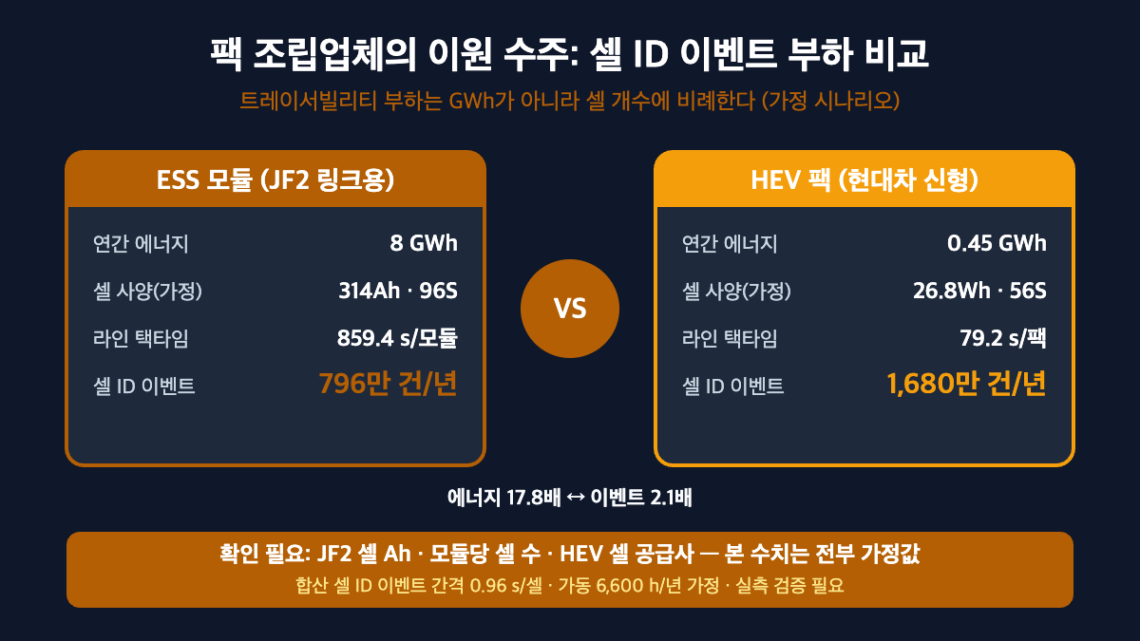
Sebang Lithium Battery simultaneously won orders for Hyundai Motor's new hybrid (HEV) battery packs and LG Energy Solution's new ESS (JF2) battery packs, together worth more than KRW 3 trillion (reported 2026-09-07). This article quantifies, under an assumed scenario, how the Cell Inbound Interface and Cell-ID Traceability load differ when a pack systems company that sources cells externally receives two heterogeneous product lines — automotive and grid-scale power — within a single organization. The conclusion is that the traceability system's load scales with cell count, not GWh. In the assumed scenario, the HEV pack, at 0.45 GWh/year, is only 1/17.8 the scale of the ESS module (8 GWh/year), yet its…
You May Also Like
45 Days from Pohang to Georgia — Safety Stock at an Intercontinental Cathode Interface Is Driven by Lead-Time Variability, Not Demand
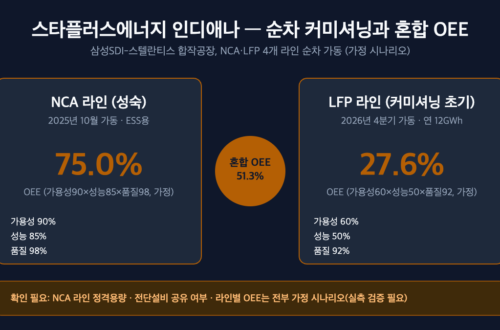
StarPlus Energy’s Indiana Plant — The Blended-OEE Illusion Created by Sequential NCA/LFP Commissioning
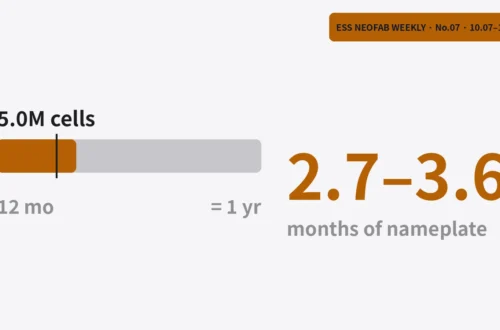
Five million ACC cells equal 2.7 to 3.6 months of nameplate output
-
Linking Cell History in Formation and Aging: History Contamination from Tray ID + Slot Mapping
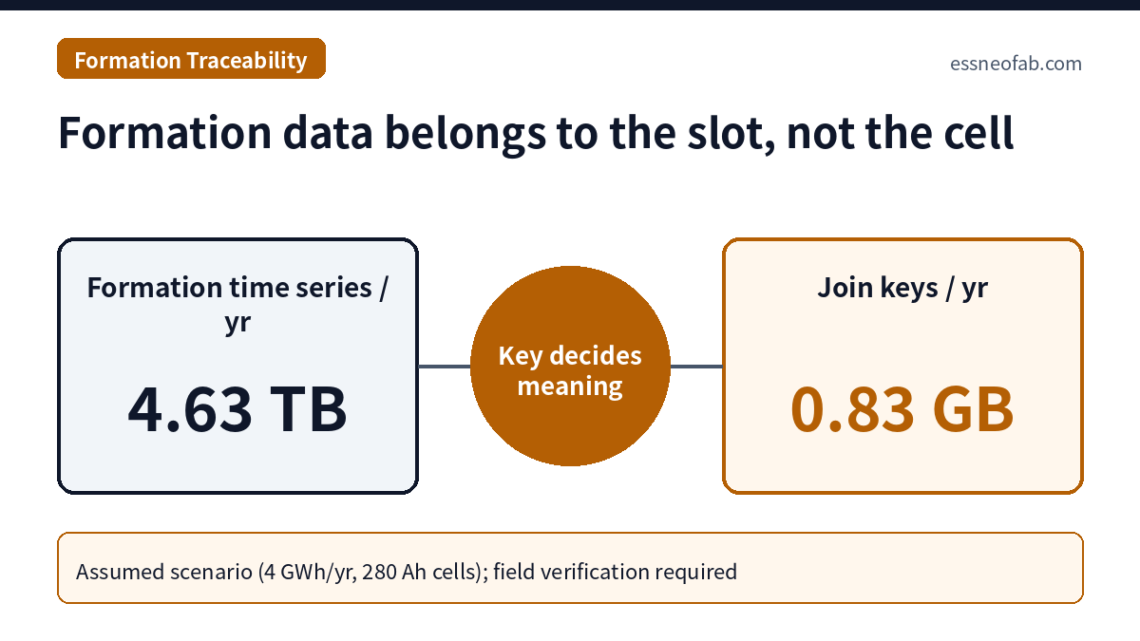
Measurement data in the formation and aging section are generated against equipment channels and tray slots, not against cell IDs; the completeness of cell history is therefore determined not by measurement accuracy but by the integrity of a join key composed of tray ID + slot position + load event. On an assumed line processing about 4.46 million cells per year, formation time series occupy about 1.04 MB per cell and about 4.63 TB per year, while the join-key record is 186 byte per cell, less than 0.02% of the total. Yet a slot misplacement rate of only 10 ppm per load event contaminates the history of about 268 cells…
You May Also Like
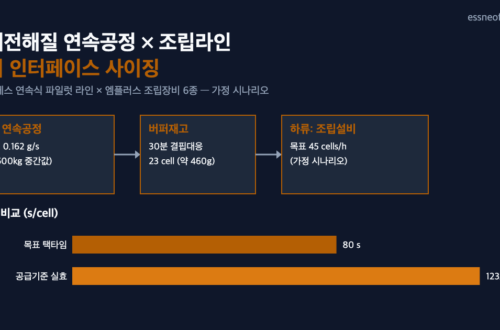
Between the Continuous Solid-Electrolyte Process and the Assembly Line: How Should the Buffer Interface Be Designed?
Market Trends from a Battery Process/Equipment Perspective — 46-Phi Ramp-Up, Dry Process, Equipment In-Housing
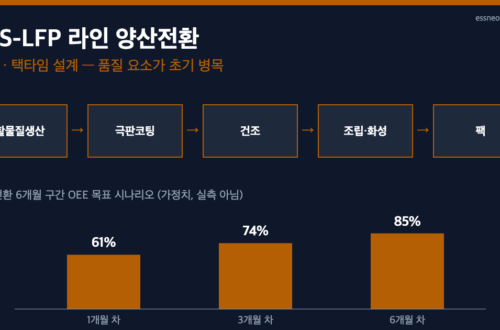
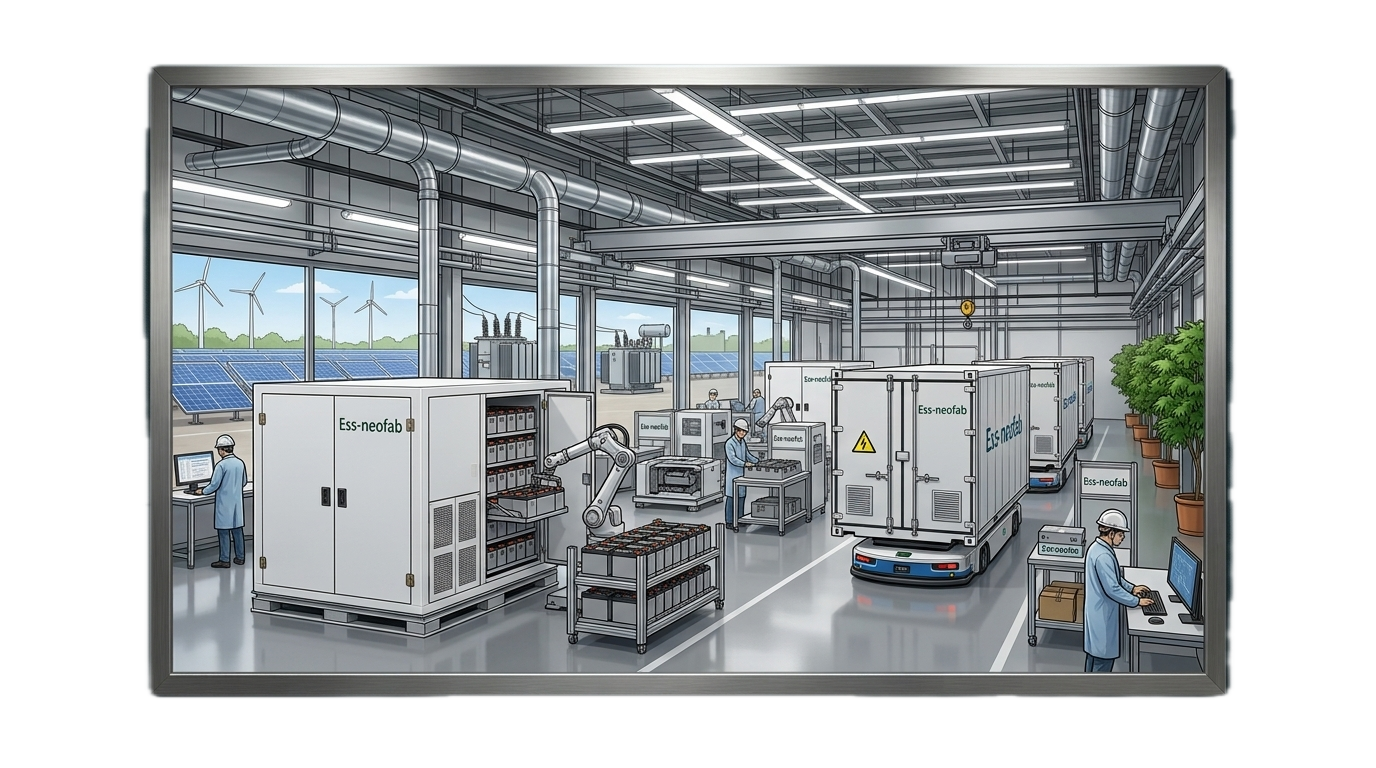
The Equipment Maker’s Line-Ownership Shift — OEE and Takt-Time Design During the ESS-LFP New-Line Mass-Production Ramp-Up
-
Electrode Roll Genealogy: How Key Reissue at Slitting and Stacking Shrinks Defect Isolation from 1,500 Cells to 2
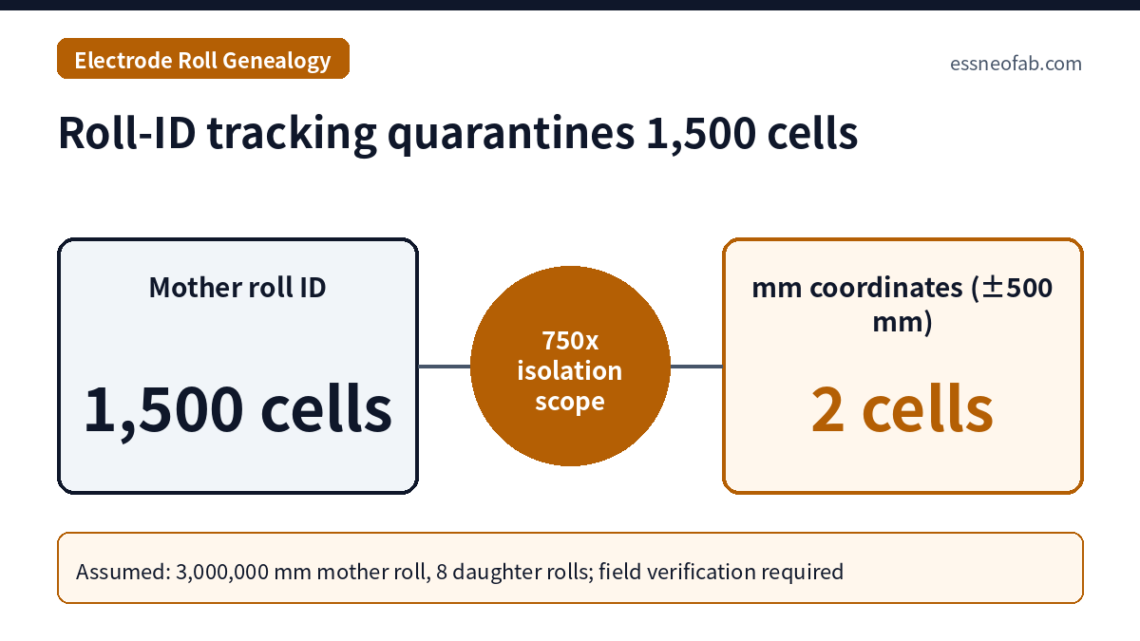
When traceability resolution in the electrode R2R section stops at the "roll ID," a 5,000 mm coating defect in one mother roll expands the isolation scope to every cell derived from that mother roll. Assuming a 3,000,000 mm mother roll, 4 lanes, 8 daughter rolls, and 8,000 mm of cathode web per cell, the isolation scope is 1,500 cells at mother-roll-ID resolution, 188 cells at daughter-roll-ID resolution, and 2 cells at encoder-based mm-coordinate resolution (±500 mm), a difference of up to 750 times. This resolution is preserved only when a key consisting of "parent ID + parent coordinate interval + direction bit + transform coefficient" is reissued at every split…
You May Also Like
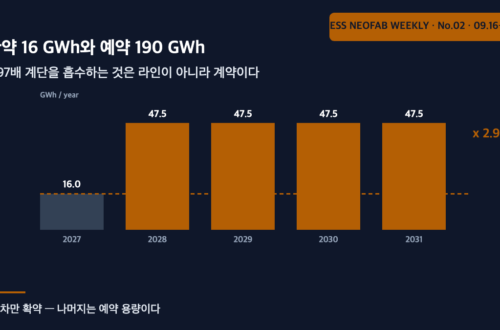
16 GWh committed and 190 GWh reserved — what absorbs the 2.97x step is the contract, not the line
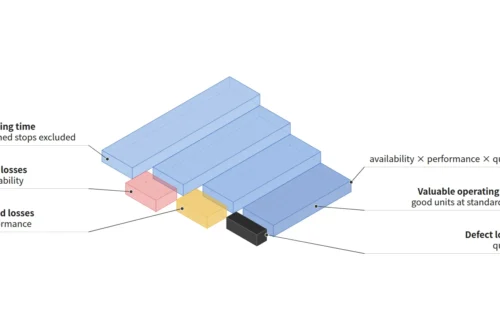
If Availability, Performance and Quality Are All 80 %, OEE Is 51.2 % — How to Calculate OEE
45 Days from Pohang to Georgia — Safety Stock at an Intercontinental Cathode Interface Is Driven by Lead-Time Variability, Not Demand