A 160 MW battery’s six-week commissioning has two baselines
ESS NEOFAB WEEKLY · No.06 · System
Six weeks of commissioning count as a 3x cut or a better-than-4x cut, depending on the baseline.
Summary
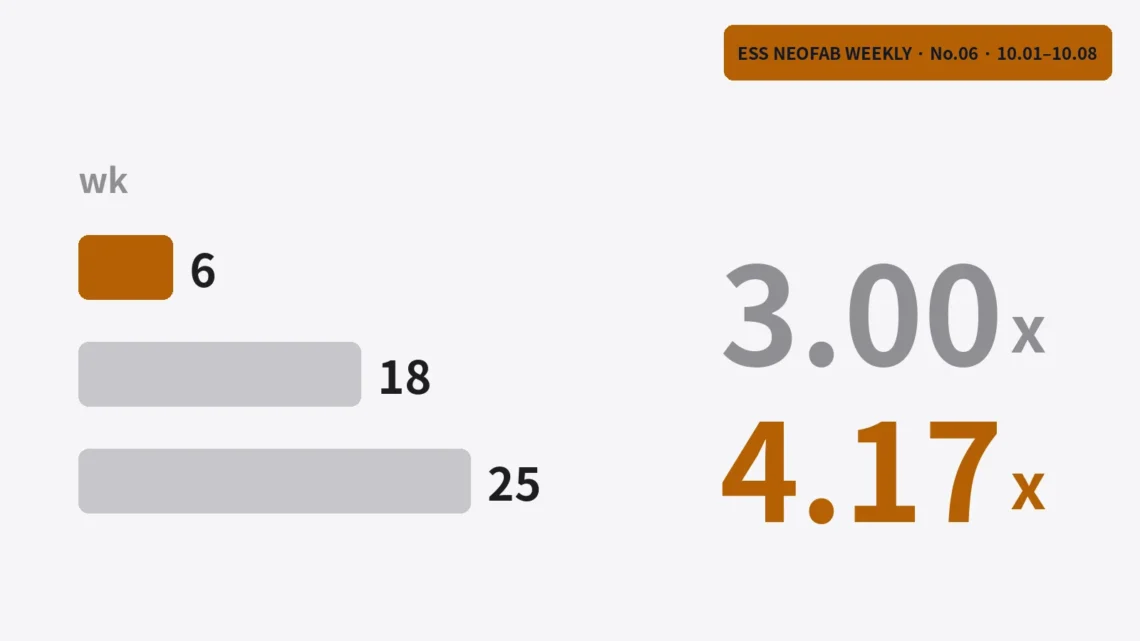
Two different baselines hang on the six-week commissioning of a 160 MW/320 MWh battery in Texas. One report says deployment time fell threefold against the original plan, and another compares the six weeks with a typical 25 weeks or more, so the baselines sit 7 weeks apart (18 and 25) and the multiples split into 3.00 and 4.17. Of roughly 16 months from groundbreaking to start-up (69.6 weeks), the six weeks make up 8.6 %, and the site announced operation 10.1 weeks after the last day of its target quarter. However the planned commissioning length is assumed, the delay that built up before commissioning stays at 4.1 weeks or more, and the reports I read do not say where commissioning began or ended.
Two baselines hang on the same six weeks
A 160 MW/320 MWh battery energy storage system (BESS)1 in Houston, Texas, announced operation on 9 September 2026. FlexGen, the system integrator2, said commissioning3 took six weeks[1]. With 160 MW4 of power and 320 MWh of energy, the site can discharge at full power for 7,200 s (2 hours).
Two comparisons came attached to that six. A report dated 10 September said deployment time fell threefold against the original timeline[1]. An ESS News piece dated 6 October set the six weeks against a typical 25 weeks or more in its summary line[3]. A threefold cut implies an original baseline of 18 weeks, and against 25 weeks the multiple is 4.17.
So one six becomes a saving of 12 weeks in one telling and 19 weeks or more in the other. Seven weeks separate the two baselines, a gap longer than the commissioning itself. Same result, different baseline. I decided to start with that gap, because a speed-up multiple is the baseline divided by the result, and the same result can read as 3x or as better than 4x depending on where the baseline comes from.
| Baseline | Length (weeks) | Multiple vs 6 weeks | Weeks saved | Share of groundbreaking to start-up (%) |
|---|---|---|---|---|
| Threefold cut (back-calculated) | 18 | 3.00 | 12 | 17.2 |
| Typical 25 weeks or more | 25 or more | 4.17 or more | 19 or more | 27.3 or more |
Weight sits in the last column. If the threefold cut holds, 17.2 % of the whole schedule disappeared, and against 25 weeks the figure is 27.3 % or more. Either way, the six weeks themselves are 8.6 % of the 69.6. Neither report says the two baselines measure the same stretch of work.
With the numbers in place, one question is left. Did a site that cut commissioning this much switch on when it had planned to?
A battery that switched on after its target quarter
Houston IV, developed by SMT Energy, is the site in question. Irby Construction built it, and FlexGen supplied the equipment and the operating software[2]. Ground was broken in May 2025 alongside the utility CenterPoint Energy[1][2]. One report put the span from groundbreaking to the start-up announcement at about 16 months[2].
Commercial operation5 in the second quarter of 2026 was the original target[2]. That quarter ends on 30 June, and the announcement came on 9 September. That is 71 days, or 10.1 weeks. That report called it about one quarter late. Neither report names a cause.
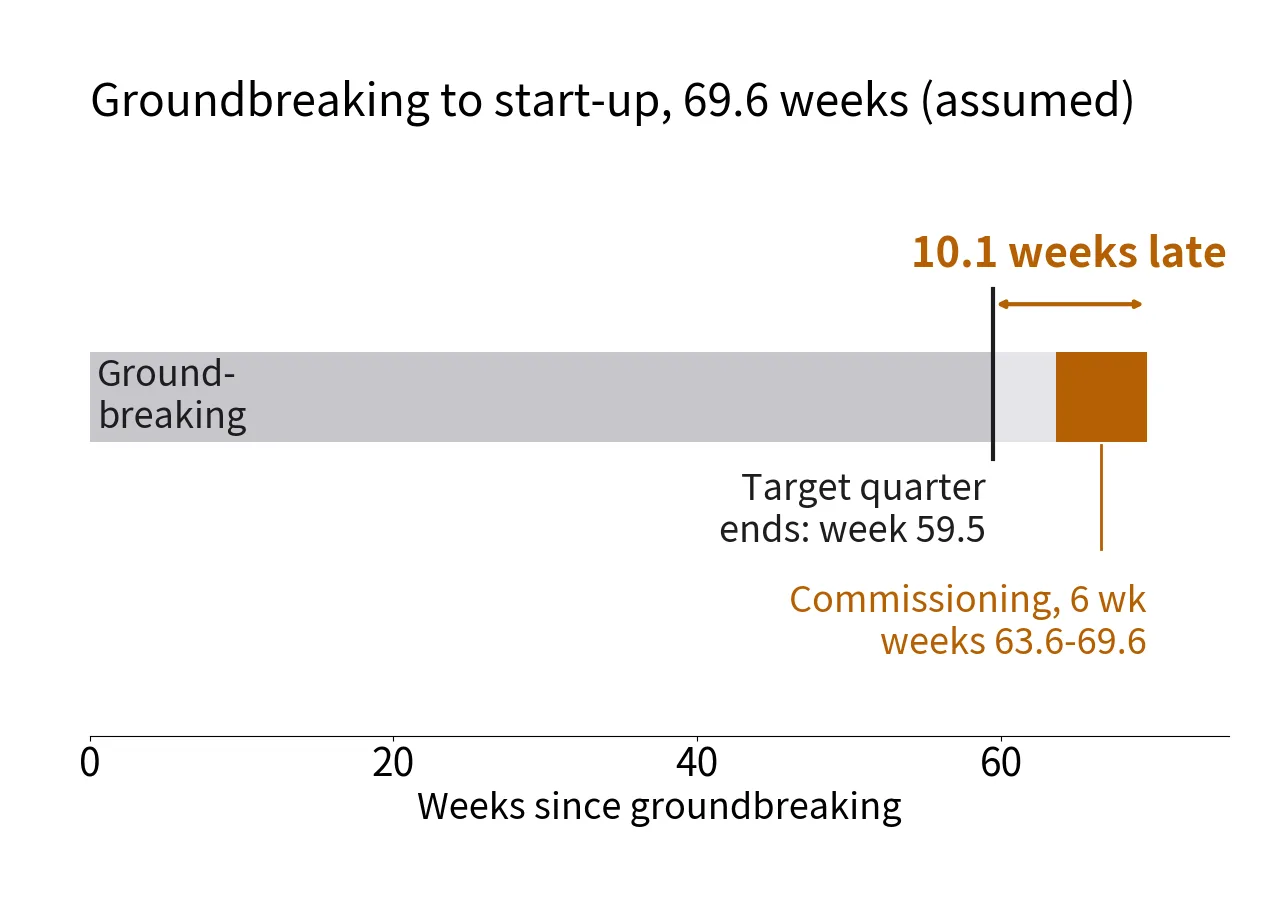
On the timeline, groundbreaking sits at zero and 69.6 weeks run along one line. Week 59.5 marks the end of the target quarter, and the six commissioning weeks fall between weeks 63.6 and 69.6. Between those two marks lie 10.1 weeks. Reports give the groundbreaking only by month, so this placement is an assumption too.
ERCOT6, the grid where the site sells power, set a new hourly peak load of 91.1 GW on 22 July 2026[1]. Its previous record was 85.5 GW on 10 August 2023. That report called the new peak 6 % higher; dividing the two figures gives 6.55 %, the same number rounded to a whole percent. At 160 MW, the site is 0.18 % of that peak.
ESS News revisited the six weeks on 6 October. I could not open its body text, so I read only the summary line in the site listing. That line compares the six weeks with a typical 25 weeks or more. Whether the company or the industry sets that typical figure is not clear from the summary alone.
Public material gives neither a start date nor an end date for commissioning. Those two dates are the largest blank in the arithmetic. Calculations below mark that blank as an assumption and keep going.
Commissioning sits at the very end of the schedule
Picture a high-speed train that runs the last 30 minutes before the terminus faster than usual. If it left two hours late, it still arrives late. Commissioning resembles that final stretch. It starts only after the equipment is erected and wired, so any time lost earlier pushes the start date back by the same amount.
Where the track doubles back, the picture breaks. A train never returns to a stretch it has passed, but commissioning does go back to earlier work when a test fails. Crews recheck the wiring, change settings and repeat the test, so the length of the last stretch depends on the quality of the work before it.
Testing on an ESS usually splits into two blocks. One is the factory test before shipping, and the other is the site acceptance test7 at the installation site. A factory test catches faults in a single product, while a site test catches problems that appear once products are connected. Interfaces where the battery management system, the power conversion system and the energy management system8 exchange signals are typical site-test targets.
Commissioning time shrinks by three routes in general. A team can move tests from the site to the factory, run the same test on several units at once, or cut the number of tests. Two of them reduce waiting, and the last one changes the scope of testing. Public reports do not say which route FlexGen took. A single threefold figure can hide a mix of all three, and the number alone cannot separate them.
On a schedule, that final stretch sits on the critical path9. It is the longest chain of tasks that sets the finish date. One day lost on it costs one day overall. If commissioning is the last task on that chain, whatever it saves passes straight to the end date. If the delay arose earlier, no cut in commissioning removes it.
Factory takt time10 applies here too. Using takt time = available operating time / customer demand quantity, with six weeks (3,628,800 s) as the available time and 160 MW as the demand quantity, each megawatt gets 22,680 s (about 6.3 hours) for commissioning. An 18-week baseline gives 68,040 s (about 18.9 hours), and 25 weeks gives 94,500 s (about 26.3 hours). If crews worked around the clock, the six-week case spends a little over a quarter of a day on each megawatt, and the 25-week case spends more than a day.
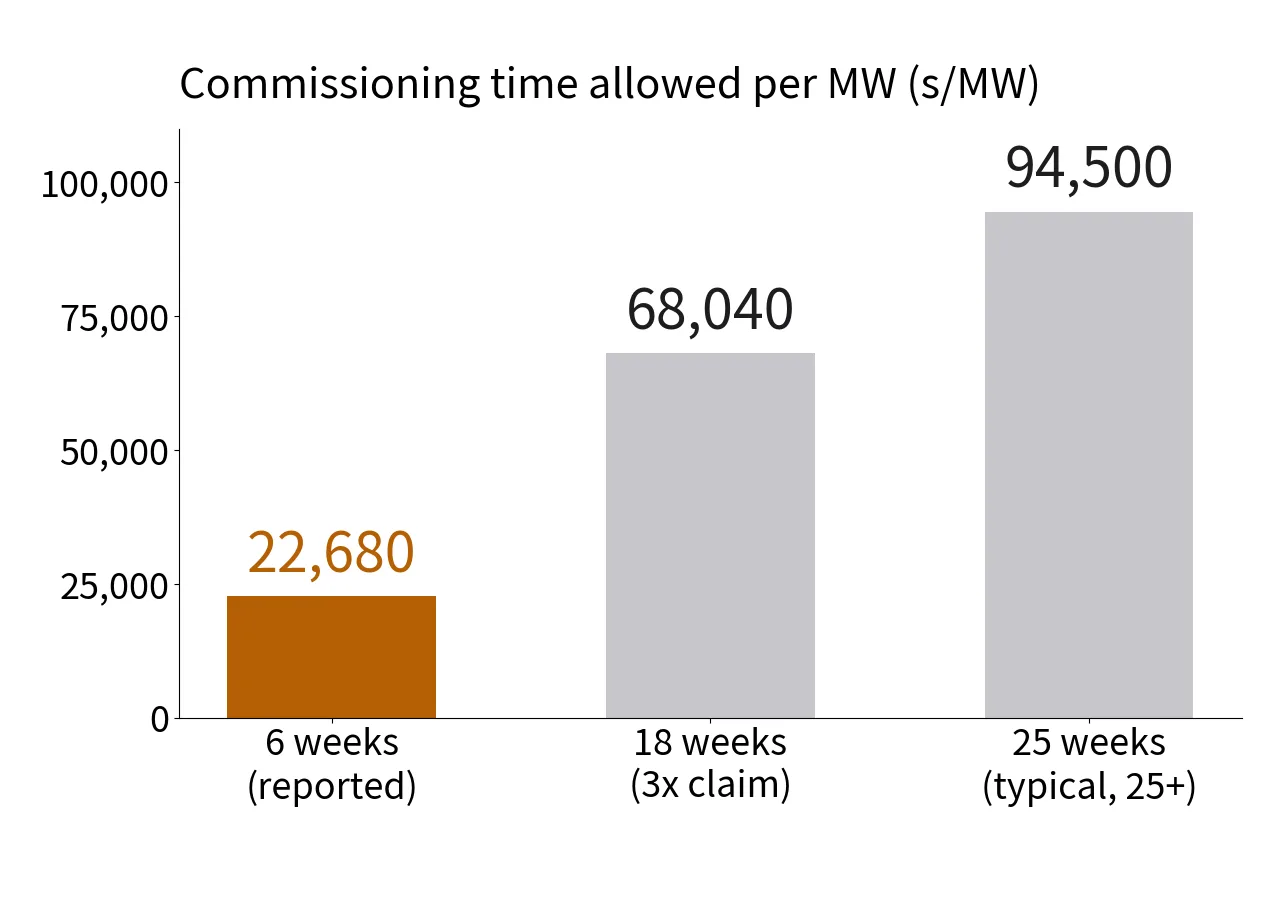
Those three values are the three bars in the chart. Six weeks gives a bar one third the height of the 18-week bar and under a quarter of the 25-week bar. Time here is calendar time, so a real working-hours basis would change every value, but the ratios between them would stay.
The bigger the claimed saving, the bigger the earlier delay
Total delay splits into two parts: delay that arose before commissioning and delay that arose during it. Delay during commissioning equals the actual six weeks minus the commissioning length that the plan assumed. Without that planned length, the earlier delay has no single value, and each assumption gives its own answer.
Neofab’s calculation note
Takt time = available time ÷ demand quantity
6 weeks: 3,628,800 ÷ 160 = 22,680 s/MW
18 weeks: 10,886,400 ÷ 160 = 68,040 s/MW
25 weeks: 15,120,000 ÷ 160 = 94,500 s/MW
Groundbreaking to start-up = 16 months × 30.4375 days ÷ 7 days = 69.6 weeks
Total delay = 71 days (30 June to 9 September) ÷ 7 days = 10.1 weeks
Earlier delay = total delay − (actual commissioning − planned commissioning)
Planned 0 weeks: 10.1 − (6 − 0) = 4.1 weeks
Planned 6 weeks: 10.1 − (6 − 6) = 10.1 weeks
Planned 18 weeks: 10.1 − (6 − 18) = 22.1 weeks
Planned 25 weeks: 10.1 − (6 − 25) = 29.1 weeks
Assumptions: 16 months from groundbreaking to the start-up announcement, a target date of 30 June (the last day of the second quarter), commissioning finished on the announcement date and covering the six weeks before it, and a threefold claim measured on commissioning time. I found none of these in the public reports.
This result points the wrong way at first glance. Claim a bigger commissioning cut, meaning a longer planned commissioning, and the earlier delay that must be back-calculated grows. If the plan was 18 weeks, the work before commissioning must have run 22.1 weeks late to produce this outcome. If the plan was the typical 25 weeks, it must have run 29.1 weeks late. Even a plan that already held six weeks leaves 10.1 weeks.
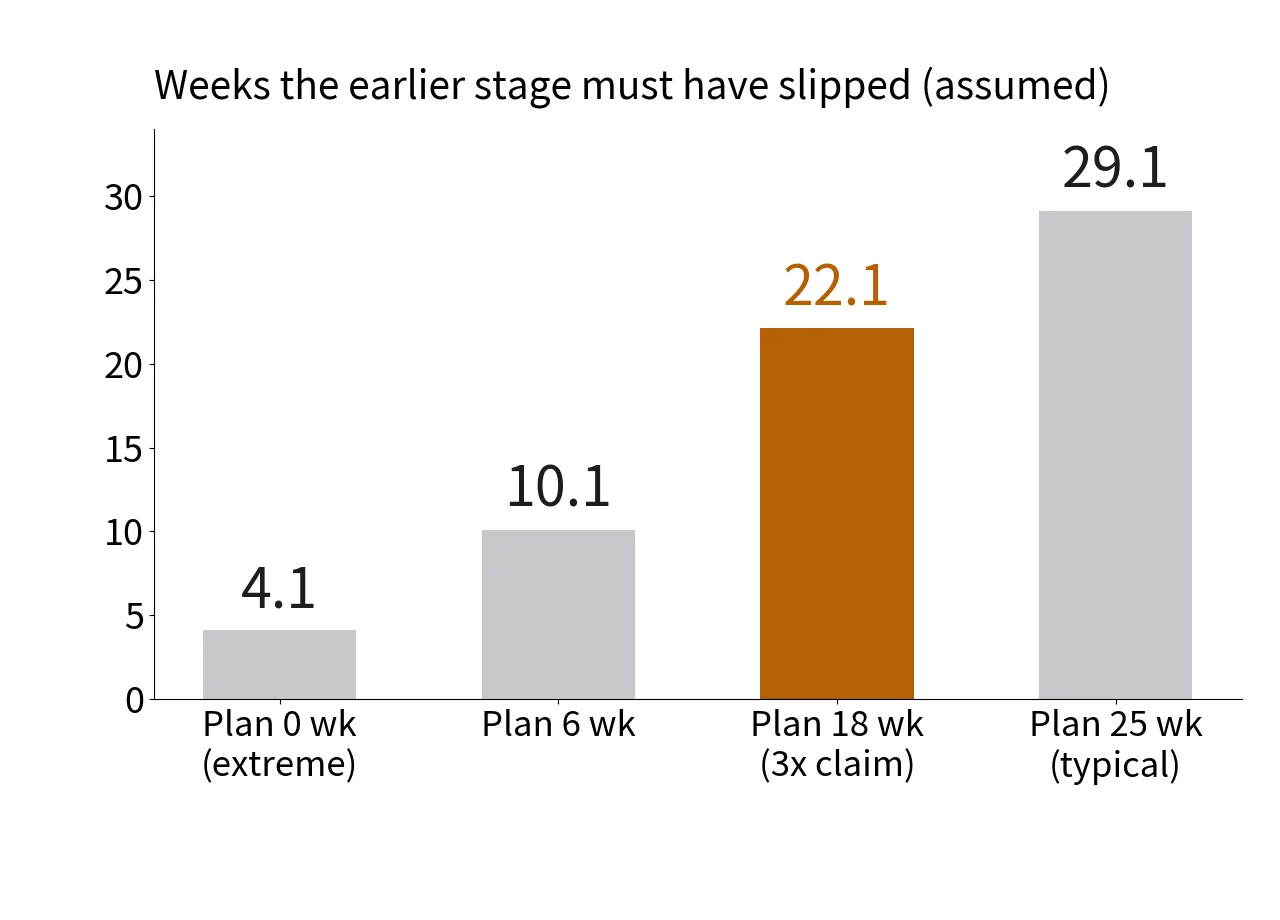
Four bars show how late the work before commissioning must have been for planned commissioning of 0, 6, 18 and 25 weeks. Even the shortest bar is 4.1 weeks. A plan of 0 weeks would mean switching on without commissioning, which no real site does, and even that extreme leaves part of the delay with the earlier work.
Read against the threefold claim (18 weeks), a pair of numbers comes along. One is the 12 weeks said to be saved in commissioning, and the other is the 22.1 weeks of earlier delay. A site that spent its entire saving and still missed the target must have lost 1.84 times the saved time (22.1 ÷ 12) before commissioning began.
I judge that this project’s delay built up outside the commissioning stretch. My evidence: for any planned commissioning length, the earlier delay stays at or above 4.1 weeks. Reports do not say which stage slipped or by how much, so the judgment holds only if the assumptions above hold.
Arithmetic of the same kind shows a limit in the other direction. Commissioning is 8.6 % of the whole, so cutting it to zero would shorten the schedule by only 8.6 %. With 15 months from groundbreaking to start-up the share is 9.2 %, and with 17 months it is 8.1 %.
What six weeks tells us and what it leaves open
Numbers can say whether a site that cut commissioning this far switched on when it planned to. It did not. Its announcement came 10.1 weeks after the last day of the target quarter, and if the target was the first day of that quarter, the delay is 23.0 weeks (161 days).
When I read a claim that something got N times faster, I think the first thing to ask for is the start event, the end event and the source of the baseline. My evidence is that the same six weeks drew baselines of 18 and 25 weeks or more in two reports, 7 weeks apart. Both reports agree the six weeks were fast. How fast depends on the baseline.
Assumptions stated above carry the calculation, and it has limits. Because the groundbreaking is given only by month, the 69.6 weeks carry an error of about 4.3 weeks either way. If commissioning ended before the announcement and the site then waited, the earlier delay changes. Treating the announcement date as the commercial operation date is an assumption as well.
If the threefold claim covers the whole on-site installation rather than commissioning alone, the reading shifts. Six weeks would then include installation, and commissioning alone would be shorter than six weeks. Then 22,680 s/MW becomes an upper bound, and the earlier delay in the calculation grows as real commissioning time shrinks. Direction holds; only size changes.
If the ESS News body gives start and end dates for commissioning, I can recount the six weeks in days. A target date for commercial operation would turn 10.1 weeks into an exact figure, and the range of the earlier delay would narrow. Before I use these six weeks as evidence that commissioning got faster, I will look for a 25-week case measured over the same stretch with the same definition.
Frequently asked questions
Isn’t six weeks fast on any baseline?
Both baselines support the conclusion that six weeks is fast. What changes is the multiple and the weeks saved. Comparing a 3x claim with a 4x claim only works if both measure the same stretch, and neither report states its start and end events. Neither report says whether the six weeks came from parallel testing or from dropped test items.
Which is right, 3x or 4.17x?
I cannot pick one. A 3x figure may use this project’s original plan, and a 25-week figure a typical project. If they answer different questions, neither is wrong. Because the reports do not name who set each baseline, it is unclear which one points at the same stretch as the six weeks.
Does a shorter commissioning mean fewer tests?
Public reports list no test counts or pass criteria. Commissioning time alone cannot show whether the testing grew or shrank. Provided information contains no answer to that.
What each reader can do
One six-week figure can serve three kinds of reader in three different ways.
| Reader | What to take away | What to try now |
|---|---|---|
| Job seeker | Commissioning can be read as takt time too (160 MW in six weeks is 22,680 s/MW) | Find the capacity (MW) and commissioning time in a project report you follow and convert them to s/MW |
| General reader | A “how many times faster” claim has a baseline behind it, and here 18 weeks and 25 weeks or more sit 7 weeks apart | When you read a speed-up claim, write one line saying which stretch was compared, from where to where |
| Reader following investments | A shorter commissioning does not mean the schedule held, and the site was 10.1 weeks late from the quarter’s last day | Put a project’s target commercial operation date next to its announced start-up date and convert the gap to weeks |
This article is for information only and is not investment advice. See our Disclaimer.
Glossary
- Battery energy storage system (BESS) — A set of equipment that stores electricity in batteries and releases it when needed. Here it means a large store connected to the power grid. ↩
- System integrator — The company that joins batteries, power converters and control software into one working system. Here it means FlexGen. ↩
- Commissioning — The stage where installed equipment is run and tested to confirm it works as designed, then handed over. Here it means the test stretch between installation and the start-up announcement, though the reports do not say where it began or ended. ↩
- MW and MWh (megawatt and megawatt-hour) — MW is how much power flows at one moment, and MWh is that power accumulated over time. Discharging 160 MW for 7,200 s gives 320 MWh. ↩
- Commercial operation date (COD) — The date a plant finishes testing and starts selling electricity. Schedules often use it as the target date. ↩
- ERCOT — The body that runs the power grid and wholesale electricity market for most of Texas. ↩
- Site acceptance test (SAT) — A test at the installation site that checks whether the equipment performs as contracted. It pairs with the factory acceptance test (FAT). More: FAT vs SAT ↩
- BMS, PCS and EMS (battery management system, power conversion system, energy management system) — The BMS watches battery voltage and temperature, the PCS converts between the battery’s direct current and the grid’s alternating current, and the EMS decides when to charge and discharge. The points where the three exchange signals are the interfaces. ↩
- Critical path — The longest chain of tasks in a schedule. If a task on it runs late, the project finishes late. ↩
- Takt time — The pace at which one unit must be produced to meet customer demand. Takt time = available operating time / customer demand quantity. More: Takt time calculation ↩
Sources and notes
- Energy-Storage.News, “FlexGen, SMT Energy commission 320MWh Texas BESS in just six weeks, as ERCOT grid faces record demand”, 2026-09-10. Used for the six weeks, the threefold cut in deployment time and the ERCOT peak record. https://www.energy-storage.news/flexgen-smt-energy-commission-320mwh-texas-bess-in-just-six-weeks-as-ercot-grid-faces-record-demand/
- MGRID, “SMT Energy and FlexGen Start Up a 160 MW / 320 MWh Houston Battery One Quarter Past Target”, 2026-09-10. Used for the target quarter, the groundbreaking month and the roughly 16 months. https://mgrid.org/2026/09/10/smt-energy-and-flexgen-start-up-a-160-mw-320-mwh-houston-battery-one-quarter-past-target/
- ESS News, “Inside the six-week commissioning of a 160 MW Texas battery”, 2026-10-06. I could not open the body text and quote only the summary line from the site listing (the comparison with a typical 25 weeks or more). https://www.ess-news.com/2026/10/06/inside-the-six-week-commissioning-of-a-160-mw-texas-battery/
- Assumed values: 16 months from groundbreaking to the start-up announcement (1 month = 30.4375 days), a target date of 30 June 2026 (the last day of the second quarter), commissioning finished on the announcement date of 9 September with the six weeks before it, a threefold claim measured on commissioning time, and calendar time throughout. The reports give the groundbreaking only by month.
- Method: the 18-week baseline is 6 weeks × 3, each share is weeks saved ÷ 69.6 weeks, and the earlier delay is total delay − (actual commissioning − planned commissioning). A target of 1 April would make the total delay 161 days (23.0 weeks). The two reports cover the same project, but I did not read the body of the ESS News piece, so its baseline definition is open.


You May Also Like
Long-Duration ESS Interface Design in the Era of Power-Grid Saturation
Even a tenfold faster model moves the whole by 1.29x — what “5 to 10 times faster commissioning” actually requires