-
A 160 MW battery’s six-week commissioning has two baselines
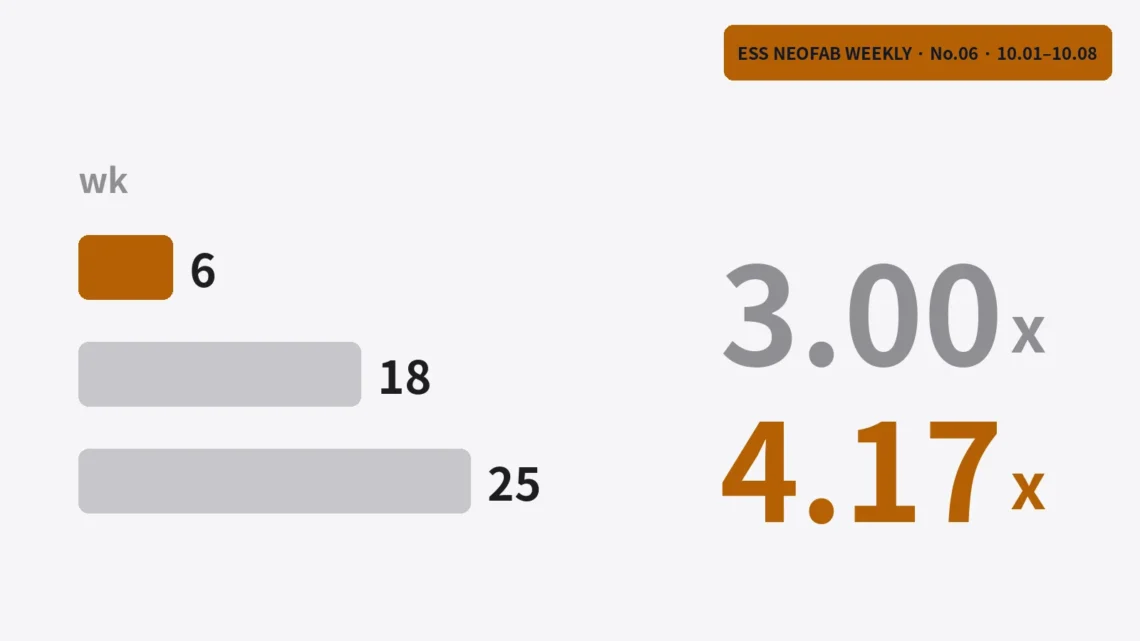
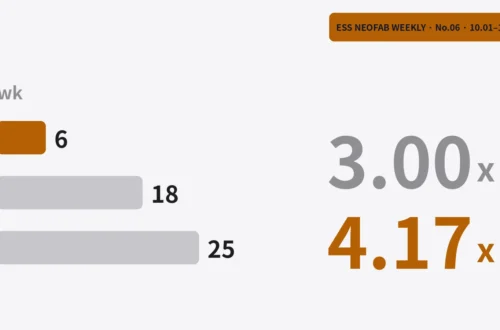
Two different baselines hang on the six-week commissioning of a 160 MW/320 MWh battery in Texas. One report says deployment time fell threefold against the original plan, and another compares the six weeks with a typical 25 weeks or more, so the baselines sit 7 weeks apart (18 and 25) and the multiples split into 3.00 and 4.17. Of roughly 16 months from groundbreaking to start-up (69.6 weeks), the six weeks make up 8.6 %, and the site announced operation 10.1 weeks after the last day of its target quarter. However the planned commissioning length is assumed, the delay that built up before commissioning stays at 4.1 weeks or more,…
You May Also Like
The Interface Between Laser Notching Cycle Time and Line Takt Time — The Head-Count Sizing Problem Revealed by DI ENT’s Ohio Supply Contract
46-Phi Cylindrical Cell Line Conversion: The Pressure-Sensor–BMS Interface Determines Takt Time
Between the Battery Rack and the PCS: Two Points Where the Interface Diverges
-
Why three qualified products landed on the same duration — in DSX Ready BESS, sizing is set by the output axis
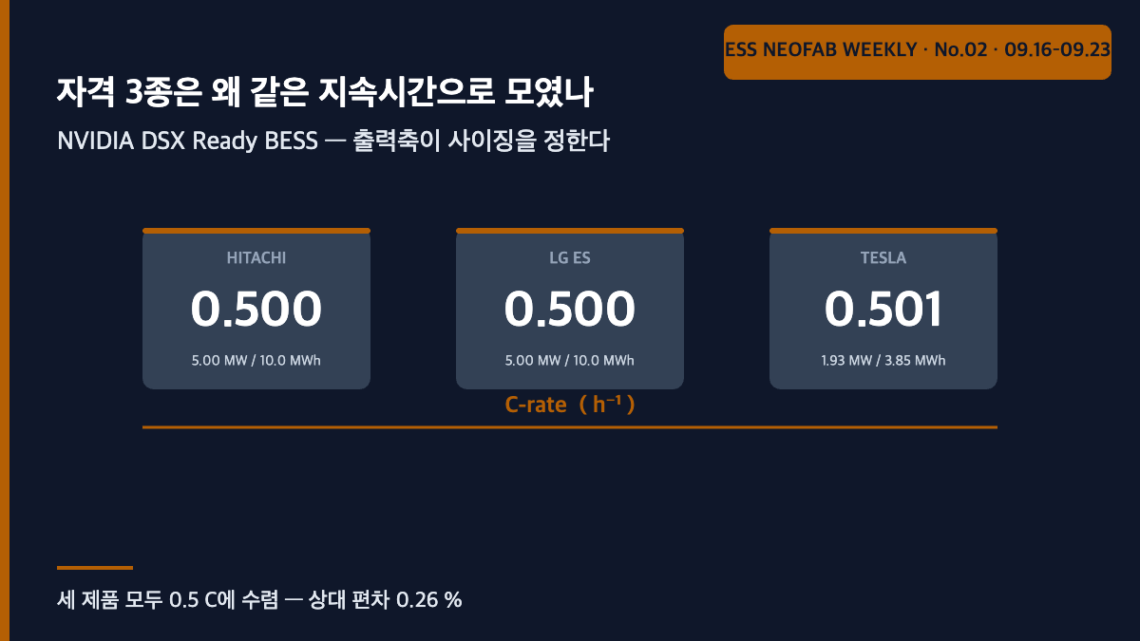
NVIDIA's DSX Ready qualification programme, launched 21 September 2026, lists three BESS offerings whose C-rates converge within 0.26 % at 0.5 C. Of the three qualified functions only demand response governs energy capacity; under a 100 MW / 30 s assumption load buffering carries a 240x energy margin for free. Sizing is dominated by the output axis, and the remaining design variable is unit granularity, not energy capacity.
You May Also Like
The Interface Between Laser Notching Cycle Time and Line Takt Time — The Head-Count Sizing Problem Revealed by DI ENT’s Ohio Supply Contract
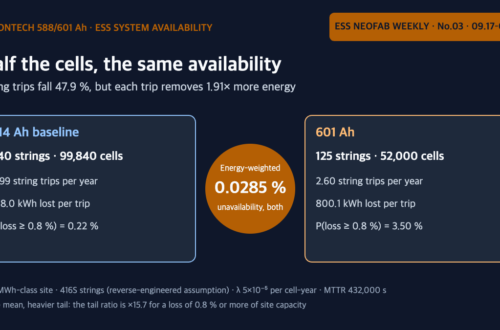
Pylontech’s 588 Ah and 601 Ah LFP Cells Enter Mass Production — Why Energy-Weighted Availability Stays the Same When the Cell Count Halves
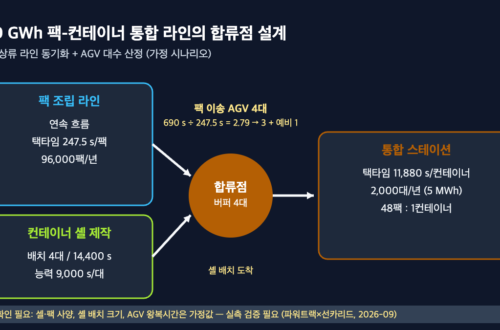
Designing the Merge Point in a 10 GWh Pack-Container Integration Line: Synchronizing Two Upstream Lines and Sizing AGV Fleet from the Powertrac × Sunka Lead Order
-
When the Station Block Grows to 62 MWh, What Actually Shrinks Is Commissioning Labor, Not Cell Count
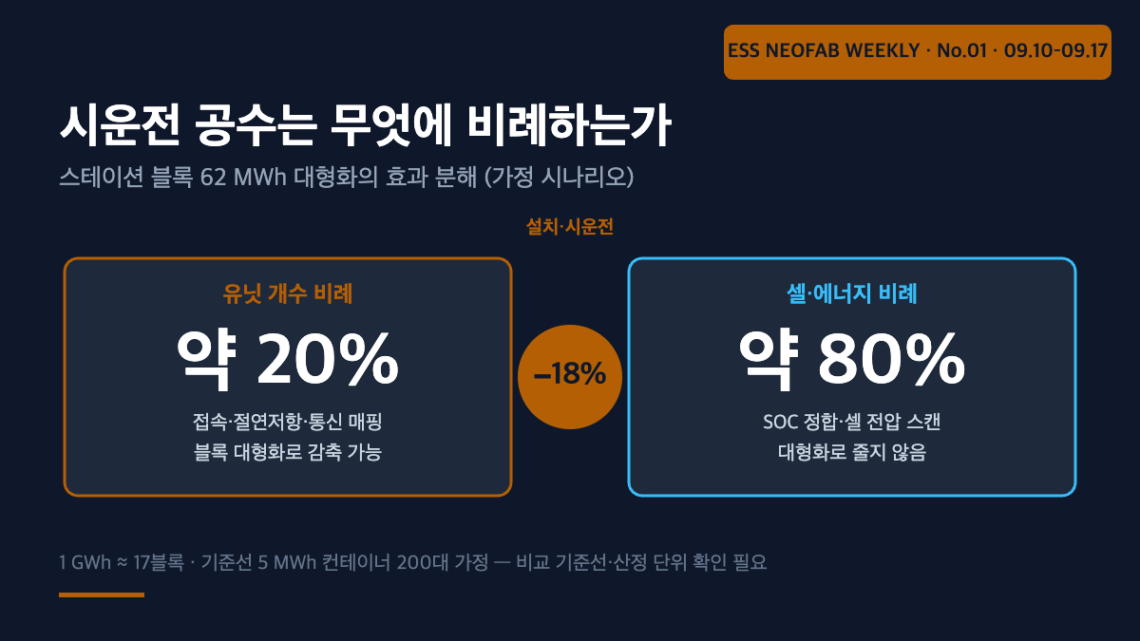
On September 16, 2026, BYD unveiled its second-generation grid-forming station block, the "GC Block," in a maximum 10 MW/62 MWh single configuration, stating that a 1 GWh project would require approximately 17 blocks. The same announcement claimed a 69.4% reduction in BMS management complexity, a maintenance workload reduction of over 60%, and an installation/commissioning workload reduction of over 18%. Working backward from these three figures using the same assumed unit-count reduction rate (91.5% under a baseline assumption), the unit-count-proportional share of on-site commissioning labor turns out to be only about 20%, with the remaining roughly 80% proportional to cell/energy count. In other words, block enlargement is a lever that attacks…
You May Also Like
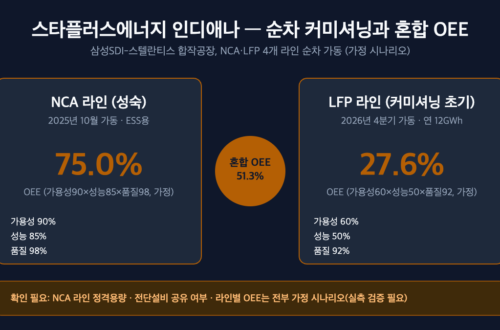
StarPlus Energy’s Indiana Plant — The Blended-OEE Illusion Created by Sequential NCA/LFP Commissioning
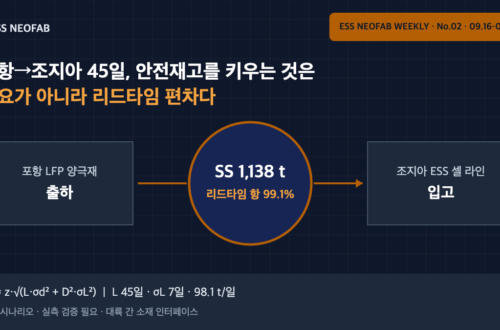
45 Days from Pohang to Georgia — Safety Stock at an Intercontinental Cathode Interface Is Driven by Lead-Time Variability, Not Demand
A 160 MW battery’s six-week commissioning has two baselines
-
Re-Reading the ESS Grid-Interconnection Queue in the Language of Line Balancing
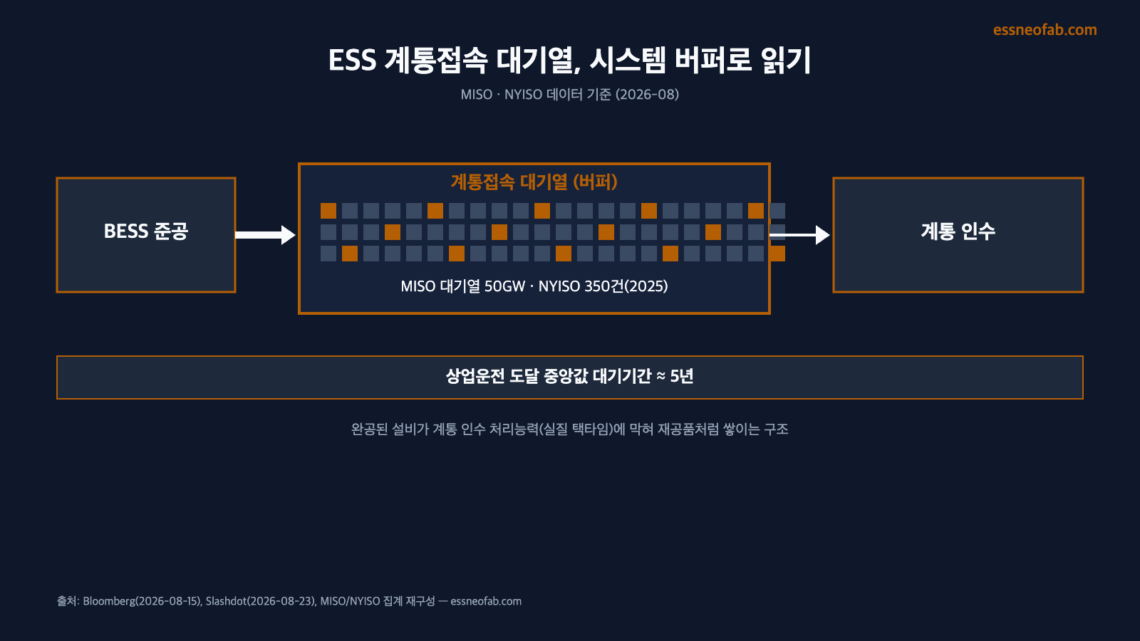
The stalled BESS (Battery Energy Storage System) commissioning cases in the US, reported successively by Bloomberg and Slashdot in August 2026, show that even after equipment is completed, delays recur at a separate bottleneck section called the grid-interconnection queue. BESS accounts for about 50 GW of MISO's total 650 GW queue, the number of NYISO's queued projects grew from 176 in 2018 to 350 in 2025, and the median wait time to reach commercial operation approaches 5 years. This article redefines this phenomenon using the line-engineering concepts of buffer, interface, and takt time, analyzing it as a work-in-process inventory structure in which completed equipment piles up without being able to…
You May Also Like
SK On’s Dual-Site ESS Production Bases — Where Fixed Contracts and Variable Bidding Split Takt Time Design
Edge AI Vision Inspection and Battery-Pack Leak Testing: How Gateway Aggregation Affects Traceability Completeness
FAT and SAT Differ in More Than Location — How IEC 62381:2024 Defines the Tests
-
Hanwha Energy Sells Two Large Italian BESS Projects to Sweden’s OX2 — Evidence of European Development Capability
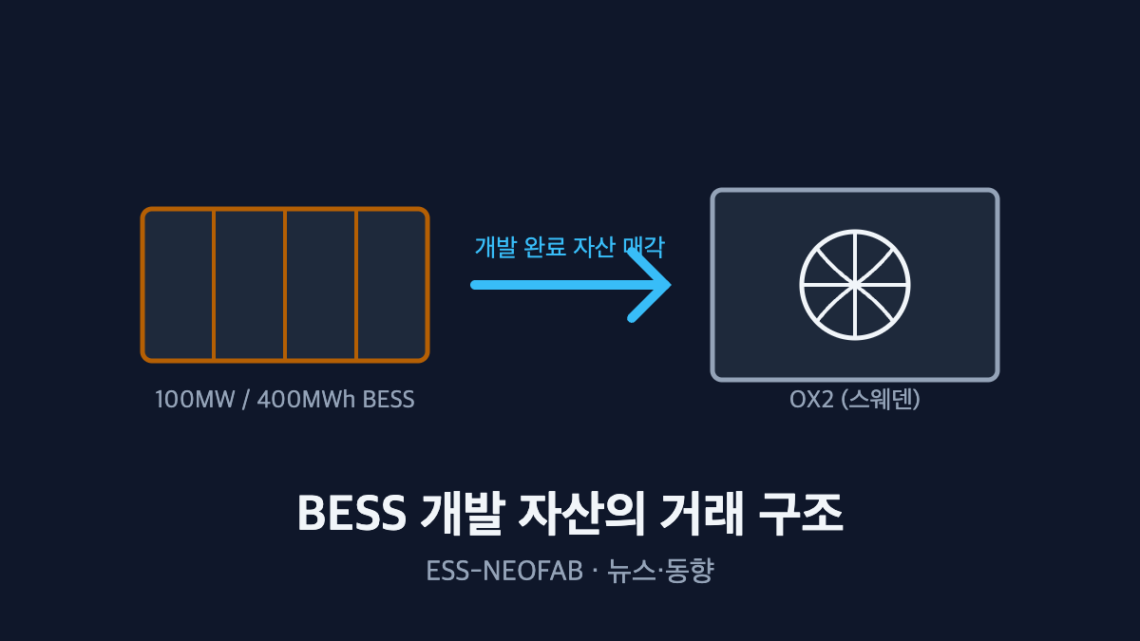
Hanwha Energy’s European subsidiary has sold two standalone BESS projects developed in the Puglia (Apulia) region of southern Italy (100 MW/400 MWh each, 200 MW/800 MWh in total) to OX2, a Swedish renewable energy developer (OX2 announcement, 2026-08-05). The two projects target construction start in Q2 2027 and commercial operation by the end of 2028. This article views the transaction not as a battery sale but as the transfer of “assets whose power (MW) and energy (MWh) were fixed at the permitting stage,” and uses an assumed scenario to show that a 4-hour-duration configuration skews site interfaces toward the battery side. At the same 100 MW, extending duration from 2…
You May Also Like
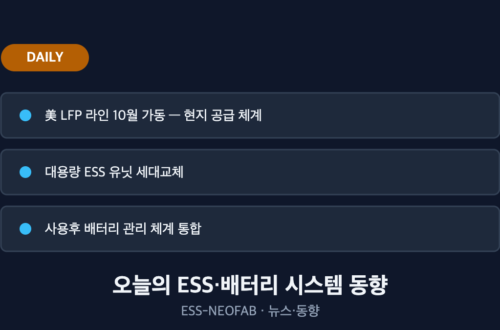
Today’s ESS/Battery System Trends — U.S. LFP Mass Production Imminent, Megapack 3 Launched, Used-Battery Platform Integration (2026.08.11)
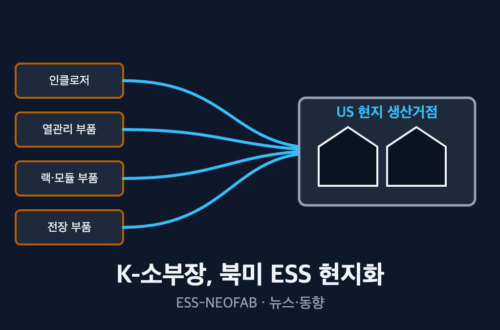
“Capturing the U.S. ESS Market” — K-Battery Supply Chain’s Wave of Localization: What’s Going Where
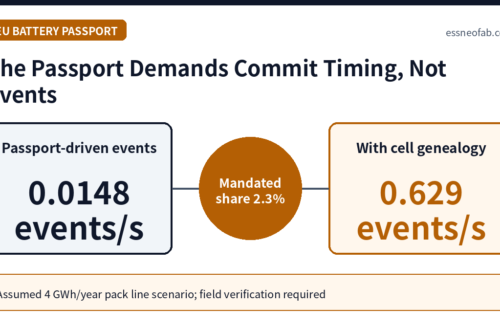
EU Battery Passport 2027: Which Station on an ESS Pack Line Commits What