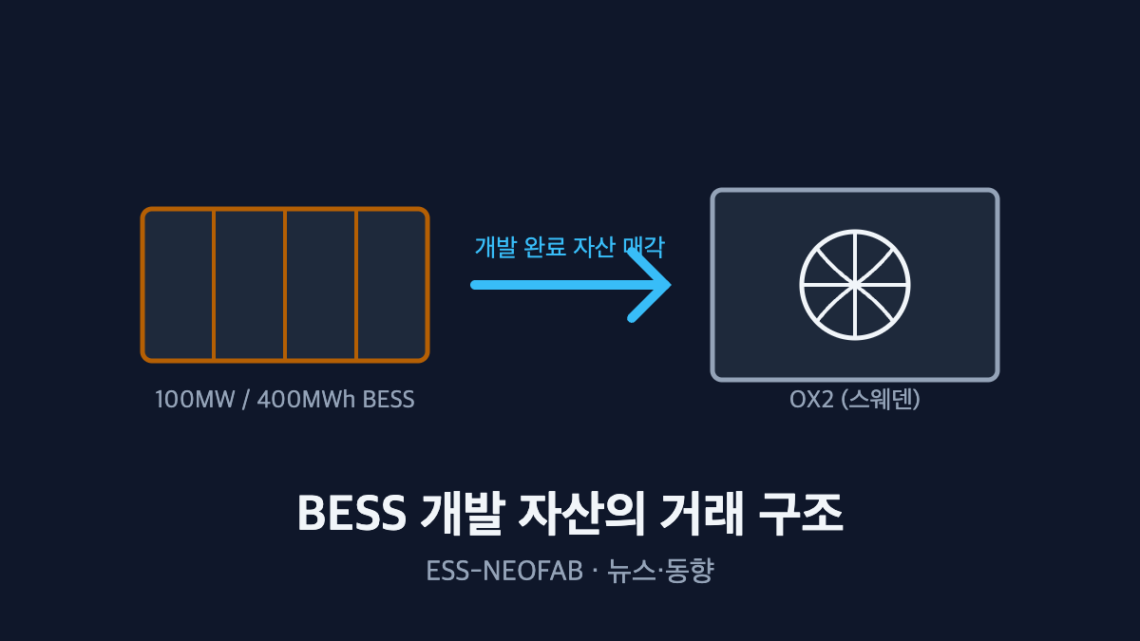
Hanwha Energy Sells Two Large Italian BESS Projects to Sweden’s OX2 — Evidence of European Development Capability
Abstract
Hanwha Energy’s European subsidiary has sold two standalone BESS projects developed in the Puglia (Apulia) region of southern Italy (100 MW/400 MWh each, 200 MW/800 MWh in total) to OX2, a Swedish renewable energy developer (OX2 announcement, 2026-08-05). The two projects target construction start in Q2 2027 and commercial operation by the end of 2028. This article views the transaction not as a battery sale but as the transfer of “assets whose power (MW) and energy (MWh) were fixed at the permitting stage,” and uses an assumed scenario to show that a 4-hour-duration configuration skews site interfaces toward the battery side. At the same 100 MW, extending duration from 2 hours to 4 hours doubles the number of battery containers while the number of PCS units stays the same, so DC-side interfaces per MW increase from 0.4 to 0.8.
1. The Conclusion First — What Was Sold Is Not Batteries but “Fixed MW/MWh”
The core of this transaction from a line and system perspective is that, because the assets change hands with power and energy already fixed by permitting, the buyer inherits unchanged the site interface structure determined by the 4-hour duration.
Situation (S): Since establishing its European subsidiary in 2018, Hanwha Energy has developed solar and BESS businesses centered on Spain and Italy, and it opened its Italian subsidiary in February 2023. Complication (C): The two projects sold this time are part of six projects (600 MW in total) that obtained integrated permits from Italy’s Ministry of Environment and Energy Security (MASE) in 2025. Question (Q): What does an asset transfer before construction start pass on to the subsequent build phase? Answer (A): Equipment selection is still open, but the two upper-level constraints of MW and MWh are already closed.
2. Transaction Overview
| Item | Details |
|---|---|
| Seller | Hanwha Energy’s European subsidiary (Hanwha Energy Europe) |
| Buyer | OX2 (Swedish renewable energy developer, 1.5 GW Italian development pipeline) |
| Subject | Two standalone BESS projects in the Puglia (Apulia) region, Italy |
| Scale | 100 MW/400 MWh each, 200 MW/800 MWh in total |
| Schedule | Construction start in Q2 2027, commercial operation targeted for end of 2028 |
| Permitting | MASE integrated permit (2025, six projects totaling 600 MW in one batch) |
| Nature of transaction | Sale of development assets (not a battery cell or system supply contract) |
100 MW/400 MWh is a configuration capable of discharging at 100 MW output for 4 hours. Grid connection conditions and equipment suppliers could not be confirmed from public sources and are therefore left as items for which verification is required.
3. Mechanism — On Which Side Does Duration Stack the Interfaces?
At a BESS site, the number of battery containers is proportional to energy (MWh), and the number of PCS units to power (MW). Because each container carries DC-side interfaces[1]—DC cabling, BMS communication, and fire-protection interlocks—longer duration skews interfaces toward the battery side. The following is an assumed scenario to illustrate this.
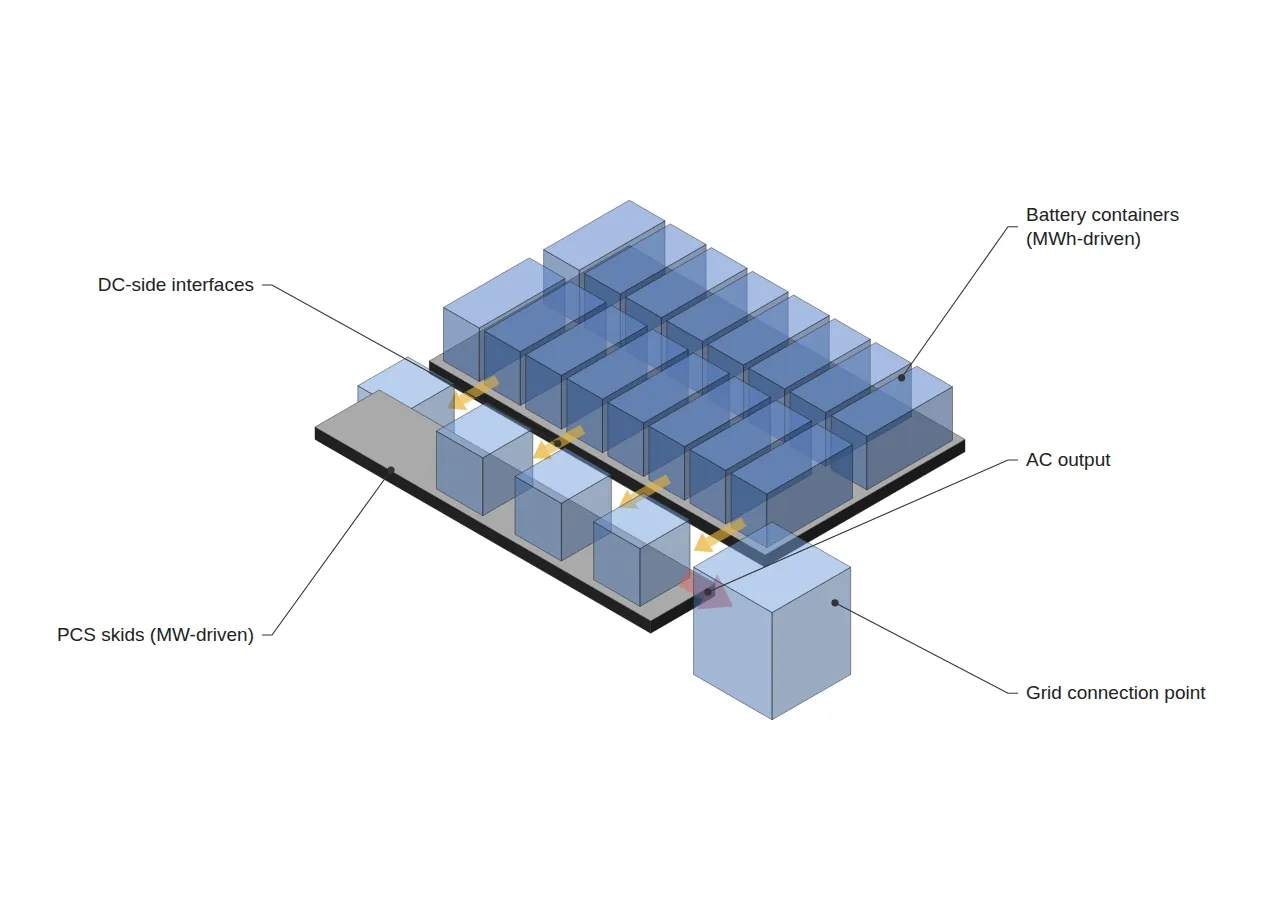
| Category | 2-hour configuration (assumed comparison group) | 4-hour configuration (same ratio as this transaction) |
|---|---|---|
| Power / Energy | 100 MW / 200 MWh | 100 MW / 400 MWh |
| Battery containers (5 MWh/unit assumed) | 40 units | 80 units |
| PCS skids (4 MW/unit assumed) | 25 units | 25 units |
| Container : PCS ratio | 1.6 | 3.2 |
| DC-side interfaces per MW | 0.4 | 0.8 |
Even at the same power, the 4-hour configuration has twice the DC-side interfaces. Commissioning labor and site communication points are therefore driven more strongly by energy than by power. This is an observation in the same direction as When the Station Block Grows to 62 MWh, What Actually Shrinks Is Commissioning Labor, Not Cell Count, which dealt with how a substantial portion of commissioning labor remains proportional to energy even when unit counts are reduced through larger station blocks; this article, however, addresses the layer at which duration, rather than block size, changes the distribution of interfaces.
4. Limits of Application and Schedule Interfaces
From construction start (Q2 2027) to commercial operation (end of 2028) is approximately 18 to 21 months. Installation and commissioning of 80 containers (per project, assumed) must be completed within this period, and installation speed depends on site manpower and the grid-connection testing schedule. The container capacity of 5 MWh and the PCS rating of 4 MW are assumed values of this article, and the ratios may change once actual equipment is finalized (further verification required).
In addition, the reason a developer acquires assets at an advanced stage cannot be reduced to “the difficulty of permitting in Europe” alone. What public sources confirm is only the timing of the transaction—after permits were obtained and before construction start—and the price and deal terms were not disclosed.
5. Conclusions and Implications
This transaction is a case of Hanwha Energy turning over its development capability itself as an asset. From a line and system perspective, what matters is that the MW/MWh fixed by permitting determines the interface structure of the build phase in advance. When acquiring or building a 4-hour-configuration project, commissioning labor and communication points should be estimated on the basis of the number of battery containers, not the number of PCS units.
FAQ
Q. Did Hanwha Energy sell batteries?
A. No. It is a transaction selling permitted BESS development project assets, which differs in nature from a battery cell or system supply contract.
Q. Is the scale 100 MW/400 MWh or 200 MW/800 MWh?
A. Each project is 100 MW/400 MWh, and the two combined total 200 MW/800 MWh (per the OX2 announcement). A previous version of this article stated the total scale as 100 MW/400 MWh; this was corrected in the 2026-09-23 revision.
Q. Does a 4-hour configuration require twice as many PCS units?
A. No. PCS scales with power (MW), so for the same 100 MW it is independent of duration. What increases is the battery containers and their associated DC-side interfaces.
Field Application Notes
| Check | How to execute | Remarks |
|---|---|---|
| ☐ Change the basis for interface estimation | Estimate commissioning labor by container count (MWh ÷ container capacity), not by MW | 2× difference in a 4-hour configuration |
| ☐ List DC-side communication points | Pre-register BMS, fire-protection, and HVAC signal points for each container in the EMS signal map | Complete before construction start |
| ☐ Back-calculate the schedule | Set the installation completion deadline by subtracting the grid-connection testing period from the target commercial operation date | Derive the installation interval per container (s) |
| ☐ Check scale notation | In reports and contracts, state project-level figures and portfolio totals separately | This transaction: 100/400 per project, 200/800 in total |
Footnotes
[1] DC-side Interface: the point of contact for DC cabling, BMS communication, and fire-protection and HVAC interlock signals between a battery container and the PCS. In this article, one set is counted per container.
Sources: OX2 acquires 200 MW / 800 MWh energy storage in Italy (OX2, 2026-08-05, https://www.ox2.com/newsroom/press-releases-news/2026/ox2-acquires-200-mw-800-mwh-energy-storage-in-italy/) / Hanwha Energy sells Italian BESS projects to Sweden’s OX2 (The Guru, 2026-08-06, https://www.theguru.co.kr/news/article.html?no=105469) / OX2 acquires 200 MW/800 MWh Italy BESS portfolio from Hanwha Energy Europe (ESS News, 2026-08-05, https://www.ess-news.com/2026/08/05/ox2-acquires-200-mw-800-mwh-italy-bess-portfolio-from-hanwha-energy-europe/)
Measurement & Calculation Conditions: The battery container at 5 MWh/unit, PCS skid at 4 MW/unit, and the 2-hour comparison group are all assumed values for structural illustration, not the actual equipment specifications of these projects. Field verification is required. The body text was supplemented and corrected on 2026-09-23.
Related reading — “Capturing the U.S. ESS Market” — K-Battery Supply Chain’s Wave of Localization: What’s Going Where · When the Station Block Grows to 62 MWh, What Actually Shrinks Is Commissioning Labor, Not Cell Count


You May Also Like
After Korea’s Battery History Management System: IDs Continue, Operating History Breaks — History Continuity of ESS Reuse Racks
NFPA 855 (2026 Edition) Revision: ESS Safety Standards Expand From the Cell to the Entire System
2 Comments
Pingback:
Pingback: