After Korea’s Battery History Management System: IDs Continue, Operating History Breaks — History Continuity of ESS Reuse Racks
Abstract
Korea’s battery history management system under the amended Motor Vehicle Management Act, in force since 17 February 2025, requires the battery identification number assigned at the manufacturing stage to be registered in the vehicle registration record and tracked through operation and scrapping; the Used Battery Act promulgated in May 2026 (in force 27 May 2027) and the August 2026 agreement between the industry and climate-environment ministries on an integrated platform now extend it to later stages. Yet when assumed success rates are compounded across the six lifecycle interfaces, identification-number continuity is 91.0% while history continuity, including BMS operating data, falls to 81.9%.
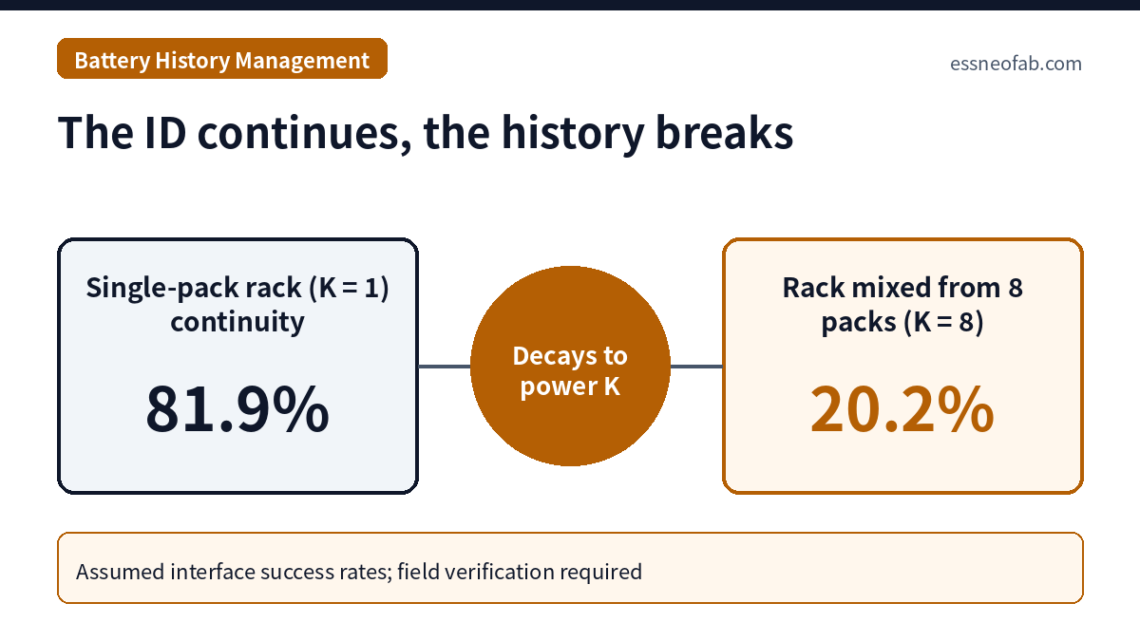
The larger variable lies in the reuse stage. If one ESS rack is built from modules taken from K different packs, the probability that the entire rack history is intact decays as the K-th power, reaching 44.9% at K = 4 and 20.2% at K = 8. The rack composition rule of a reuse line (number of source packs K) must therefore be managed as both a process variable and a traceability variable.
1. Conclusion First — The Number Continues, the History Breaks
The bottleneck of battery history management is not identification-number registration but the transfer of the operating data that should hang on that number, and the mixing of lineages in the reuse stage.
Situation (S): The Ministry of Land, Infrastructure and Transport (MOLIT) put the battery safety certification system and the history management system into effect on 17 February 2025. The core is that each battery is assigned an identification number (a serial number of up to 24 characters) at the manufacturing stage and registered in the vehicle registration record, with a change registration required when the battery is replaced.
Complication (C): The Act on the Management of Used Batteries and Industry Promotion was promulgated on 26 May 2026 and takes effect on 27 May 2027 (pre-removal performance evaluation, a legal basis for a used-battery history management system, and more), and on 7 August 2026 the Ministry of Trade and Industry and the Ministry of Climate, Energy and Environment agreed to build a “battery trading and history management platform” linking the systems each had operated separately. Question (Q): As the number assigned by the manufacturing line passes through operation, removal and reuse into an ESS, where does it actually break, and how often?
Answer (A): The number itself carries through reasonably well by institutional design, but history continuity decays exponentially at the transfer of BMS operating history and at reuse rack composition.
2. Lifecycle Interface Map — What Passes to Whom
Lifecycle history is not a single database but a chain of interfaces[1] at which ownership changes. Table 1 summarizes the points at which the identifier assigned by the manufacturing line passes to the next stage. No public statistics exist for the success rate of each stage, so Section 3 treats them as assumed values.
| Interface | Identifier handed over | Data to be handed over | Owner / basis | Break risk factors |
|---|---|---|---|---|
| I1 Cell-to-pack binding (manufacturing line) | Cell ID ↔ pack ID | Cell lot and process history mapping | Manufacturer MES[2] | Mapping not updated on rework or cell replacement |
| I2 Pack-to-vehicle registration | Battery ID number ↔ vehicle | ID number | MOLIT, vehicle registration record (from 2025-02-17) | Registration entry error |
| I3 Operation, maintenance, replacement | Changed ID number | Replacement and maintenance history | MOLIT (change registration on replacement) | Unregistered informal repair |
| I4 Removal | ID read and report | Fact of removal, performance evaluation result | Used Battery Act (in force 2027-05-27) | Damaged label, read failure |
| I5 Operating history transfer | (linked to ID number) | Cumulative BMS data (SoH[3], cycles, temperature history) | Linkage method: verification required | No BMS access rights or format |
| I6 Reuse reconfiguration | Pack/module ID ↔ new ESS rack ID | Full history of source packs | Reuse operator, history management system | Module-level mapping lost after pack disassembly |
The interface to watch in Table 1 is I5. I1 to I4 and I6 are interfaces that “hand over a number,” whereas I5 hands over not a number but the operating data hanging on the number. In the institutional descriptions published so far, what is recorded in the registration record is the ID number and replacement and maintenance history; it is not confirmed in what format and under what rights the operating history held by the BMS passes to the next owner.
The direction of institutional expansion is likewise concentrated on identification information. In March 2026, MOLIT pre-announced legislation increasing the battery information provided at sale from 6 to 10 items (adding manufacturer, country of production, month and year of manufacture, and product name or management number). This thickens the static information at I2 and sits on a different layer from the transfer of dynamic operating data at I5.
3. Calculation — What Remains When Stage Success Rates Are Multiplied
The transfer success rate of each interface is assumed as follows: I1 99.9%, I2 99.8%, I3 99.0%, I4 97.0%, I5 90.0% and I6 95.0%. Assuming independence between interfaces, identification-number continuity is the product excluding I5 (91.0%), and history continuity including operating data is the full product (81.9%). Up to the point of removal (I1 to I4) it is 95.7%, so most of the loss occurs after removal.
The structure changes in the reuse stage. When packs are disassembled, modules are graded by performance and ESS racks are reassembled, one rack can be filled with modules from K different source packs. For the entire rack history to be intact, the histories of all K source packs must be continuous, so rack history continuity becomes (per-pack continuity)K.
| Source packs per rack K | ID-number continuity | History continuity (baseline, I5 = 90%) | History continuity (improved, I5 = 99%) |
|---|---|---|---|
| 1 | 91.0% | 81.9% | 90.0% |
| 2 | 82.7% | 67.0% | 81.1% |
| 4 | 68.4% | 44.9% | 65.7% |
| 8 | 46.8% | 20.2% | 43.2% |
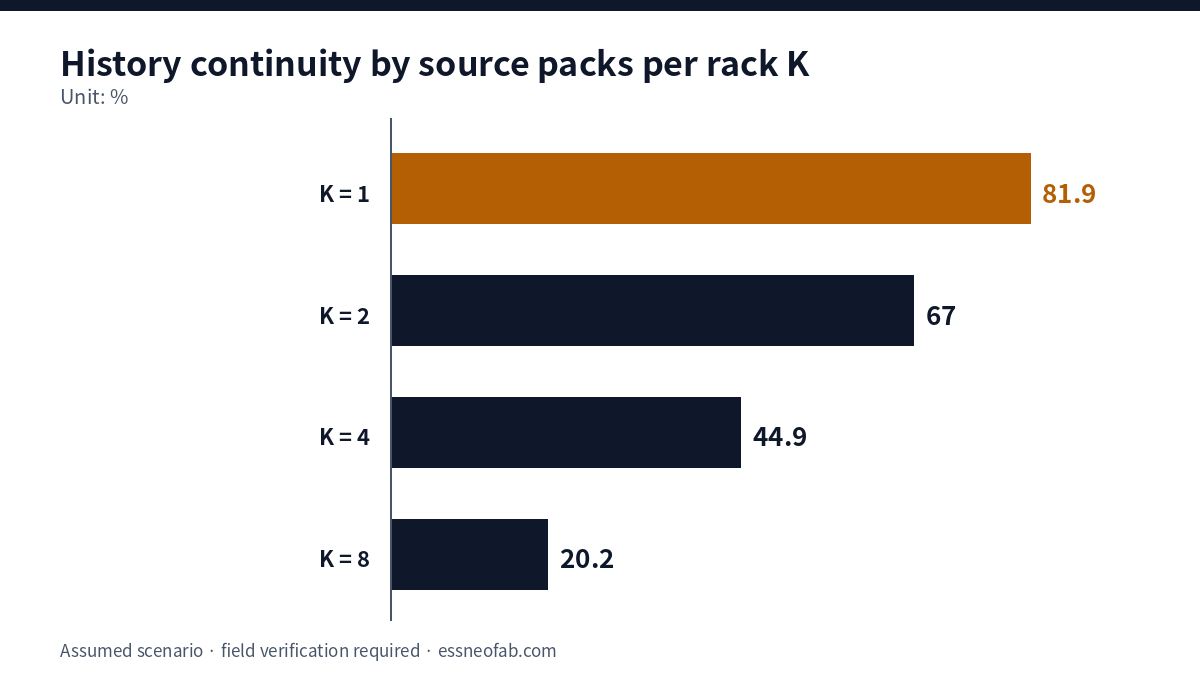
Taking K = 1 (a rack from a single pack) at 81.9% as the baseline, continuity drops by 37.0 percentage points to 44.9% at K = 4, and at K = 8 it falls to 20.2%, leaving four out of five racks with incomplete history. It is important that this decline arises from the composition rule alone, regardless of the quality of individual interfaces.
Comparison with the improved scenario reveals the size of each lever. Raising I5 from 90% to 99% improves K = 1 by 8.1 percentage points, whereas reducing K from 4 to 1 from the same 81.9% baseline improves it by 37.0 percentage points. On a reuse line, in other words, the number of lineages per rack is a larger variable than data-transfer quality.
4. Design Tasks in ESS Reuse — Managing K as a Process Variable
This result has two implications for reuse lines. First, a composition rule that mixes modules solely by performance grade favors line yield but penalizes history continuity. A rule that fills a rack first with modules from the same pack and supplements only the shortfall from other packs lowers the average K. Because this raises inventory in the grading buffer, the trade-off between buffer capacity and K must be fixed numerically at the line design stage.
Second, it is rational to handle I5 and I6 physically in the same process. If cumulative BMS data is extracted and bound to the ID number at the time of the pre-removal performance evaluation (Used Battery Act), and module IDs are issued as sub-keys of the source pack ID in the disassembly process, module-level lineage is preserved. This structure repeats, in reverse on the reuse line, the logic of I1 that binds cell IDs to pack IDs on the manufacturing line.
The scope of this article is the interfaces after factory shipment. The article on where cell history management breaks at the line level analyzed missing inter-process bindings inside the manufacturing line, which is a different concern. And whereas the article on cell inbound interfaces and cell ID event rates treated event load as proportional to cell count, history loss in the reuse stage responds exponentially not to cell count but to the number of source packs per rack, K.
There are limits of application. Whether the registered ID number includes module or cell information, and by what key the used-battery history management system links to the registration record, can only be judged once subordinate legislation and platform design are finalized (verification required). The independence assumption may also fail in practice. For example, vehicles that went through informal repair may also be more likely to fail ID reading at removal, in which case actual cumulative loss could exceed Table 2.
5. Conclusion and Implications
The battery history management system has secured continuity of the identification number institutionally, and the Used Battery Act and the integrated platform are bringing post-removal stages into the institutional framework. But continuity of the number is not continuity of the history. In the assumed scenario, the 9.1 percentage-point gap between 91.0% number continuity and 81.9% history continuity arises at operating-data transfer (I5), and reuse rack composition amplifies this loss to the K-th power.
This article therefore proposes that, when designing an ESS reuse line, an upper limit on the number of source packs per rack, K, be specified as a process specification alongside Takt Time[4] and yield. All probability values in the text are assumptions, however, and further verification with measured data from the early period of implementation is required.
FAQ
Q. Reused ESS racks are retested anyway, so isn’t source-pack history unnecessary?
A. Performance at shipment can be confirmed by retesting, but event history such as past deep discharge or high-temperature exposure cannot be reconstructed by retesting. This history is used to predict subsequent degradation rates and to analyze causes in an incident, so retesting can hardly be regarded as a substitute. Operating without history requires conservative operating limits, which returns as a cost in usable capacity.
Q. If the success-rate assumptions are arbitrary, isn’t the conclusion arbitrary too?
A. The absolute values depend on the assumptions. But the structure “rack history continuity = per-pack continuityK” holds regardless of the assumed values, so as long as per-pack continuity is below 100%, the conclusion that history loss grows exponentially with K stands.
Field Application Notes
The following items can be executed first thing Monday morning.
| Check | How to execute | Remarks |
|---|---|---|
| ☐ Audit the pack ID numbering scheme on the manufacturing line | Verify with 10 samples that the ID number of up to 24 characters and the MES cell/module mapping key can be retrieved 1:1 | Always include reworked packs in the sample |
| ☐ Measure the current K distribution on the reuse line | Count source packs per recently shipped rack and derive mean and maximum K | Share of racks with K ≥ 4 is the control metric |
| ☐ Add a K limit to the rack composition rule | Write the rule “fill from the same pack first, supplement only the shortfall from other packs” into the work standard | Estimate the added grading-buffer inventory at the same time |
| ☐ Bind BMS data extraction to pre-removal performance evaluation | Add a step to extract cumulative BMS data and bind it to the ID number in the performance-evaluation procedure | Agree extraction format and access rights with the manufacturer in writing |
| ☐ Define the module ID issuing rule | Issue module IDs as sub-keys of the source pack ID in the disassembly process | Review again when the platform linkage key is finalized |
Footnotes
[1] Interface: A boundary at which different equipment, systems or organizations meet and signals, material flow or responsibility pass over.
[2] MES (Manufacturing Execution System): A line operations system that records work orders, results and quality data per process at the individual-item level.
[3] SoH (State of Health): A measure of the extent to which a battery can deliver its specified performance compared with its initial condition.
[4] Takt Time: Available operating time ÷ customer demand quantity. Not to be confused with Cycle Time or FPY.
Sources: MOLIT, “Battery certification and history management systems in effect from 17 Feb 2025 under the amended Motor Vehicle Management Act” (2025-02), https://www.molit.go.kr/USR/NEWS/m_71/dtl.jsp?lcmspage=1&id=95090683 / MOLIT, “Safety certification procedures and ID number entry methods defined ahead of February introduction” (2024-11), https://www.molit.go.kr/USR/NEWS/dtl.jsp?lcmspage=42&id=95090356 / Etoday, “ID numbers for EV batteries from February next year, with safety certification marks” (2024-11), https://www.etoday.co.kr/news/view/2417904 / Industry Journal, “Government to certify EV battery safety directly, introduces history tracking system” (2025-02-17), https://industryjournal.co.kr/news/240444 / Law Times, “Key contents and implications of the Used Battery Act” (2026-06-25), https://www.lawtimes.co.kr/news/articleView.html?idxno=222505 / Financial News, “Climate ministry launches battery recycled-material certification pilot, to be institutionalized in May 2027” (2026-06-25), https://www.fnnews.com/news/202606251744526923 / Asia Economy, “Used battery management unified as industry and climate ministries tear down silos” (2026-08-07), https://view.asiae.co.kr/article/2026080710113555890 / Herald Business, “Battery trading and history management platform to be built” (2026-08-07), https://biz.heraldcorp.com/article/10833762 / Star News, “MOLIT pre-announces legislation on additional battery information items” (2026-03-22), https://www.starnewskorea.com/business-life/2026/03/22/2026032218391370837
Measurement & Calculation Conditions: Interface transfer success rates (I1 99.9%, I2 99.8%, I3 99.0%, I4 97.0%, I5 90.0% or 99.0%, I6 95.0%), independence between interfaces, and the number of source packs per rack K (1, 2, 4, 8) are all assumed values. No measured public statistics exist, so field verification with early implementation data and reuse-line results is required. Results from pilot reuse lines are not applied 1:1 to mass-scale reuse operations.