-
Sebang Lithium Battery’s Simultaneous HEV Pack and ESS Module Orders — Analyzing the Cell-Inbound Interface and Cell-ID Traceability Load
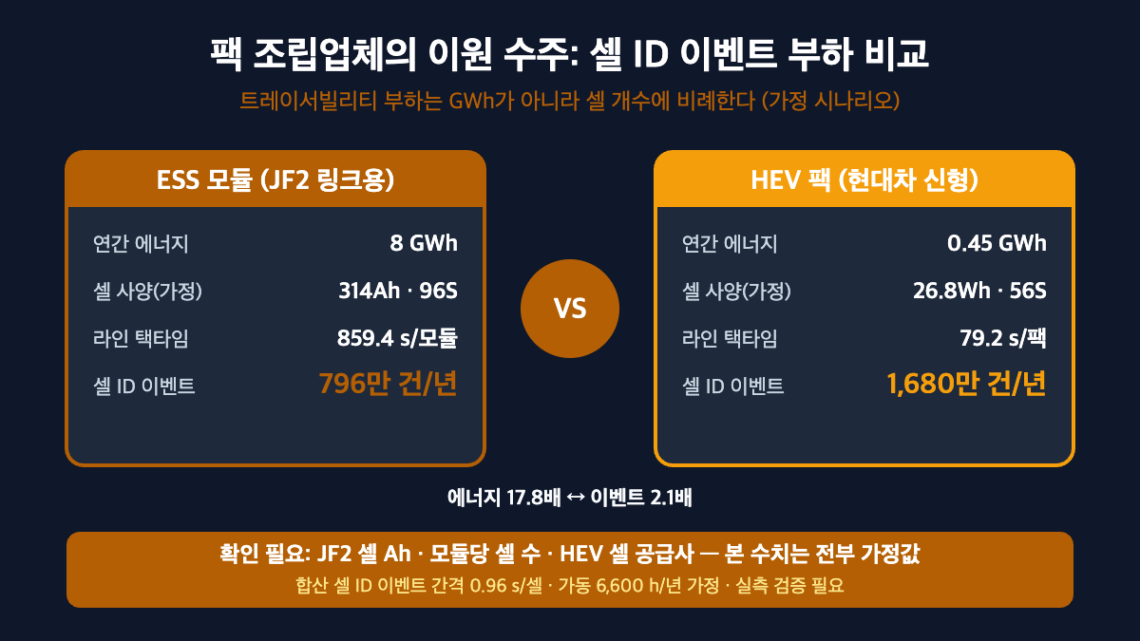
Sebang Lithium Battery simultaneously won orders for Hyundai Motor's new hybrid (HEV) battery packs and LG Energy Solution's new ESS (JF2) battery packs, together worth more than KRW 3 trillion (reported 2026-09-07). This article quantifies, under an assumed scenario, how the Cell Inbound Interface and Cell-ID Traceability load differ when a pack systems company that sources cells externally receives two heterogeneous product lines — automotive and grid-scale power — within a single organization. The conclusion is that the traceability system's load scales with cell count, not GWh. In the assumed scenario, the HEV pack, at 0.45 GWh/year, is only 1/17.8 the scale of the ESS module (8 GWh/year), yet its…
You May Also Like
Pylontech’s 588 Ah and 601 Ah LFP Cells Enter Mass Production — Why Energy-Weighted Availability Stays the Same When the Cell Count Halves
Five million ACC cells equal 2.7 to 3.6 months of nameplate output
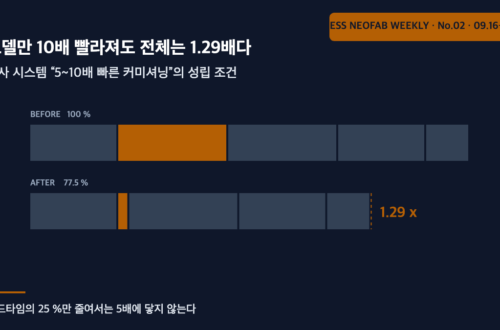
Even a tenfold faster model moves the whole by 1.29x — what “5 to 10 times faster commissioning” actually requires
-
128 MW of Distribution-Grid ESS Volume Allocated — Can the Battery Pack Assembly Line Absorb the Takt Time?
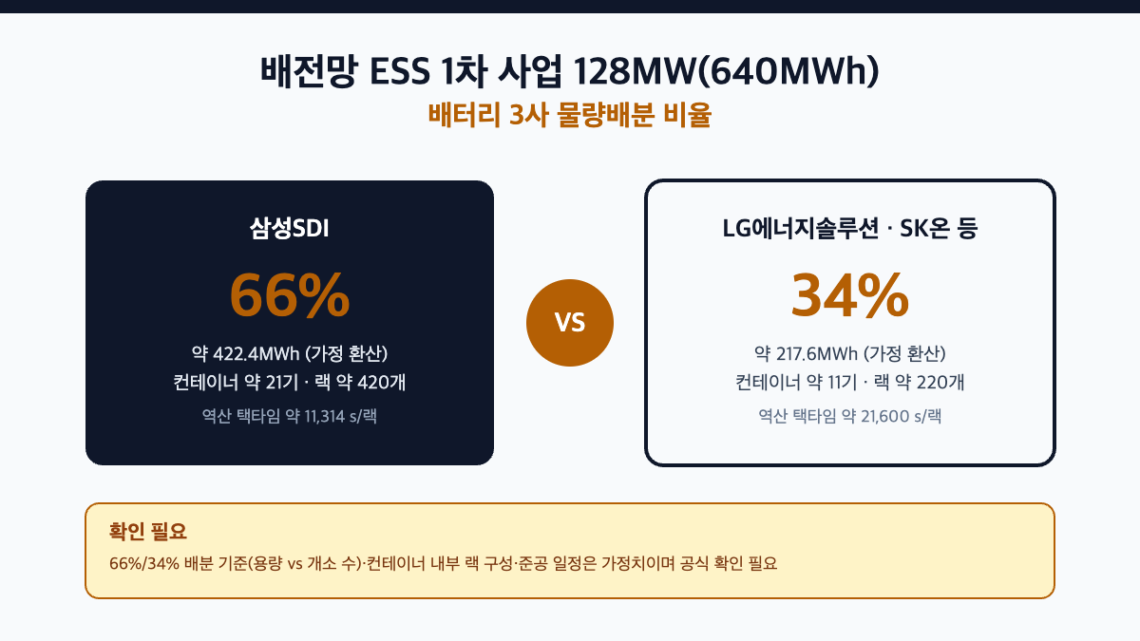
The Ministry of Climate, Energy and Environment’s Phase 1 distribution-grid ESS project — linked to additional renewable-energy interconnection — confirmed 9 operators and allocated a combined 128 MW (640 MWh) across 32 distribution feeders. Samsung SDI recorded the largest award at 66%, with LG Energy Solution and SK On splitting the remainder. This article converts that volume-allocation ratio into a load distribution across battery-pack assembly lines, and back-calculates, under an assumed scenario, how far the takt time diverges between operators. The conclusion is that a difference in procurement-volume ratio is carried straight through into a load imbalance at the production-line design stage, so Line Balancing review must be conducted together,…
You May Also Like
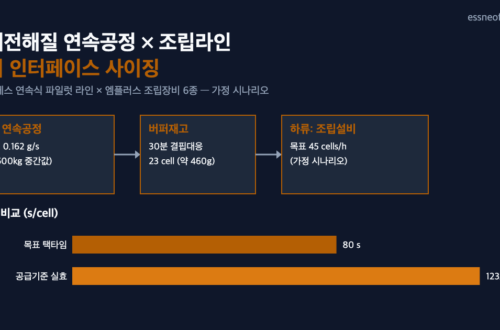
Between the Continuous Solid-Electrolyte Process and the Assembly Line: How Should the Buffer Interface Be Designed?
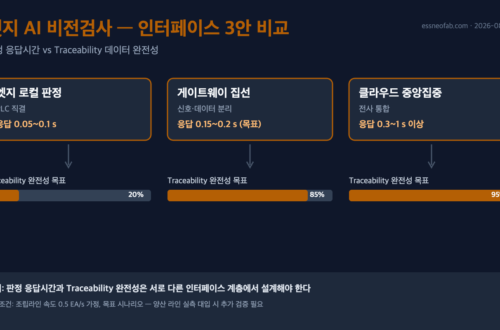
Edge AI Vision Inspection and Battery-Pack Leak Testing: How Gateway Aggregation Affects Traceability Completeness
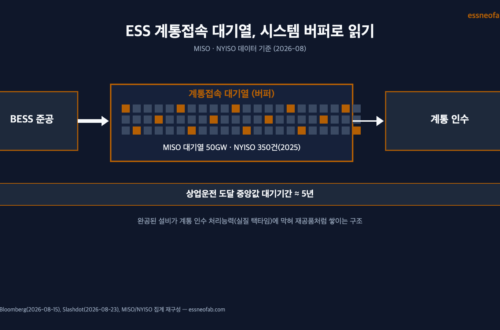
Re-Reading the ESS Grid-Interconnection Queue in the Language of Line Balancing