ESS Fire-Safety Kits Across 20 Sites — What the System Must Prepare
Abstract
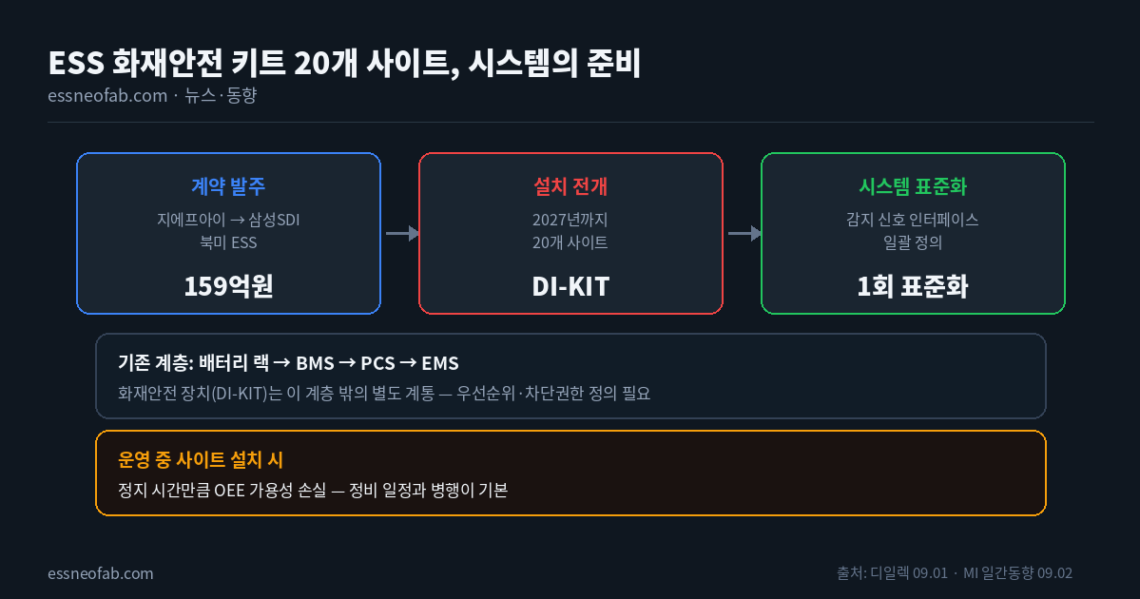
GFI has won a KRW 15.9 billion contract for Samsung SDI’s North American ESS fire-safety solution. It will install DI-KIT at 20 sites by 2027. This contract shows that fire-safety devices are being ordered not as a cell-level option but as a site-level system line item. On the operations side, what is needed first is defining the installation sequence across the 20 sites and the interface with existing systems.
1. What Happened
To state the conclusion first: ESS fire-safety solutions have moved into a phase of being applied in bulk across multiple sites. Until now, the general approach for North American ESS was to address site-specific safety requirements individually. Bundling 20 sites into a single contract is a signal that standardization of safety devices has begun. So what does the system side need to prepare?
| Item | Reported details |
|---|---|
| Supplier | GFI |
| Customer | Samsung SDI North America ESS |
| Contract size | KRW 15.9 billion |
| Installation scope | 20 sites by 2027, DI-KIT |
| Background | Responding to expanding ESS safety-management demand |
| Source | The Elec (2026.09.01), MI Daily Trends (2026.09.02) |
The composition of DI-KIT (detection, suppression, exhaust, etc.) is not specified in the reporting. Converting this to a per-site unit price (KRW 15.9 billion / 20 approx. KRW 800 million) requires assuming an even contract structure, so it should be treated only as a reference figure.
2. Where This Sits from a System Perspective
An ESS site is structured as a hierarchy of battery racks, BMS1, PCS2, and EMS3. A fire-safety device does not belong to any of these layers – it is a separate, standalone system. This is where the problem arises. If it is not defined which layer receives the detection signal and in what sequence it triggers shutdown, the system operates in isolation even once the device is installed.
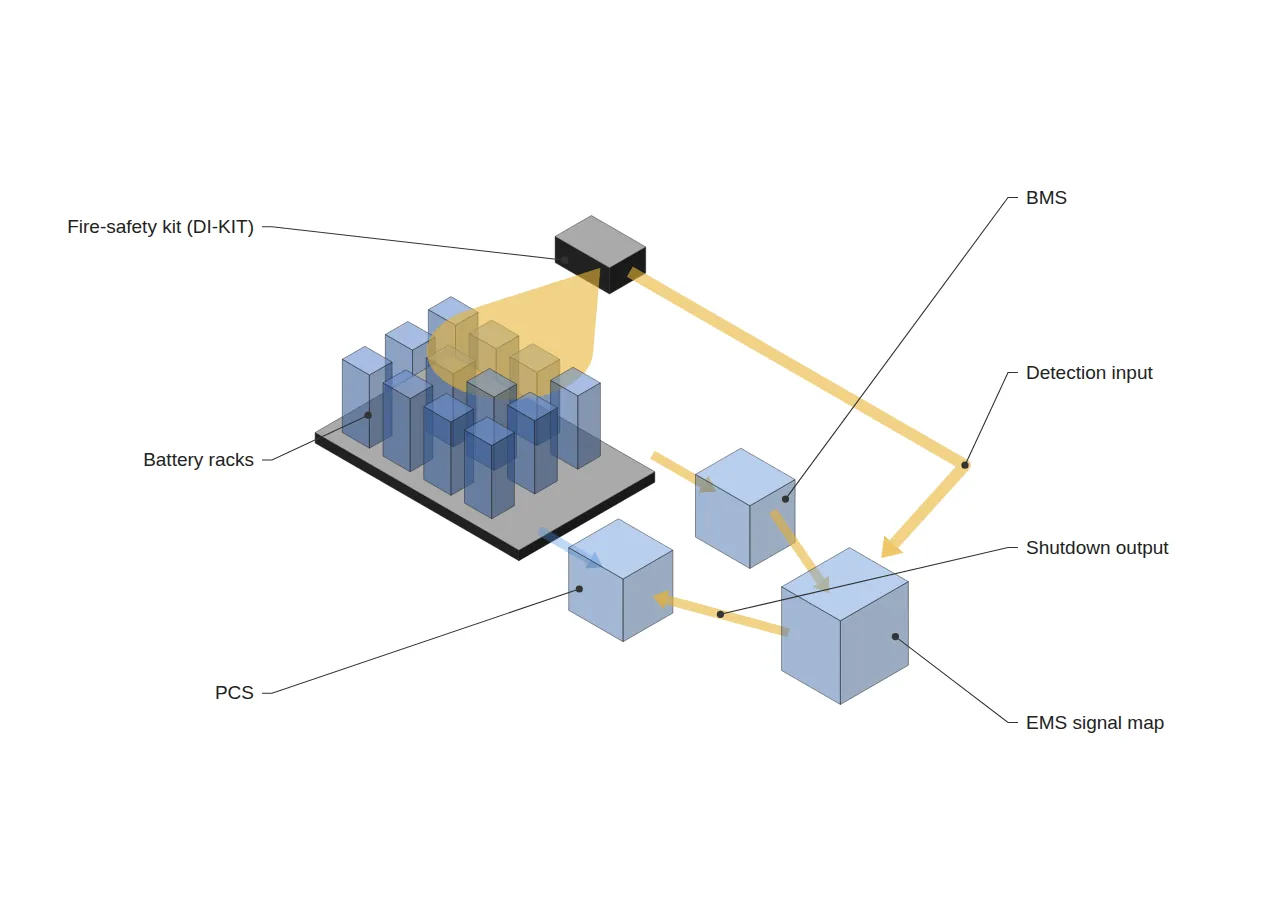
If the same kit goes into 20 sites, this interface definition only needs to be done once. That is the practical advantage of a bulk contract.
3. What “20 Sites by 2027” Means
“20 sites by 2027” implies there is an installation sequence. New sites and sites already in operation have different installation conditions. An operating site must secure downtime, and that time directly cuts into the Availability term of OEE4. Scheduling installation to overlap with maintenance windows is the basic way to reduce this loss.
4. Preparation Items Compared
| Category | New site | Operating site |
|---|---|---|
| Installation timing | Concurrent with rack installation | Uses maintenance downtime |
| Interface definition | Finalized at design stage | Requires revising existing EMS signal map |
| Impact on availability | None | Loss equal to downtime |
| Verification | Included in commissioning | Requires separate functional testing |
This table says one thing. How many of the 20 sites are operating sites determines how difficult this contract is to execute. That ratio is not in the reporting.
5. Implications
ESS safety regulation is on a trajectory of expanding from the cell level to the system level as a whole. The bulk application of fire-safety kits across multiple sites is a case of that trend being reflected at the procurement stage. This is different in character from a trend like the NFPA 855 revision, which sets individual-site regulatory-compliance standards such as clearance distance and detection response time (Related reading: The NFPA 855 revision and the ESS TRPP interface/Traceability).
The practical distinguishing feature of this contract is that it is a procurement approach that standardizes the interface definition all at once by applying the same kit across multiple sites (the author’s view). From an operator’s standpoint, the signal interface and downtime plan come before device specifications. The expanded renewable-energy budget announced during the same period is likewise a demand signal broadening the base of ESS installations, so fire-safety standardization can be read as the safety-side response accompanying that expansion (the author’s view) (Related reading: Doubling the renewable-energy budget and fire-detection AI – two signals for the ESS line).
FAQ
Q. Doesn’t adding the kit duplicate the existing BMS protection function?
A. It is not duplication – it is a different layer. BMS monitors cell/module electrical quantities, while a fire-safety device monitors physical phenomena such as heat, smoke, and gas. Because the two signals occur at different points in time, it must be defined which one holds shutdown priority.
Q. Isn’t KRW 800 million per site expensive?
A. That is only an even-distribution assumption. The figure varies widely depending on site scale and whether existing equipment is present, so it should not be judged by this number.
Field Application Notes
- If it is an operating site, open the next maintenance-downtime schedule and mark the slots available for kit installation.
- Add rows for the fire-detection input and shutdown output to the EMS signal map, and specify their priority.
- Once the kit specification sheet is received, record the detection method and response time together with the measurement conditions (temperature, installation location).
¹ BMS (Battery Management System): a system that monitors and controls battery status.
² PCS (Power Conversion System): a device that converts power between DC and AC.
³ EMS (Energy Management System): a system that integrates the operation and management of generation, storage, and load.
⁴ OEE (Overall Equipment Effectiveness): overall equipment efficiency calculated as Availability x Performance x Quality.


You May Also Like
China’s GB/T 34014 24-Character Battery Code: How Code Structure Fixes Issuance Timing and Authority on the Line
After Korea’s Battery History Management System: IDs Continue, Operating History Breaks — History Continuity of ESS Reuse Racks
2 Comments
Pingback:
Pingback: