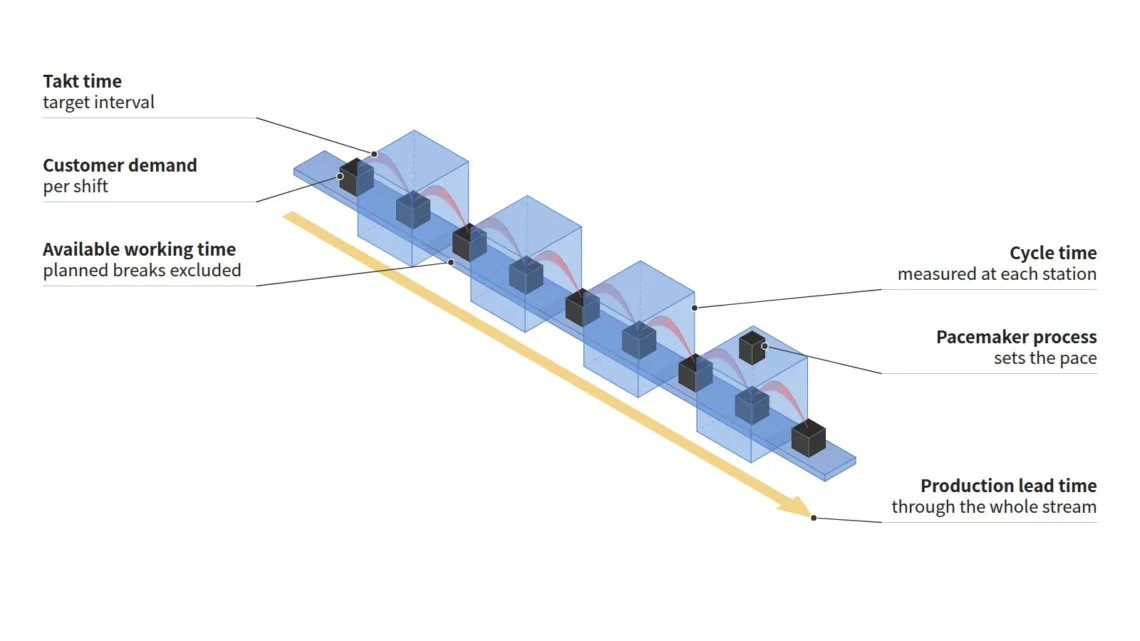
Don’t Subtract Breakdowns When Calculating Takt Time — Takt Time vs. Cycle Time vs. Lead Time
Abstract
Takt time is the target production interval obtained by dividing available working time by customer demand, whereas cycle time is the measured time a process actually takes to make one unit¹·². The calculation rule in the workbook published by the Lean Enterprise Institute (LEI) subtracts from shift time planned operator breaks, meetings, cleanups, etc., but not time for unplanned machine downtime, changeovers or other internal problems³. Dividing the 27,600 s of available working time per shift obtained under this rule by the demand per shift of 690 units gives a takt time of 40 s³. To cover stopped time as well, the measured cycle time must be shorter than takt time; with the actual running ratio assumed to be 90 %, that upper limit is 36 s.
1. Conclusion First — Takt Time Is the Target Interval, Cycle Time Is the Measured Result
The conclusion has two parts. Takt time is a target interval set only by customer demand and available working time, and it has nothing to do with how fast the equipment is. Cycle time is the result that equipment and operators actually deliver, and line design is the task of fitting cycle time within takt time.
The situation (S) is clear. The two times always appear together in line balancing and in equipment specification reviews. The complication (C) is that the two terms are mixed up even in official sources. Toyota’s official UK magazine glosses Taktzeit, the German word from which takt time derives, as ‘cycle time’ in a parenthetical note⁴, and LEI’s Lean Lexicon lists ‘Total Product Cycle Time’ as another name for production lead time².
There are three questions (Q). What does each of the three times measure, how is takt time calculated, and what relationship should the two times have? The answer (A) is summarized in the table below, and Sections 2–4 present the evidence in turn.
| Term | Definition in the primary source (gist) | Nature (as classified in this article) | In this article |
|---|---|---|---|
| Takt time | Available production time divided by customer demand¹ | Target value set by calculation | Section 2 |
| Cycle time | Time required to produce a part or complete a process, as timed by actual measurement² | Measured value | Sections 3 and 4 |
| Production lead time | Time required for a product to move all the way through a process or a value stream from start to finish² | Throughput time | Section 3 (for distinction) |
2. How to Calculate Takt Time — What Is and Is Not Subtracted from Available Working Time
The takt time formula fits on one line. The Lean Lexicon defines takt time as “a calculation of the available production time divided by customer demand” and states that its purpose is to precisely match production with demand¹. This site’s fixed definition (takt time = available operating time / customer demand quantity) has the same structure; this article’s ‘available working time’ (the workbook’s ‘effective working time’) is exactly that available operating time, a different value from the JIPM ‘operating time’ (actual running time with stops subtracted) used in Part 2 of this series. This numerator is also where calculation errors arise.
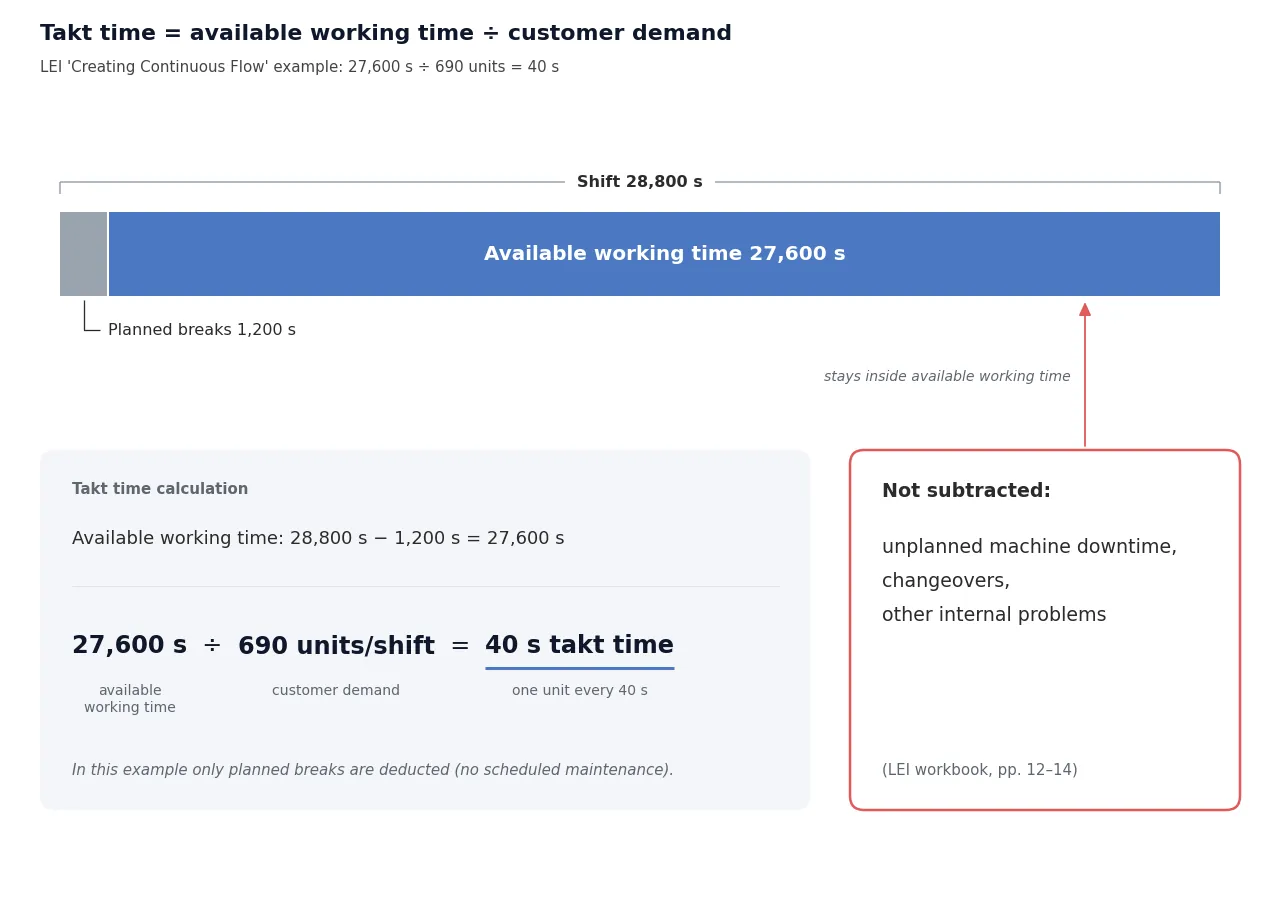
The LEI workbook, Creating Continuous Flow, defines available working time (‘effective working time’ in the original) as “start-to-stop shift time minus any scheduled operator breaks, meetings, cleanups, etc.”³ It then states explicitly that, because takt time must represent the actual customer demand rate, time for unplanned machine downtime, changeovers or other internal problems is not subtracted³. In other words, time lost to breakdowns and product changeovers is not a reason to change takt time but a loss that the process must absorb separately.
| Step | Value | Calculation / remarks |
|---|---|---|
| Customer demand per week | 6,900 units | LEI workbook example |
| Shifts per week | 10 shifts | Shifts of equal length |
| Demand per shift | 690 units | 6,900 ÷ 10 |
| Shift time | 28,800 s | Shift length in the original converted to s |
| Planned breaks | 1,200 s | 2 breaks per shift |
| Available working time | 27,600 s | 28,800 − 1,200 |
| Takt time | 40 s | 27,600 ÷ 690 |
※ Calculation conditions: All figures are from the LEI workbook example (fuel line cell, 10 shifts per week), a case with no planned downtime for maintenance³. Implication: even within the same shift, the numerator changes depending on which items are designated as planned stops, so the items used to calculate available working time should be listed next to the takt time.
Other examples point to the same conclusion. The Lean Lexicon example gives a takt time of 120 s for 28,800 s of available time per day and a demand of 240 units¹, and Art Byrne’s signed column on LEI’s blog, The Lean Post, gives 60 s for 450 units in 27,000 s, falling to 30 s when available working time stays the same and demand doubles to 900 units⁵ (both examples converted from the original units to s). The only variables that move takt time are demand and available working time.
The origin of the name reflects the same character. According to the Lean Lexicon, Takt is German for a precise interval of time, such as a musical meter, and it was first used in the German aircraft industry in the 1930s as the interval at which aircraft were moved ahead to the next production station¹. The concept came into wide use at Toyota in the 1950s, and Toyota typically reviews the takt time of each process every month, with tweaking reviews at shorter intervals in between¹ (the original gives the tweaking-review interval in days). Toyota’s chronology records in its 1953 entry that the company established ‘standard operations consisting of specified takt times, work sequences, and standard amounts of work-in-process’⁶, and Toyota’s official page lists “Make them at the pace at which they’re sold” as the third principle of Just-in-Time (JIT)⁷.
3. Cycle Time and Related Time Terms — Machine, Operator and Effective Machine Cycle Times, and Production Lead Time
Cycle time is a single term, but it refers to several different measurements. The Lean Lexicon defines cycle time as “the time required to produce a part or complete a process, as timed by actual measurement” and divides the related time terms as shown below². Because a document that says only ‘cycle time’ does not reveal which value is meant, comparison tables should state the type as well.
| Term | LEI definition (gist) | How it is obtained (per LEI) |
|---|---|---|
| Machine cycle time | Time a machine requires to complete all of its operations on one piece | Not specified by LEI |
| Operator cycle time | Time it takes an operator to complete all the work elements at a station before repeating them | Direct observation |
| Effective machine cycle time | Machine cycle time + load and unload time + (changeover time ÷ number of pieces produced between changeovers) | Calculation |
| Production lead time | Time for a product to move all the way through a process or a value stream from start to finish. Also called Throughput Time or Total Product Cycle Time | Not specified by LEI |
Effective machine cycle time is machine cycle time plus load and unload time, plus the result of dividing changeover time by the number of pieces produced between changeovers. The LEI example adds 1 s, a 30 s changeover divided by a minimum batch of 30 units, to a machine cycle time of 20 s and a load and unload time of 30 s, giving 51 s². This means that looking at the machine cycle time alone leaves out the changeover share; how changeover should be classified as a loss is addressed separately in Part 4 of this series.
The LEI workbook uses one more definition. Cycle time is “how frequently a finished unit actually comes off the end of your pacemaker cell,” and takt time is a reference number used to help match the rate of production in a pacemaker process to the rate of sales³. A pacemaker process is the process that sets the pace for the entire value stream, and LEI cautions that it should not be confused with a bottleneck process, which constrains downstream processes due to a lack of capacity⁸. The reference point for matching takt time is therefore the pacemaker, not the bottleneck.
4. How to Align the Two Times — Cycle Time ‘Slightly’ Shorter Than Takt Time
Cycle time must be shorter than takt time, but sources differ in how they express how much shorter. The Lean Lexicon entry for the operator balance chart states that making the amount of work for each operator “very nearly equal to, but slightly less than, takt time” is essential for minimizing the number of operators needed⁹. Art Byrne’s column sets the goal of making cycle time equal to takt time⁵, and the LEI workbook warns that chronically cycling much faster than takt time increases the chances of overproducing and may mean that extra operators are being used³.
The same workbook also notes that when there is no time available to catch up if equipment or the materials system fails, as in a facility running 3 full shifts, cycle time has to be set slightly below takt time³, but no primary source was found that states the margin as a number.
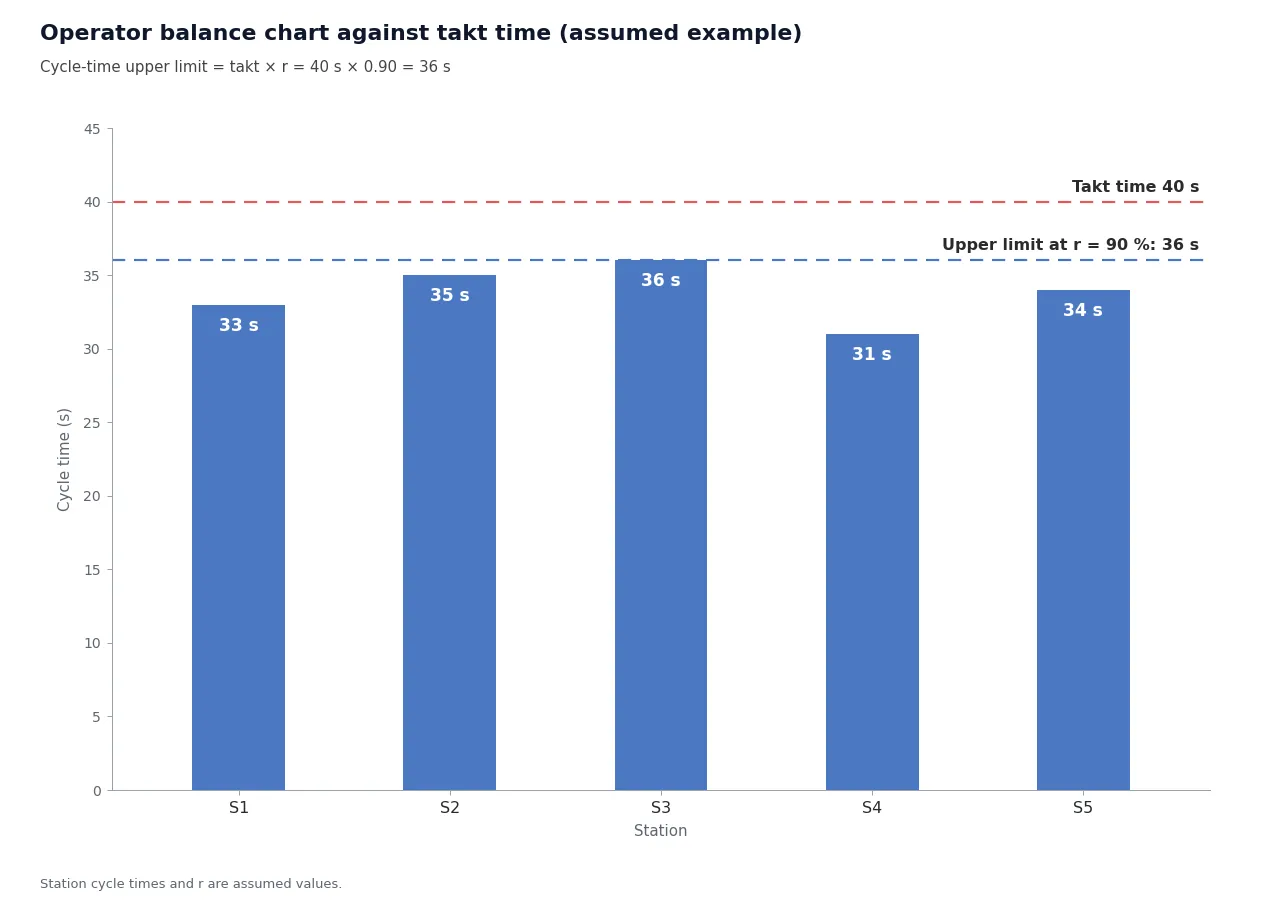
The margin can be derived directly from the calculation rule in Section 2. Because breakdown and changeover time were not subtracted from the numerator of takt time, the line must meet the per-shift demand using only the time it actually runs. If r denotes the ratio of actual running time to available working time, the cycle-time upper limit is takt time × r, and this upper-limit formula is what this article newly adds.
| Actual running ratio r (assumed) | Actual running time | Cycle-time upper limit | Relative to takt time |
|---|---|---|---|
| 100 % | 27,600 s | 40.0 s | 0 % |
| 95 % | 26,220 s | 38.0 s | −5 % |
| 90 % | 24,840 s | 36.0 s | −10 % |
| 85 % | 23,460 s | 34.0 s | −15 % |
※ Calculation conditions: In the LEI workbook example from Section 2 (available working time 27,600 s, demand 690 units, takt time 40 s), only r was varied as an assumed value, and it was assumed that there are no defects and that losses are not recovered through overtime or finished-goods inventory. Implication: a cycle time shorter than takt time does not by itself guarantee that demand is met; the upper limit is set by the actual running ratio. When loading time is set equal to available working time and changeovers are counted as stop losses (the JIPM approach), r equals OEE availability, so Part 2 of this series links the two metrics in a single formula and Part 4 covers the differences that arise from the classification.
The same formula can also be tentatively applied to continuous processes (interpretation). Assuming a process whose demand is set in length rather than in units, dividing a required length of 13,800 m per shift (assumed) by the available working time of 27,600 s gives an average line speed of 30 m/min. If the actual running ratio is 90 %, the line speed required while running rises to 33.3 m/min, and comparing the operating speed in the equipment specification against this value allows the takt time review to be carried out in speed units.
5. Conclusion and Limitations
Takt time is the beat set by demand, and cycle time is the beat the process actually delivers. When calculating takt time, only planned time (breaks, meetings, cleanups, etc.) is subtracted, not breakdown or changeover time, and those losses are absorbed by keeping cycle time at or below takt time × r. In the LEI workbook example (takt time 40 s), assuming r to be 90 % gives a cycle-time upper limit of 36 s.
This article is a primer on the definitions and calculation of the two times. The problem of matching the cycle time of specific equipment to line takt time was covered in The Interface Between Laser Notching Cycle Time and Line Takt Time (head-count sizing) and Introducing Robotic Automation Equipment — Where Does the Interface with Line Takt Time Break Down. Where those two articles dealt with equipment-side variables, this article sets out the numerator and denominator of takt time, the starting point of that calculation.
There are also limitations. The definitions in this article are based on the Lean Lexicon, the LEI workbook and official Toyota materials; the corresponding term definitions in KS A 3020 (Korean Industrial Standard, production-management terms — process control) could not be compared because the full text could not be accessed (to be confirmed). The actual running ratio and the required length of the continuous process are assumed values, with further verification needed through line-specific measurement before they are applied to an actual line.
FAQ
Q1. Doesn’t reducing takt time raise productivity?
Takt time is a value set by demand and available working time, so it is not something to be reduced. It moves only when demand or available working time changes, and with available working time unchanged, a doubling of demand halves it⁵. The targets for improvement are cycle time and stoppage losses, that is, r in the Section 4 formula.
Q2. Doesn’t breakdown time also have to be subtracted for takt time to be realistic?
The LEI workbook prescribes the opposite. Because takt time must represent the actual customer demand rate, time for unplanned stops, changeovers and internal problems is not subtracted³. A value calculated with breakdown time subtracted is not takt time but the cycle-time upper limit of Section 4 (takt time × r), and only by keeping the two values separate can the demand rate and internal losses be managed independently.
Q3. Isn’t it a good thing if cycle time is much shorter than takt time?
The LEI workbook warns that chronically cycling much faster than takt time increases the chances of overproducing and may mean that more operators are being used than necessary³. The operator balance chart likewise uses “very nearly equal to, but slightly less than, takt time” as its criterion⁹. Therefore, setting cycle time near the Section 4 upper limit (takt time × r) and checking staffing and work-in-process at processes that run much faster than that does not conflict with the sources’ warnings (interpretation).
Field Application Notes
| Check | How to execute | Decision criterion | Remarks |
|---|---|---|---|
| ☐ Prepare an available working time calculation sheet | Subtract only planned time (breaks, meetings, cleanups, etc.) from shift time (s) and record each item separately | Were unplanned stops and changeovers left unsubtracted? | LEI workbook rule³ |
| ☐ Confirm demand per shift | Weekly demand ÷ shifts per week | Is it based on the same period as available working time? | E.g., 6,900 ÷ 10 = 690 units³ |
| ☐ Post and update takt time | Available working time ÷ demand per shift | Recalculate when demand changes | Toyota reviews monthly¹ |
| ☐ Label the cycle-time type | Measure machine, operator and effective machine cycle times separately | Is the type stated in the comparison table? | LEI definitions² |
| ☐ Calculate the cycle-time upper limit | Takt time × r (recent actual running ratio) | Measured cycle time ≤ upper limit | Measure r for each line (the 90 % in the text is assumed) |
| ☐ Check processes running too fast | List processes that run much faster than the upper limit | Overproduction or excess staffing? | LEI workbook warning³ |
Sources and Notes
¹ Lean Enterprise Institute (LEI), Lean Lexicon, “Takt Time” entry, paragraphs 1–3, modified 2024-08-23, lean.org. Paragraph 1: definition; paragraph 2: example (original units converted to s); paragraph 3: etymology, history and Toyota’s review cycle.
² LEI, Lean Lexicon, “Cycle Time” entry, modified 2022-05-23, lean.org. Definition sentence; definitions of machine, operator and effective machine cycle time and of production lead time under the subheading “Cycle Time-Related Terms Involving Time”; the 51 s example.
³ Rick Harris and Mike Rother, Creating Continuous Flow, LEI public excerpt, “Question 2: What is the Takt Time?” in “PART I: GETTING STARTED,” pp. 12–14, lean.org PDF. Available working time rule, example figures, cycle-time definition and the warning against cycling too fast.
⁴ Toyota (GB), “Toyota Production System – what it all means,” 2025-08-29, parenthetical note in the “Muri” entry, mag.toyota.co.uk.
⁵ Art Byrne, “Ask Art: Why is Takt Time So Important in a Lean Turnaround?” LEI, The Lean Post, 2019-11-13 (signed column), lean.org. The 60 s and 30 s examples (original units converted to s) and the sentence about making cycle time equal to takt time.
⁶ Toyota Motor Corporation, 75 Years of TOYOTA, TPS chronology, “Establishment of standardized work (1953)” entry, toyota-global.com PDF.
⁷ Toyota Motor Corporation, “Toyota Production System” page, Just-in-Time principle 3), global.toyota.
⁸ LEI, Lean Lexicon, “Pacemaker Process” entry, modified 2020-07-02, lean.org.
⁹ LEI, Lean Lexicon, “Operator Balance Chart” entry, modified 2020-07-02, lean.org.
※ Assumed values: the actual running ratio r (85–100 %), the required length per shift for the continuous process (13,800 m) and the station-by-station cycle times in Figure 2 are assumptions of this article and require verification against measured data. The corresponding term definitions in KS A 3020 (Korean Industrial Standard, production-management terms — process control) are to be confirmed.
Line Metrics Glossary — Other Articles in This Series
- Part 2. If Availability, Performance and Quality Are All 80 %, OEE Is 51.2 % — How to Calculate OEE
- Part 3. FAT and SAT Differ in More Than Location — How IEC 62381:2024 Defines the Tests
- Part 4. Is a Changeover Planned Downtime or an Availability Loss? — How the Definition Changes OEE


You May Also Like

Pylontech’s 588 Ah and 601 Ah LFP Cells Enter Mass Production — Why Energy-Weighted Availability Stays the Same When the Cell Count Halves

Why three qualified products landed on the same duration — in DSX Ready BESS, sizing is set by the output axis

5 Comments
Pingback:
Pingback:
Pingback:
Pingback:
Pingback: