본문으로 바로가기
Ess-neofab

A line- and system-level record of ESS and secondary-battery manufacturing processes

  • 한국어
  • English
  • Home
  • Process
  • System
  • Interface
  • Traceability
  • News & Trends
  • About
  • Contact
  • 한국어
  • English
  • Home
  • Process
  • System
  • Interface
  • Traceability
  • News & Trends
  • About
  • Contact

카테고리

  • Interface (28)
  • News & Trends (20)
  • Process (32)
  • System (31)
  • Traceability (22)

최근 글

  • Five million ACC cells equal 2.7 to 3.6 months of nameplate outputOctober 15, 2026
  • A 160 MW battery’s six-week commissioning has two baselinesOctober 8, 2026
  • Two Cycles a Day Take 106.8 % of a Day, and the Retention Tier Shifts Cell Volume by 1.47 GWhOctober 1, 2026
  • Battwoo’s Second-Life EV Batteries — When an 80 % Acceptance Threshold Overlaps the Retirement Distribution, Incoming Screening Becomes the BottleneckSeptember 30, 2026
  • US storage set an energy record in Q2 as installed power fell 7%September 29, 2026
  • CATL Starts Trial Production in Debrecen — The Digits of the Defect-Rate Target, Not the Equipment, Set the Length of a Trial RunSeptember 29, 2026
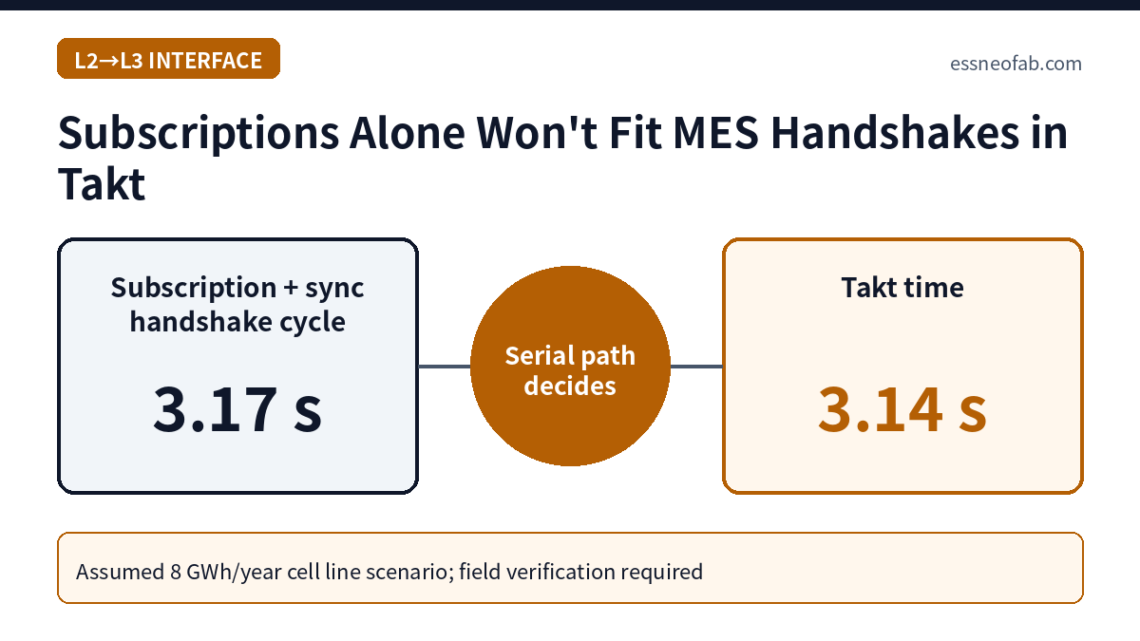
  • Subscriptions Alone Won't Fit MES Handshakes in Takt
    System,  Traceability

    Traceability Events at the ISA-95 L2→L3 Boundary: How OPC UA Polling, Subscriptions and MES Handshakes Erode Takt Time

    July 5, 2026 /

    At the boundary between equipment (ISA-95 Level 2) and MES (Level 3), the main reason traceability events erode takt time is not the transport method (polling vs. subscription) but a structure in which the MES acknowledgement (handshake) sits serially on the critical path of the station cycle. On an 8 GWh/year cell line (assumed takt time 3.14 s, net station processing 2.80 s), 1.0 s polling with a synchronous handshake adds an average of 0.72 s, stretching the cycle to 3.52 s and creating a shortfall of about 10.9% against required quantity; switching to a 0.1 s/0.2 s subscription still adds 0.37 s on average and still exceeds takt time.…

    read more
    ESS-neofab Comments Off on Traceability Events at the ISA-95 L2→L3 Boundary: How OPC UA Polling, Subscriptions and MES Handshakes Erode Takt Time

    You May Also Like

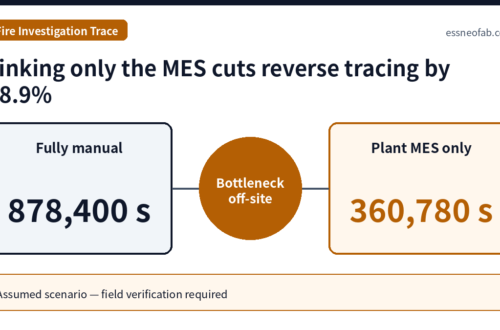
    Linking only the MES cuts reverse tracing by 58.9%

    ESS Fire Investigation and Traceability: Decomposing Reverse-Trace Time from the Incident Rack to Same-Lot Sites
    July 13, 2026
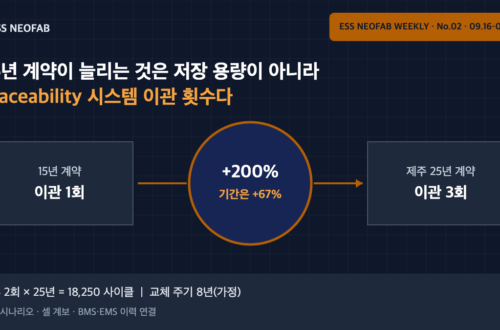
    15년 계약 이관 1회와 제주 25년 계약 이관 3회를 비교한 ESS Traceability 시스템 이관 횟수 도식

    A 25-Year Contract Increases Migrations, Not Storage — Traceability Design for Jeju Long-Term ESS Contracts
    September 24, 2026
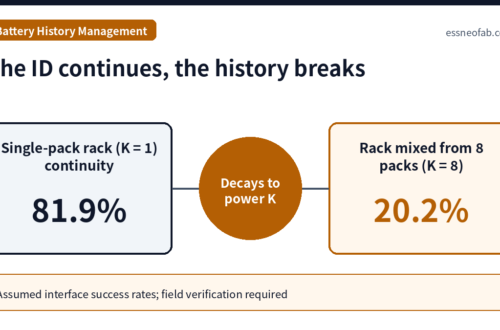
    The ID continues, the history breaks

    After Korea’s Battery History Management System: IDs Continue, Operating History Breaks — History Continuity of ESS Reuse Racks

    July 10, 2026
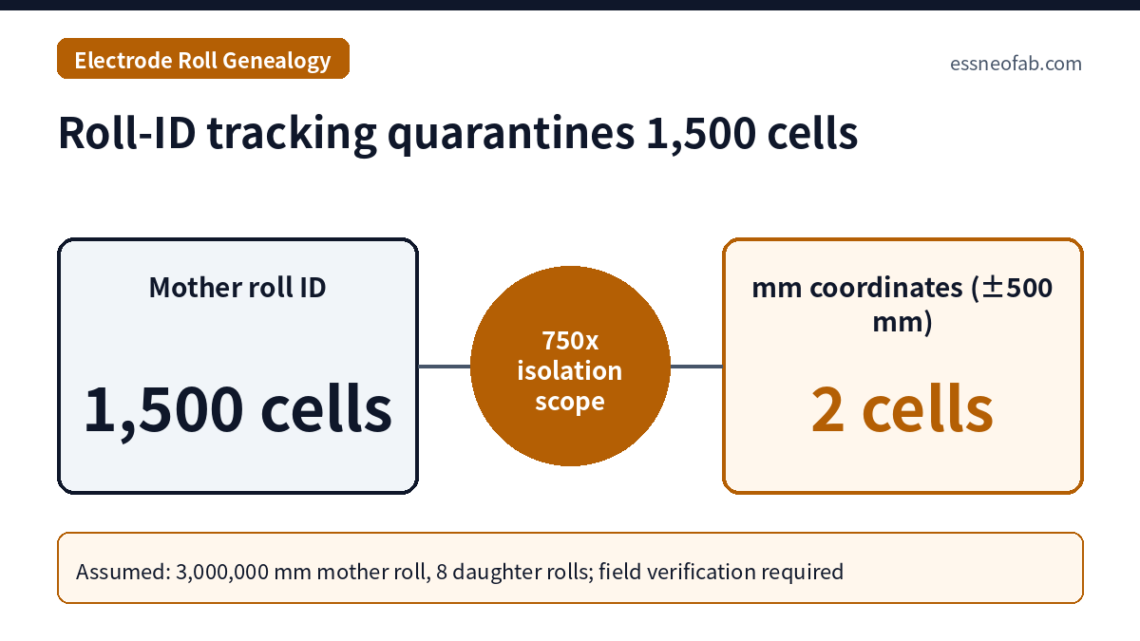
  • Roll-ID tracking quarantines 1,500 cells
    Process,  Traceability

    Electrode Roll Genealogy: How Key Reissue at Slitting and Stacking Shrinks Defect Isolation from 1,500 Cells to 2

    July 4, 2026 /

    When traceability resolution in the electrode R2R section stops at the "roll ID," a 5,000 mm coating defect in one mother roll expands the isolation scope to every cell derived from that mother roll. Assuming a 3,000,000 mm mother roll, 4 lanes, 8 daughter rolls, and 8,000 mm of cathode web per cell, the isolation scope is 1,500 cells at mother-roll-ID resolution, 188 cells at daughter-roll-ID resolution, and 2 cells at encoder-based mm-coordinate resolution (±500 mm), a difference of up to 750 times. This resolution is preserved only when a key consisting of "parent ID + parent coordinate interval + direction bit + transform coefficient" is reissued at every split…

    read more
    ESS-neofab Comments Off on Electrode Roll Genealogy: How Key Reissue at Slitting and Stacking Shrinks Defect Isolation from 1,500 Cells to 2

    You May Also Like

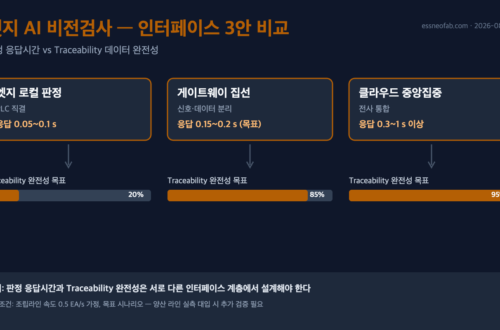
    엣지 AI 비전검사 인터페이스 3안 비교: 엣지 로컬 판정, 게이트웨이 집선, 클라우드 중앙집중의 응답시간과 Traceability 완전성 비교 도식

    Edge AI Vision Inspection and Battery-Pack Leak Testing: How Gateway Aggregation Affects Traceability Completeness
    August 27, 2026
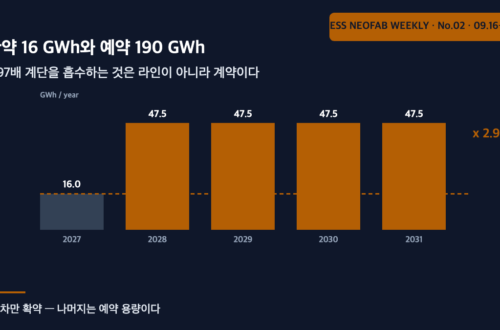
    EVE–Fluence 206 GWh 계약의 연도별 물량 계단 그래프 — 2027년 16 GWh에서 2028년 이후 47.5 GWh로 2.97배 뛰는 구조

    16 GWh committed and 190 GWh reserved — what absorbs the 2.97x step is the contract, not the line
    September 27, 2026
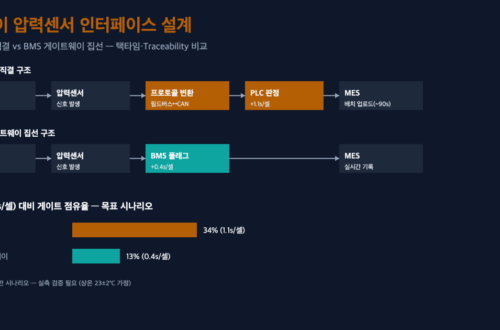
    46파이 원통형 셀 압력센서 데이터가 라인 PLC 직결과 BMS 게이트웨이 집선 중 어느 경로로 흐르는지 비교하는 다이어그램. 택타임 대비 게이트 점유율 34%와 13% 비교 막대그래프 포함

    46-Phi Cylindrical Cell Line Conversion: The Pressure-Sensor–BMS Interface Determines Takt Time

    August 26, 2026
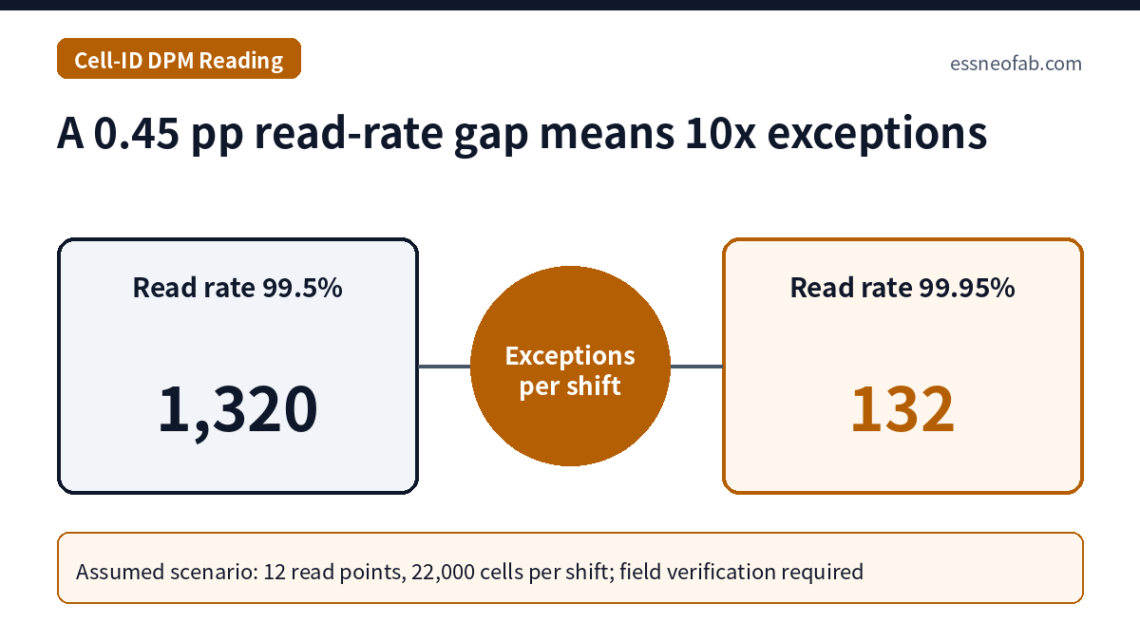
  • A 0.45 pp read-rate gap means 10x exceptions
    Process,  Traceability

    Cell-ID Laser DPM Read Rate 99.5% vs 99.95%: How No-Reads Drive Exceptions per Shift and OEE

    July 3, 2026 /

    The read rate of a cell-ID direct part mark (DPM) is a probability defined at a single read point, but the line experiences it raised to the power of the number of read points each cell passes. Assuming 12 read points and 22,000 cells per shift, a 99.5% read rate generates 1,320 No-Read exceptions per shift, while 99.95% generates 132. Under the same assumptions, OEE falls from a baseline of 84.64% to 75.50% at 99.5% (−9.14 pp), but only to 84.13% at 99.95% (−0.51 pp). A DPM specification should therefore be defined not as "read rate X%" but by three items: verification grade immediately after marking (ISO/IEC 29158), allowable exceptions…

    read more
    ESS-neofab Comments Off on Cell-ID Laser DPM Read Rate 99.5% vs 99.95%: How No-Reads Drive Exceptions per Shift and OEE

    You May Also Like

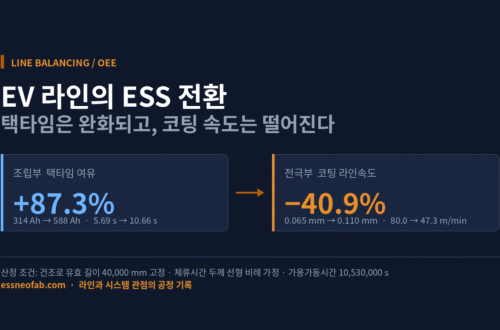
    EV 라인의 ESS 전환 시 조립부 택타임 여유 87.3% 증가와 코팅 라인속도 40.9% 하락을 비교한 라인 밸런싱 도식

    Converting EV Lines to ESS: Where Does OEE Break Down?

    August 19, 2026
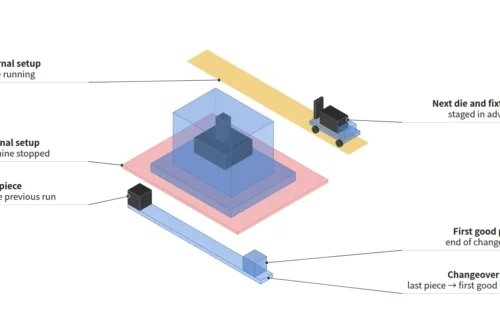
    Isometric concept of a changeover split into internal work while stopped and external work while running, from last piece to first good piece

    Is a Changeover Planned Downtime or an Availability Loss? — How the Definition Changes OEE

    September 25, 2026
    배터리 ESS 제조 라인 전경

    Market Trends from a Battery Process/Equipment Perspective — 46-Phi Ramp-Up, Dry Process, Equipment In-Housing

    July 11, 2026
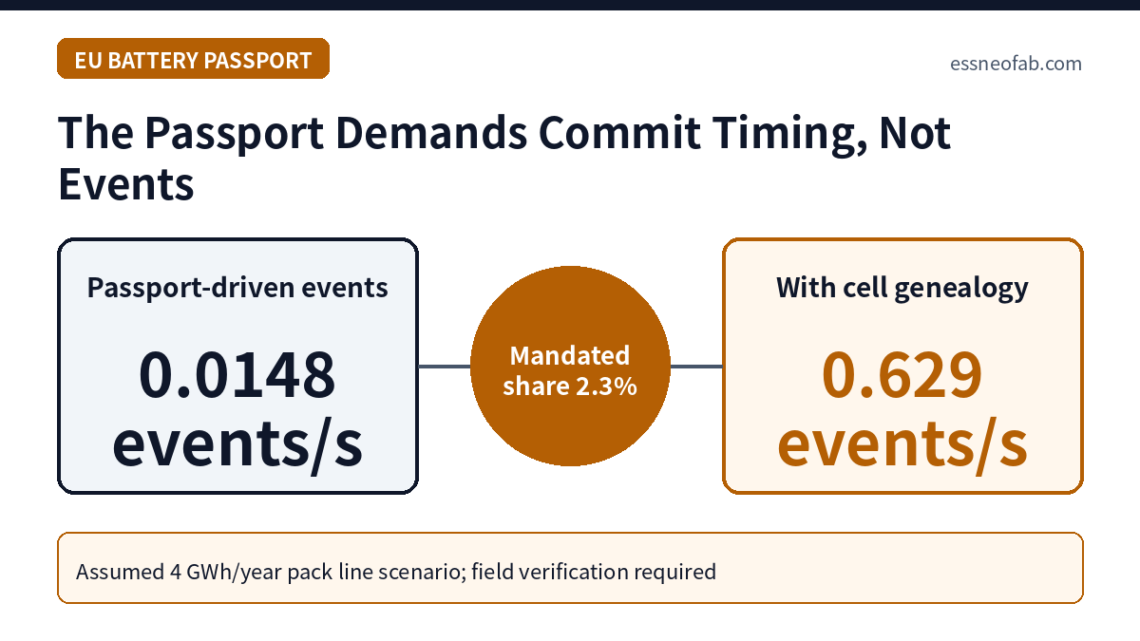
  • The Passport Demands Commit Timing, Not Events
    News & Trends,  System,  Traceability

    EU Battery Passport 2027: Which Station on an ESS Pack Line Commits What

    July 1, 2026 /

    Under Article 77 of the EU Batteries Regulation (Regulation (EU) 2023/1542), industrial batteries above 2 kWh require a battery passport from 18 February 2027, and as of September 2026 no legislative proposal changing that date has been identified. Breaking down the passport data attribute list (the version aligned with DIN DKE SPEC 99100) for the stationary ESS category shows that, of 80 mandatory attributes, only 5 static attributes must be recorded on the line at individual-battery level; the remaining static attributes are fixed once at battery-model level. In an assumed scenario (4 GWh/year pack line, pack takt time 338.6 s), passport-driven line capture events amount to 5 per pack (0.0148…
    read more
    ESS-neofab 0 Comments

    You May Also Like

    Dry Electrode: Where Does the Line Bottleneck Move?

    August 17, 2026
    ESS 제조·설치 공간 전경

    NFPA 855 (2026 Edition) Revision: ESS Safety Standards Expand From the Cell to the Entire System

    August 5, 2026

    LS Electric Ships First Units of Next-Gen ESS PCS “G2” — Is Liquid Cooling the Answer?

    August 10, 2026
Newer Posts 
© 2026 Ess-neofab · A line- and system-level record of ESS and secondary-battery manufacturing processes
  • About
  • Contact
  • Privacy Policy
  • Disclaimer
Ashe Theme by WP Royal.