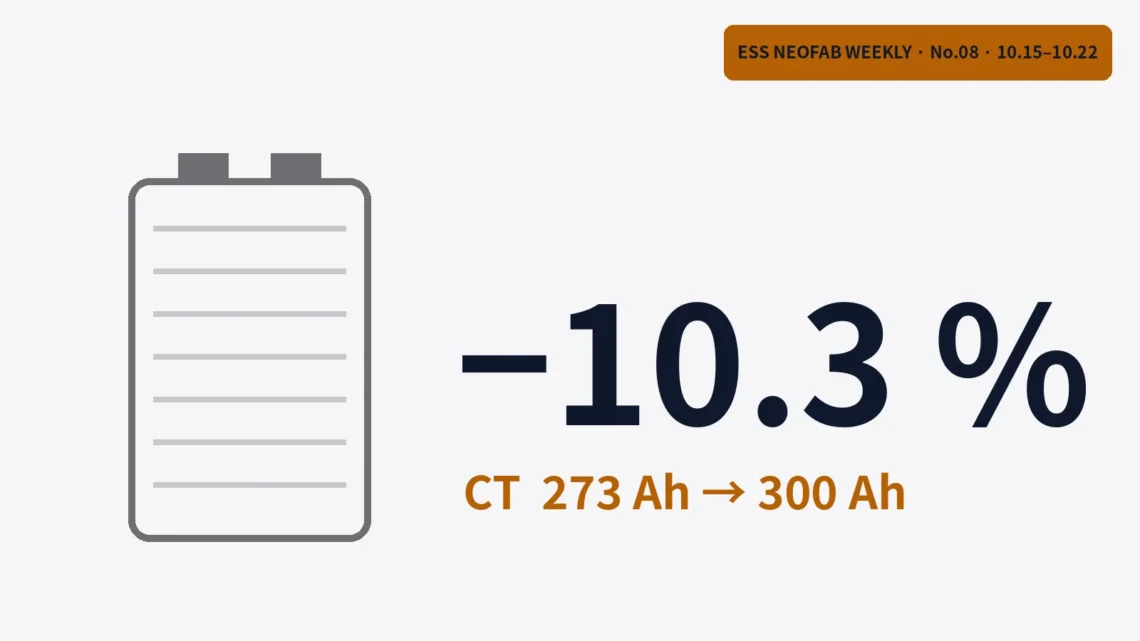
Samsung SDI’s third US LFP line: CT orders fell 10.3 %
ESS NEOFAB WEEKLY · No.08 · Process
A third line in the same plant does not buy the same equipment, and each process moves its own way.
Summary
On 21 October 2026, Korean trade press reported two new equipment orders for the third LFP line for energy storage at Samsung SDI’s joint-venture plant in Indiana. In the same plant, the CT inspection order for that line came in 10.3 % below the first line’s order, while the assembly equipment order that covers stacking came in 20.9 % above the second line’s. When the cell grows from the 273 Ah class to the 300 Ah class, a step that handles one cell at a time needs about 9.0 % less equipment, which sits within 1.3 percentage points of the CT drop. Cell size does not explain the assembly increase, and line capacity and cell voltage in the calculation are assumed values.
The third line’s orders split in two directions
Two Korean equipment makers announced orders on 21 October for the third energy storage line at the StarPlus Energy plant, the Samsung SDI and Stellantis joint venture in Indiana[1][2]. Phillenergy took an assembly equipment order worth 86.1 billion won. MOT took a smaller assembly order worth 10.1 billion won. This plant has four lines built for electric vehicle cells, and three of them are switching to LFP1 cells for energy storage.
Its suppliers have disclosed their orders line by line this year. That makes it possible to set one process side by side across lines. Two numbers caught my eye because they point in opposite directions. One goes down, and one goes up.
Innometry’s CT inspection orders fell from 5.52 billion won for line 1 to 4.96 billion won for line 3, a drop of 10.3 %[3]. Phillenergy’s assembly orders rose from 71.2 billion won for line 2 to 86.1 billion won for line 3, a rise of 20.9 %[1]. Same plant, same customer, same year.
Cell size accounts for half of the answer. Reports say line 1 makes 273 Ah2 class prismatic3 cells and line 3 makes 300 Ah class cells[3]. Bigger cells mean fewer cells for the same energy, so any step that handles one cell at a time gets less work. My calculation says that work falls by about 9.0 %, and the CT order fell by 10.3 %.
Cell size leaves the other half open. Stacking4 handles electrode area, and the area you stack for a given amount of energy barely changes with cell size. Cell size alone cannot produce a 20.9 % rise. So is line 3 just a copy of line 1?
Steps that count cells and steps that count area
To answer that, you first sort each step by what it counts as one unit of work. Picture a baker with a fixed batch of dough. Bake fewer, larger loaves and you need fewer bags and fewer labels. You still knead the same amount of dough.
A battery assembly line splits the same way. Notching5 and stacking cut and pile electrode sheets, so their work grows roughly with electrode area. Inserting the jelly roll6 into the can, closing the cap, welding it shut and scanning the finished cell with CT7 all treat one cell as one job. When cells get bigger, the first group keeps roughly the same work. Steps in the second group lose work in proportion to the cell count.
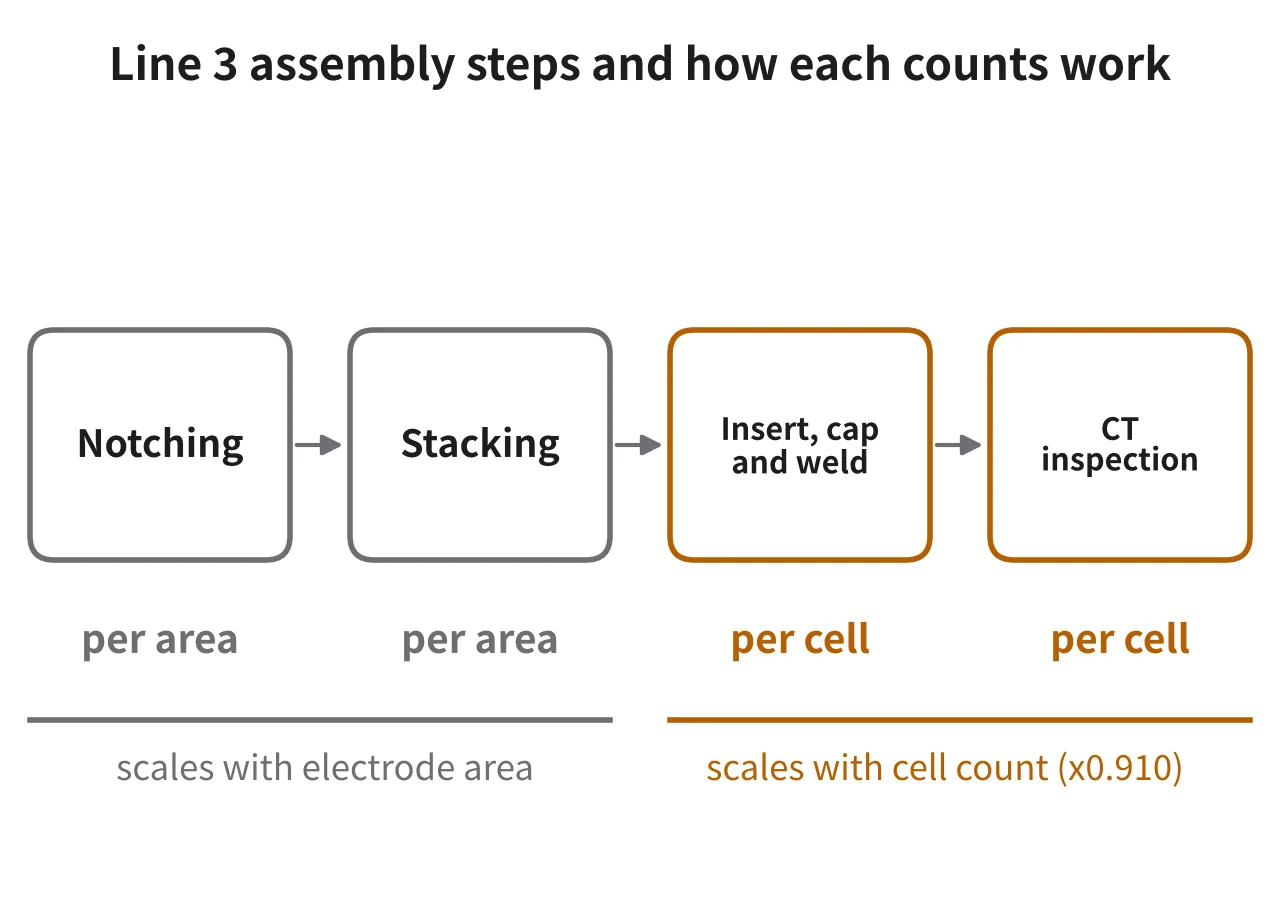
The figure lays out the steps named in the line 3 reports in flow order and tags each with the unit it counts. Both steps on the left count area, while those on the right count cells. A change of cell spec hits the two groups differently, and that difference shows up in the orders.
Bread and cells part ways at a certain point. A bigger cell can use larger electrode sheets or more sheets, and the choice changes how long one stacking cycle takes. A CT scan may also take longer per cell when the cell gets bigger. So this split tells you the direction of a change, not the exact number of machines.
Even so, it changes how you look at line balancing8. For a whole line to release cells at one pace, each step needs the right number of machines, because the slowest step sets the pace. When the cell spec changes, the cell-count steps end up with spare machines while the area steps do not. That is why the equipment list gets rebuilt line by line.
What the filings and reports say
Four Korean news reports supplied the numbers. Two articles in The Elec covered this week’s orders, Lead Economy listed the CT orders and cell specs by line, and Electronic Times reported line capacity and suppliers in June[1][2][3][4]. I did not open the original filings and used only the values the reporters quoted.
| Supplier and equipment | Line | Order value | Reported date or term |
|---|---|---|---|
| Innometry, CT inspection | Line 1 (273 Ah class) | 5.52 billion won | Ordered 16 January |
| Innometry, CT inspection | Line 2 (for Tesla) | 5.30 billion won | Ordered 30 May |
| Innometry, CT inspection | Line 3 (300 Ah class) | 4.96 billion won | Ordered 27 August |
| Phillenergy, assembly | Line 2 | 71.2 billion won | Ordered in July |
| Phillenergy, assembly | Line 3 | 86.1 billion won | Reported 21 October, term to 1 April 2027 |
| MOT, assembly | Line 3 | 10.1 billion won | Reported 21 October, term to 20 April 2027 |
Grouping the six orders by process makes the pattern clear. All three CT orders are public, so with line 1 set at 100 the index runs 96.0 and then 89.7. Only two assembly orders are public, and with line 2 at 100, line 3 comes in at 120.9.
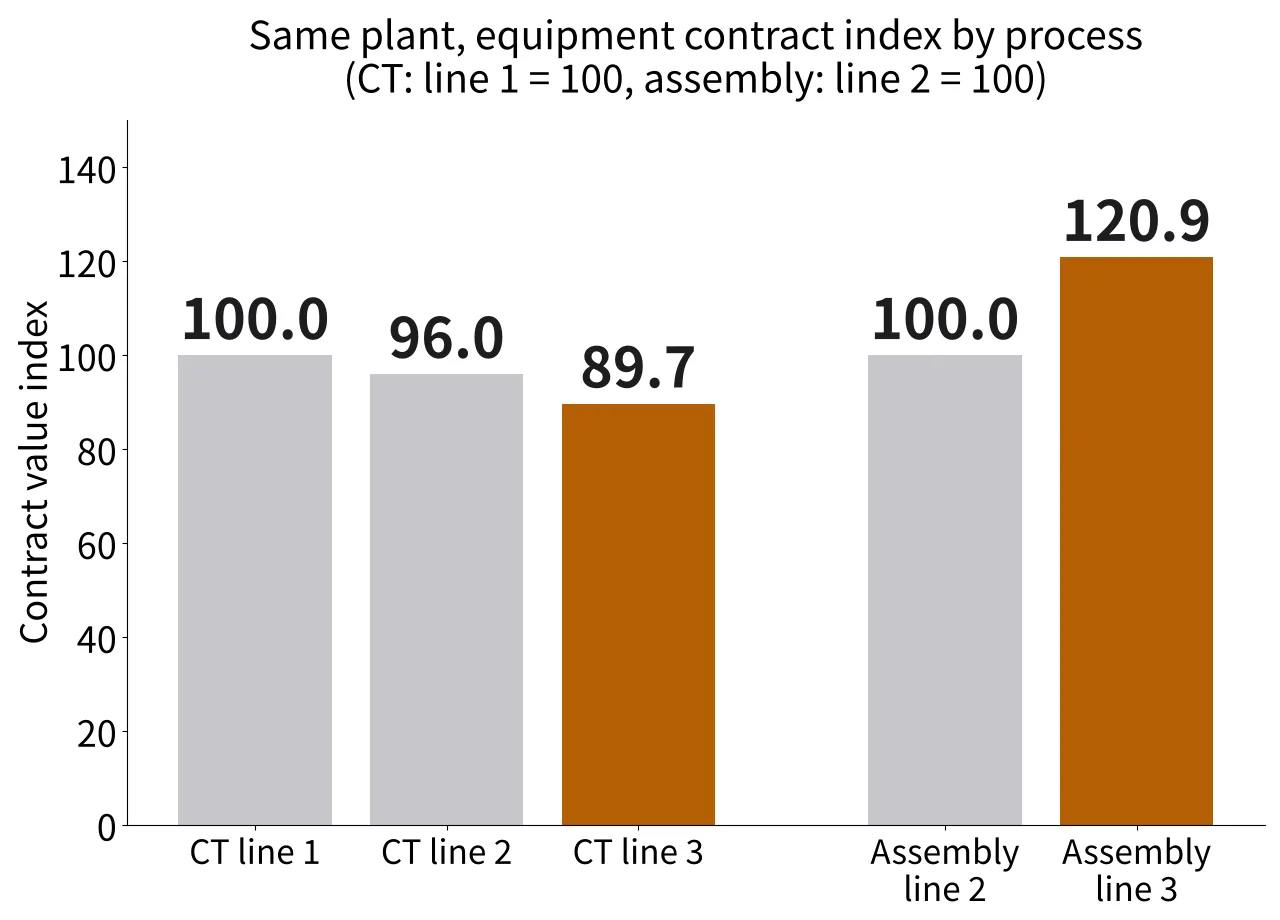
Read by bar height alone, the two kinds of equipment moved in opposite directions inside one plant. Still, the Phillenergy reports give notching and stacking only as examples, and nothing shows whether the line 2 and line 3 orders cover the same machine list. MOT’s machines serve jelly roll insertion, cap closing, welding and the laser cleaning before welding[2]. Whether MOT also supplied line 2 is not reported either, so the cell-count assembly steps cannot be compared across lines.
It is tempting to add up the disclosed orders and call the total the cost of a line. The three public orders for line 3 add up to 101.16 billion won. That is a lot of money. It is still not the whole line, and I don’t think it should be read as one. Electronic Times also named suppliers for electrolyte filling and battery box cooling parts without any value, and none of these reports mention electrode or formation equipment at all[4].
Contract terms end on two dates. Phillenergy runs to 1 April 2027 and MOT to 20 April 2027, a gap of 19 days or 1,641,600 s. Stacked electrode packs have to pass into MOT’s assembly machines before they become cells, so the interface9 between the two suppliers’ machines sets when the whole line can start commissioning. Nothing in the reports says a contract term equals an installation date, so the 19 days serve only as a reference.
Takt time for 273 Ah and 300 Ah side by side
Cell size explains the CT drop only if the takt math agrees, so I calculated the takt time10 for both lines. Demand here is the number of cells a line must release in a year, and the fixed definition applies: takt time = available operating time / customer demand quantity. For line capacity I assumed the roughly 12 GWh11 per LFP line that Electronic Times reported in June[4].
Energy per cell is capacity times voltage. With an assumed nominal LFP voltage of 3.2 V, a 273 Ah cell holds 873.6 Wh and a 300 Ah cell holds 960 Wh. Filling 12 GWh takes 13,736,264 cells a year at 273 Ah. At 300 Ah it takes 12,500,000. With an assumed 28,512,000 s of available time a year (330 days around the clock), takt time comes to 2.08 s and 2.28 s.
Neofab’s calculation note
Energy per cell = 273 Ah × 3.2 V = 873.6 Wh, 300 Ah × 3.2 V = 960 Wh
Cells per year = 12,000,000,000 Wh ÷ 873.6 Wh = 13,736,264, ÷ 960 Wh = 12,500,000
Takt time = available operating time / customer demand quantity = 28,512,000 s ÷ 13,736,264 = 2.08 s, ÷ 12,500,000 = 2.28 s
Machine ratio for cell-count steps = 2.08 ÷ 2.28 = 873.6 ÷ 960 = 0.910 (9.0 % fewer)
Disclosed CT order ratio = 49.5529 ÷ 55.2337 = 0.897 (10.3 % lower), gap 1.3 percentage points
Work ratio for area steps = 12 GWh ÷ 12 GWh = 1.00 (disclosed assembly ratio 861 ÷ 712 = 1.209)
Assumptions: line capacity 12 GWh a year, LFP nominal voltage 3.2 V, available time 28,512,000 s, CT scan time per cell independent of cell size, and the same electrode size and capacity per layer for area steps. The reports give neither line 3’s actual capacity nor its cell voltage.
Look at the fourth line of the note. If one CT scan takes the same time regardless of cell size, the number of CT machines scales inversely with takt time. That ratio equals the ratio of cell energies. A cell 9.9 % larger needs 9.0 % fewer cell-count machines, while the area steps keep the same work because total electrode area is tied to the 12 GWh.
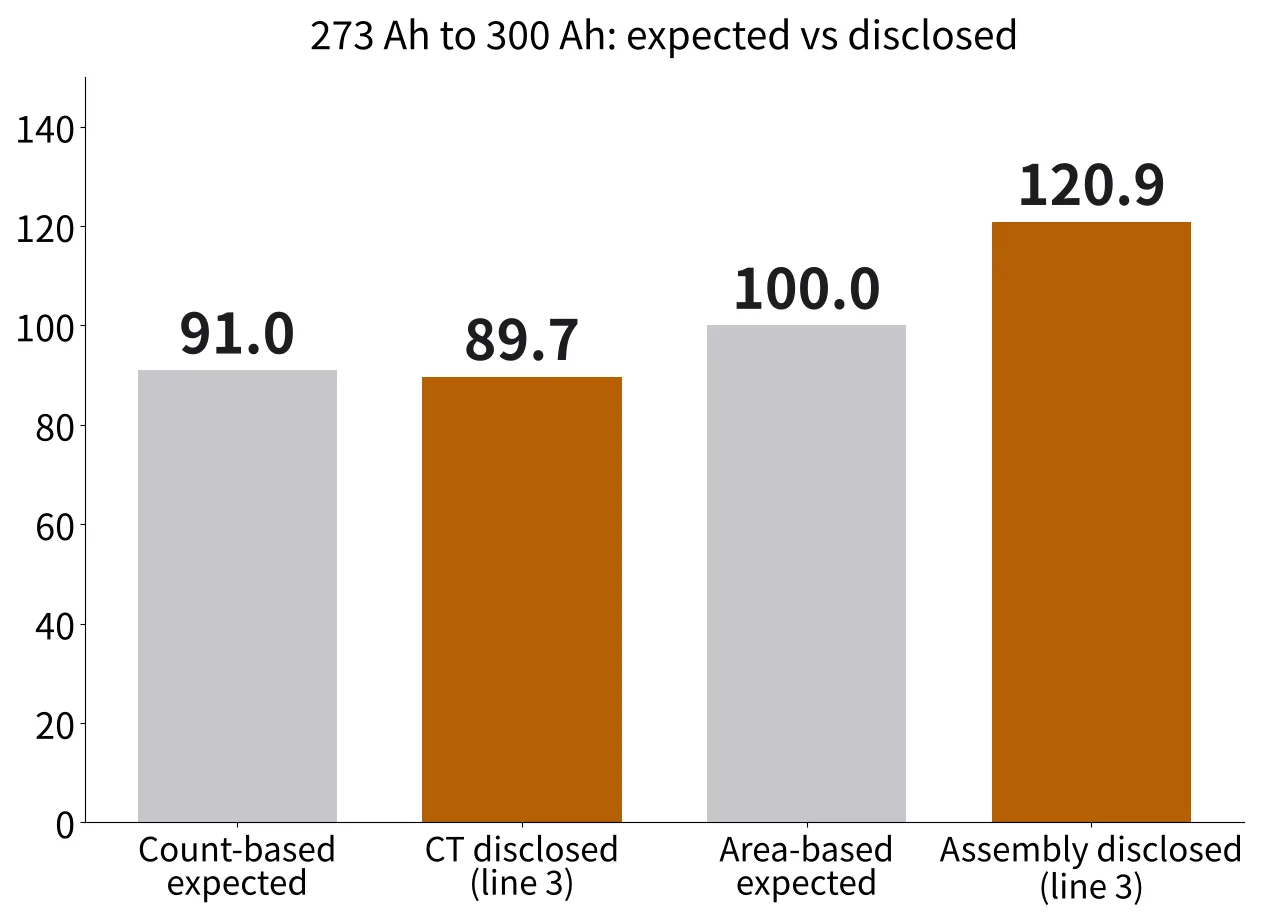
Each bar in the figure is indexed to the earlier line. My expected 91.0 and the disclosed 89.7 sit 1.3 percentage points apart. The expected 100 for area steps and the disclosed 120.9 for assembly sit far apart. You would not see this shape if both kinds of equipment followed the same rule.
A close match on CT does not prove cell size caused it. Unit prices may have dropped. Line 3’s order was also signed in dollars, at USD 3,578,863, so exchange rates are mixed in[3]. I read the 1.3-point gap only as no reason to drop the cell-size explanation. It is too early to call it confirmed.
Line 3 was rebalanced, and the numbers fit that reading
Line 3 is hard to read as a copy of line 1. Moving from 273 Ah class to 300 Ah class cells stretches takt time from 2.08 s to 2.28 s on the same 12 GWh. Cell-count steps can buy fewer machines. Area steps have to buy the same amount. The numbers fit a line whose machine count was reset step by step, and the 10.3 % CT drop lands 1.3 points from that calculation.
I think anyone reading the next line announcement at this plant should check the cell spec first. One spec change moves takt time by 9.9 %, and that change reaches each step’s equipment list at a different size. News that a plant added a line does not mean every equipment supplier gets the same share of extra work.
A 20.9 % rise in assembly orders does not fit this frame. Reports say only that line 2 makes large prismatic cells for Tesla, with no capacity given[3]. If line 2’s cells are larger than line 3’s, the area steps should still need the same work, so the increase more likely comes from order scope or machine count. Neither order’s machine list is public. Nothing more can be said from public data.
Here are the assumptions once more. The 12 GWh figure is June’s value for the planned LFP lines, and line 3’s capacity may have changed after it became a dedicated line for a new customer. As for voltage, 3.2 V is a common nominal value for LFP. If capacity and voltage are the same for both lines, though, the takt ratio depends only on the ratio of cell capacities, so the 9.0 % holds even if those two assumptions are off.
Two numbers would settle more of this. The first is the annual GWh in Samsung SDI’s main contract with the line 3 customer, which reports expect in the fourth quarter[3]. The second is the cell capacity on line 2. With that, the 71.2 and 86.1 billion won assembly orders can be divided by the same unit.
Frequently asked questions
Isn’t the 10.3 % lower CT order just a price cut?
It could be. A disclosed amount bundles the machine count and the unit price, and you cannot pull them apart from outside. My calculation shows only that cell-count steps need 9.0 % fewer machines when cells grow from 273 Ah class to 300 Ah class. The CT drop of 10.3 % lands close to that value, which does not rule out a price cut.
Bigger cells need bigger stackers, so isn’t a 21 % rise obvious?
A bigger machine is not the same thing as more machines on the line. With the same electrode design, the total electrode area stacked for 12 GWh barely depends on cell size. If each stacker slows down because cells get bigger, the line may need more stackers. Fewer cells also stretch takt time, though, and the two effects roughly cancel, so the work for area steps stays near 1.00.
What each reader can do
The six equipment orders for this plant are useful in different ways depending on where you sit.
| Reader | What to take away | What to try now |
|---|---|---|
| Job seekers | Moving from 273 Ah to 300 Ah stretches takt time from 2.08 s to 2.28 s, and a one-cell-at-a-time step such as CT needs 9.0 % fewer machines | Pick one assembly step you are curious about and write down whether it counts work by cell or by electrode area |
| General readers | Within one plant and one customer, line 3’s CT order can fall 10.3 % while its assembly order rises 20.9 % | When you read about a new line, check first whether the cell spec matches the earlier lines |
| Readers who follow the industry | The 101.16 billion won of public orders for line 3 leaves out electrode and formation equipment, so it is not the cost of the line | When the fourth-quarter contract gives line 3’s annual GWh, divide the equipment orders by it and keep the per-GWh figure |
This article is for information only and is not investment advice. See our Disclaimer.
Glossary
- LFP (lithium iron phosphate) — A cell chemistry that uses lithium iron phosphate in the cathode. Here it names the product of the energy storage lines. ↩
- Ah (ampere-hour) — A unit for the charge a cell can hold. This article uses it to compare cell sizes, and multiplying by voltage gives Wh. ↩
- Prismatic cell — A cell whose electrodes sit inside a rigid rectangular can. It is the format made on the plant’s storage lines. ↩
- Stacking — The step that piles cathode, separator and anode sheets into an electrode pack. This article treats it as a step whose work scales with electrode area. ↩
- Notching — The step that cuts electrode foil from a roll into the shape that goes into a cell. It sits right before stacking. ↩
- Jelly roll — The name for a stacked or wound electrode pack. Assembly puts it into the can, closes the cap and welds it shut. ↩
- CT inspection (computed tomography) — An X-ray scan from many angles that shows electrode alignment and foreign particles inside a cell. It scans one cell at a time, so this article treats it as a cell-count step. ↩
- Line balancing — Matching the machine count and workload of every step so the whole line releases products at one pace. ↩
- Interface — The point where one step, or one supplier’s machine, hands parts and signals to the next. Here it means the link between the stacking and assembly machines. ↩
- Takt time — How often a line must release one product to meet customer demand. Takt time = available operating time / customer demand quantity. More: How to calculate takt time ↩
- GWh (gigawatt-hour) — A unit of energy, where 1 GWh is 1,000,000,000 Wh. It describes a battery line’s size as the total energy of cells it makes in a year. ↩
Sources and notes
- The Elec (Kim Eun-kyu), “필에너지, 올해만 삼성SDI 美 ESS 장비 1500억 수주” (Phillenergy wins 150 billion won of Samsung SDI US storage equipment this year), 21 October 2026. Source of the 86.1 billion won line 3 order, the term to 1 April 2027 and the 71.2 billion won line 2 order in July. https://www.thelec.kr/news/articleView.html?idxno=64047
- The Elec (Kim Eun-kyu), “엠오티, 삼성SDI 美 LFP 배터리 3호 라인 장비 수주” (MOT wins equipment for Samsung SDI’s third US LFP line), 21 October 2026. Source of the 10.1 billion won order, the term to 20 April 2027 and the steps covered. https://www.thelec.kr/news/articleView.html?idxno=64079
- Lead Economy (Kim Jae-yoon), “삼성SDI, 中 선그로우 전용 LFP 라인 인디애나에 깔았다” (Samsung SDI installs an LFP line in Indiana dedicated to Sungrow), 11 September 2026. Source of the cell specs by line (line 1 273 Ah class, line 3 300 Ah class), the three Innometry CT orders, the dollar value of line 3 and the expected fourth-quarter contract. https://www.leadeconomy.co.kr/news/articleView.html?idxno=9684
- Electronic Times (Park Yu-min), “삼성SDI, 美 합작공장 ESS 전환 본격화…장비 발주 착수” (Samsung SDI speeds up the storage conversion of its US joint plant and starts ordering equipment), 24 June 2026. Source of about 12 GWh per LFP line, the suppliers by process and equipment build-out in the first half of 2027. https://www.etnews.com/20260624000157
- Assumed values: line capacity of 12 GWh a year (June’s LFP line figure applied to line 3), LFP nominal voltage of 3.2 V, available time of 28,512,000 s a year (330 days × 24 hours), CT scan time per cell independent of cell size, and the same electrode size and capacity per layer for area steps. The reports give neither line 3’s actual capacity, cell voltage or line 2’s cell capacity, nor the machine list in each order.
- Method: cells per year = 12 GWh ÷ energy per cell, takt time = available time ÷ cells per year, and the machine ratio for cell-count steps is the inverse ratio of the two takt times. The CT index uses line 1 as 100 and the assembly index uses line 2 as 100. Line numbers follow Lead Economy, and the June Electronic Times report describes the line setup differently.


You May Also Like
Edge AI Vision Inspection and Battery-Pack Leak Testing: How Gateway Aggregation Affects Traceability Completeness
Designing the Merge Point in a 10 GWh Pack-Container Integration Line: Synchronizing Two Upstream Lines and Sizing AGV Fleet from the Powertrac × Sunka Lead Order