-
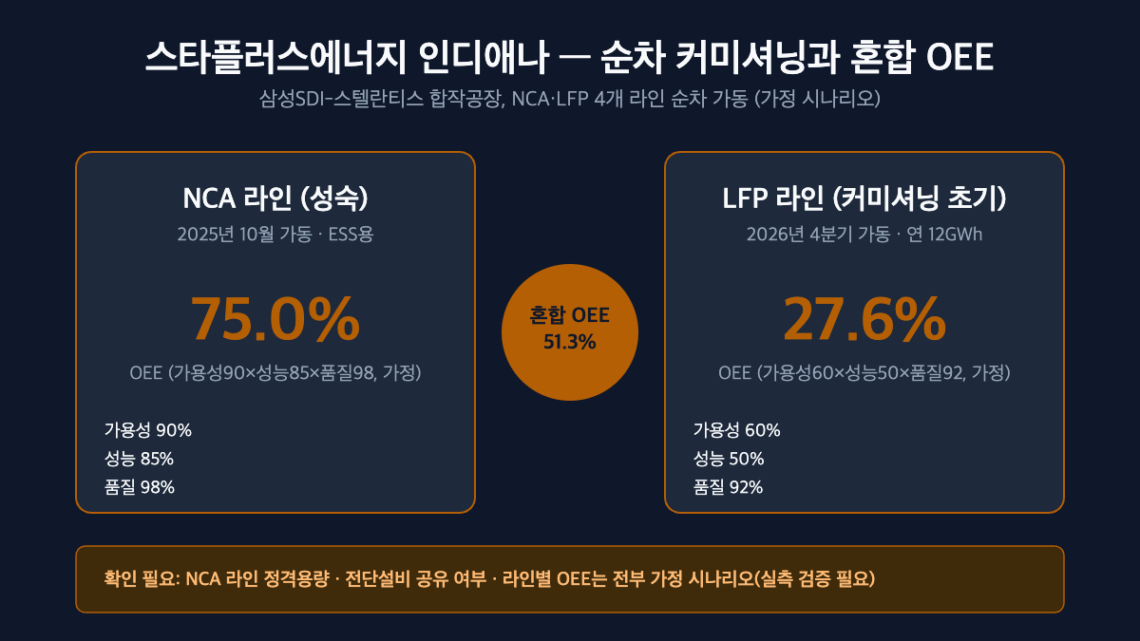
StarPlus Energy’s Indiana Plant — The Blended-OEE Illusion Created by Sequential NCA/LFP Commissioning
The Samsung SDI–Stellantis joint venture StarPlus Energy's Indiana (Kokomo) plant is bringing four lines online in sequence over 18 months: an NCA line starting October 2025, an LFP line (12 GWh/year) in Q4 2026, and additional NCA and LFP lines in Q1 2027. When lines of different chemistries (NCA, LFP) and end uses (EV, ESS) are commissioned at different times within a single site, a “Blended OEE” that sums the entire site into one number creates an illusion that obscures the actual performance of mature lines. This article back-calculates Takt Time from the publicly disclosed line-startup schedule and compares site-level blended metrics against line-level OEE under an assumed scenario. The…
-
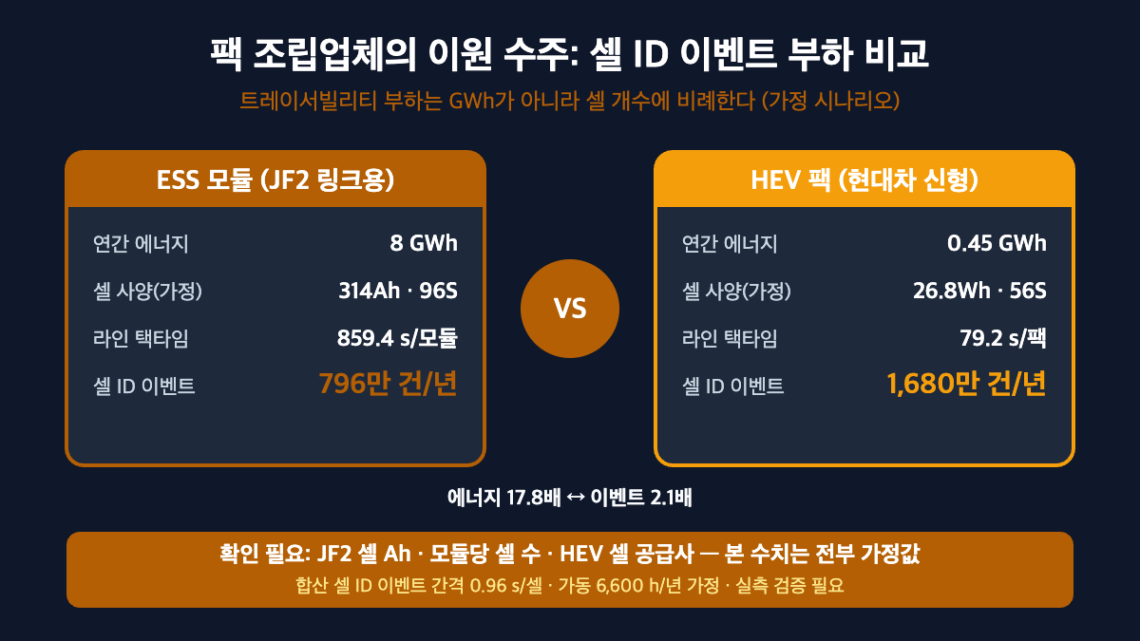
Sebang Lithium Battery’s Simultaneous HEV Pack and ESS Module Orders — Analyzing the Cell-Inbound Interface and Cell-ID Traceability Load
Sebang Lithium Battery simultaneously won orders for Hyundai Motor's new hybrid (HEV) battery packs and LG Energy Solution's new ESS (JF2) battery packs, together worth more than KRW 3 trillion (reported 2026-09-07). This article quantifies, under an assumed scenario, how the Cell Inbound Interface and Cell-ID Traceability load differ when a pack systems company that sources cells externally receives two heterogeneous product lines — automotive and grid-scale power — within a single organization. The conclusion is that the traceability system's load scales with cell count, not GWh. In the assumed scenario, the HEV pack, at 0.45 GWh/year, is only 1/17.8 the scale of the ESS module (8 GWh/year), yet its…
-
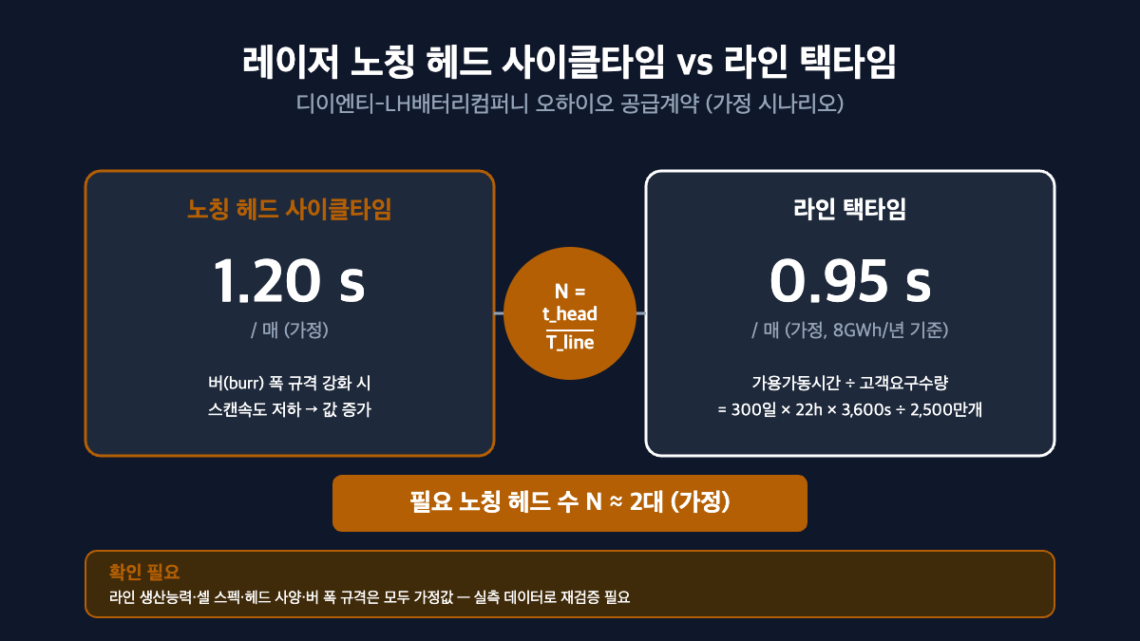
The Interface Between Laser Notching Cycle Time and Line Takt Time — The Head-Count Sizing Problem Revealed by DI ENT’s Ohio Supply Contract
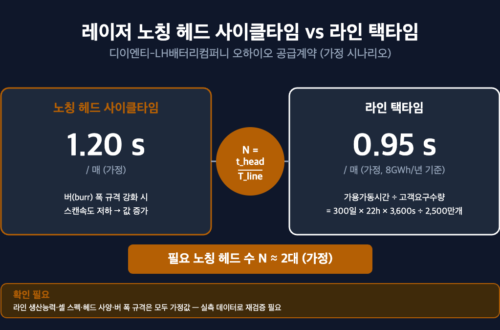
DI ENT signed laser notching equipment supply contracts worth a combined KRW 87.3 billion, across two separate orders, with LH Battery Company (an LG Energy Solution–Honda joint venture), for delivery to Honda’s new second battery plant in Ohio, USA, by March 2026. This supply contract is more than an order-win announcement — it surfaces an interface-design problem between the notching process’s cycle time and the line’s takt time. When the processing time of a single notching head is longer than the takt time the line requires, adding parallel heads becomes unavoidable, and as burr-width specifications are tightened, per-head processing time increases, causing the required head count to rise non-linearly. This…
-
Formation Channel Sizing Read from a Cell Assembly Equipment FAT — How 1 Second of Takt Time Moves 3,350 Channels
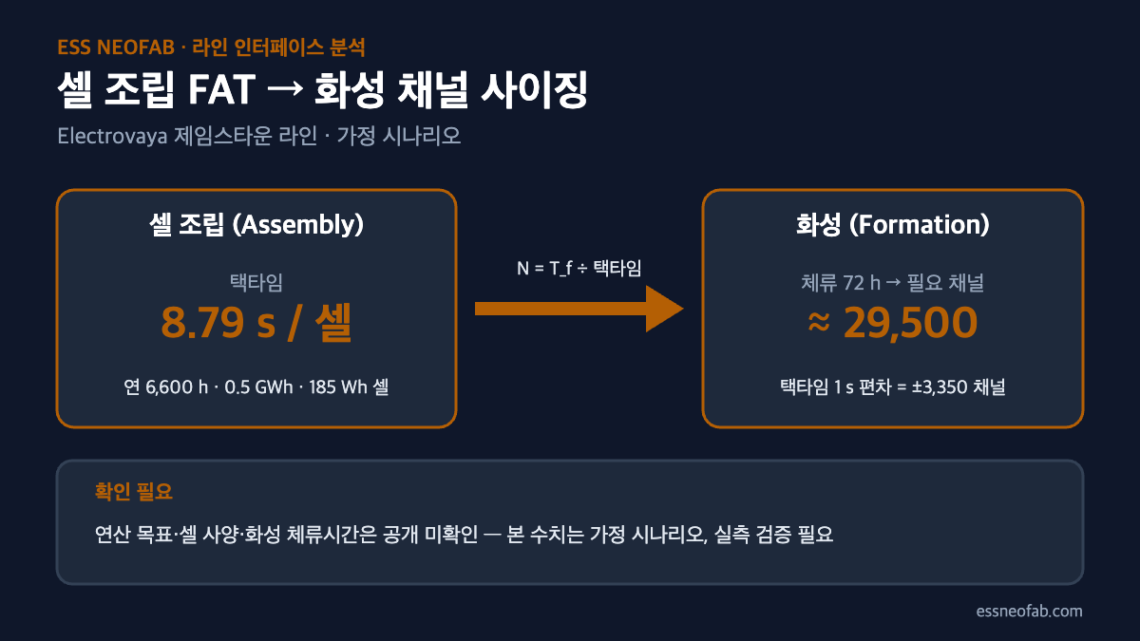
Electrovaya announced that on August 24, 2026, it began a Factory Acceptance Test (FAT) of automated cell-assembly and Formation equipment for its Jamestown, New York cell plant, to be followed after completion in early October by shipping and a Site Acceptance Test (SAT). This article reinterprets that FAT not as “equipment inspection” but as a sizing verification that absorbs, through the number of Formation channels, the takt-time mismatch between cell assembly — which moves at a second-by-second cadence — and Formation — which holds cells for hours at a time. Under an assumed scenario (0.5 GWh annual output, 185 Wh cells, 6,600 h/yr of operation, 72 h Formation dwell time),…
You May Also Like
SK On’s Dual-Site ESS Production Bases — Where Fixed Contracts and Variable Bidding Split Takt Time Design
Edge AI Vision Inspection and Battery-Pack Leak Testing: How Gateway Aggregation Affects Traceability Completeness
The Interface Between Laser Notching Cycle Time and Line Takt Time — The Head-Count Sizing Problem Revealed by DI ENT’s Ohio Supply Contract
-
128 MW of Distribution-Grid ESS Volume Allocated — Can the Battery Pack Assembly Line Absorb the Takt Time?
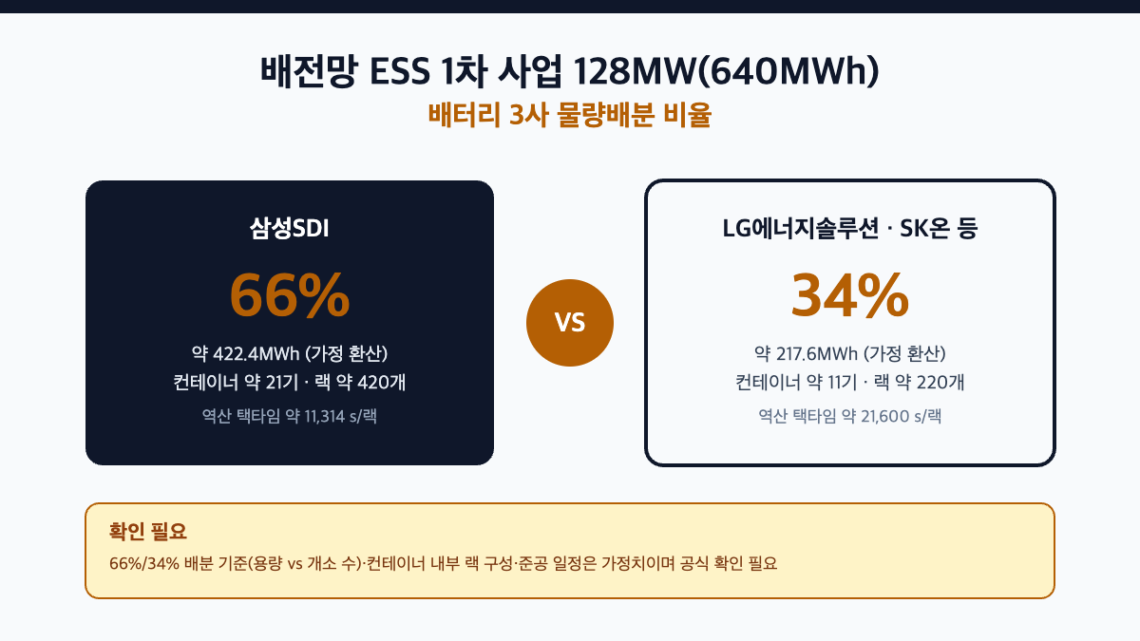
The Ministry of Climate, Energy and Environment’s Phase 1 distribution-grid ESS project — linked to additional renewable-energy interconnection — confirmed 9 operators and allocated a combined 128 MW (640 MWh) across 32 distribution feeders. Samsung SDI recorded the largest award at 66%, with LG Energy Solution and SK On splitting the remainder. This article converts that volume-allocation ratio into a load distribution across battery-pack assembly lines, and back-calculates, under an assumed scenario, how far the takt time diverges between operators. The conclusion is that a difference in procurement-volume ratio is carried straight through into a load imbalance at the production-line design stage, so Line Balancing review must be conducted together,…
You May Also Like
Introducing Robotic Automation Equipment — Where Does the Interface with Line Takt Time Break Down
Why three qualified products landed on the same duration — in DSX Ready BESS, sizing is set by the output axis
Grid-Forming PCS Mandate Redesigns FAT Takt Time and the BMS-PCS-EMS Interface
-
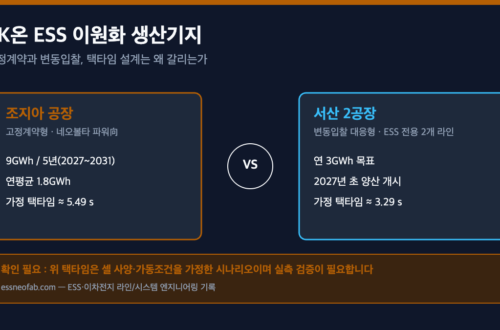
SK On’s Dual-Site ESS Production Bases — Where Fixed Contracts and Variable Bidding Split Takt Time Design
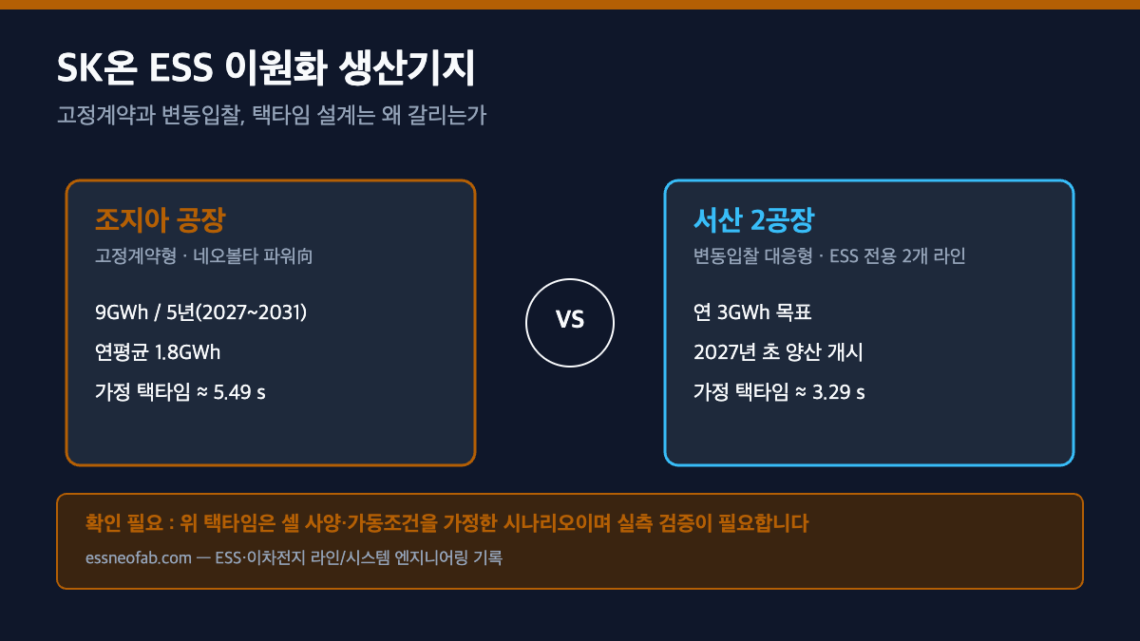
As of the second half of 2026, SK On is simultaneously pursuing two capacity-allocation efforts that look similar on the surface but differ sharply in character: a long-term fixed-contract ESS supply obligation from its Georgia, USA plant (9 GWh over 2027-2031 to NeoVolta Power), and a variable-bid-responsive capacity build at its domestic Seosan Plant 2, where 2 of 4 production lines are being converted to dedicated ESS-LFP pouch-cell lines. Both sites represent "ESS expansion" on paper, but the takt time (Takt Time) character each demands is different. Using publicly disclosed contract and conversion volumes, this article constructs an assumed scenario showing quantitatively that the fixed-contract site is better served by…
-
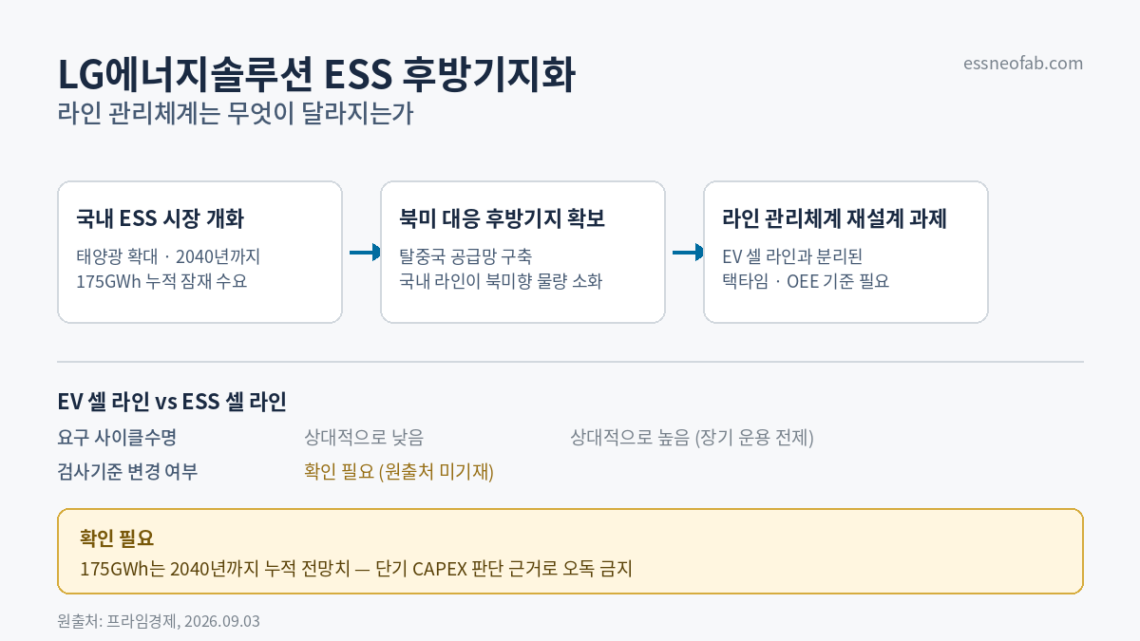
LG Energy Solution’s ESS Rear-Base Positioning — What Changes in Line Management
As Korea's domestic ESS market opens up, a trend is forming in which LG Energy Solution secures a role as a rear base responding to North American demand. Driven by solar power expansion, potential cumulative ESS battery demand of 175 GWh is projected through 2040, alongside attention to the effect of building a China-independent supply chain. However, absorbing this volume in domestic lines requires a takt time (Takt Time)¹ and OEE (Overall Equipment Effectiveness)² management system separate from existing EV cell lines, and the relevant detailed criteria are not given in the original source and require separate verification. 1. Situation and Challenge The opening of Korea's domestic ESS market is…
-
Introducing Robotic Automation Equipment — Where Does the Interface with Line Takt Time Break Down
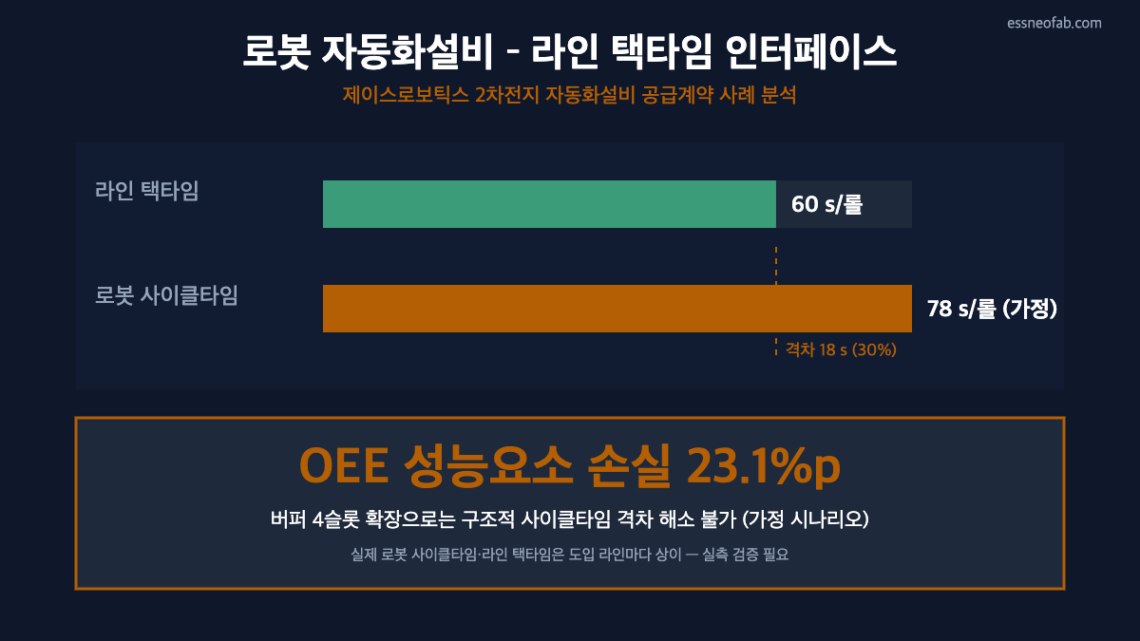
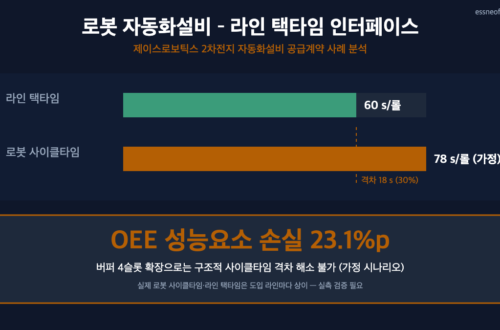
The supply contract disclosed by JS Robotics on September 2, 2026, worth roughly KRW 33.26 billion, for battery-manufacturing robotic automation equipment brings renewed attention to the Cycle Time-Takt Time gap that arises the moment new robotic equipment is connected to an existing R2R (Roll-to-Roll) line. This article calculates an assumed scenario in which one cycle of robotic automation equipment exceeds the line takt time, distinguishing the range of variation that buffer accumulation design can absorb from the structural gap it cannot. The analysis concludes that buffers absorb only micro-stop-level variation, and that a structural gap where the robot's own cycle time exceeds takt time translates directly into OEE performance-factor loss,…
You May Also Like
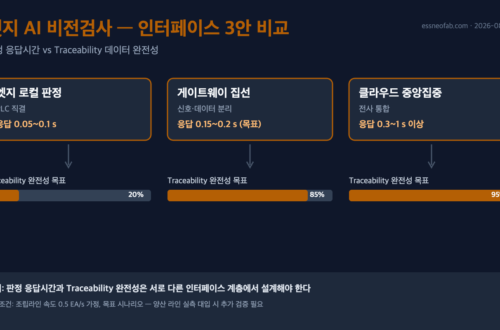
Edge AI Vision Inspection and Battery-Pack Leak Testing: How Gateway Aggregation Affects Traceability Completeness
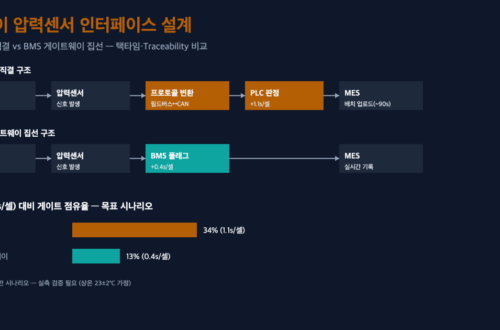
46-Phi Cylindrical Cell Line Conversion: The Pressure-Sensor–BMS Interface Determines Takt Time
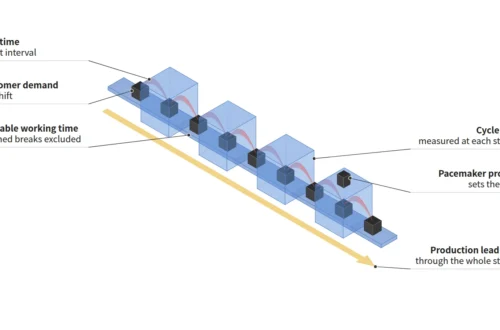
Don’t Subtract Breakdowns When Calculating Takt Time — Takt Time vs. Cycle Time vs. Lead Time
-
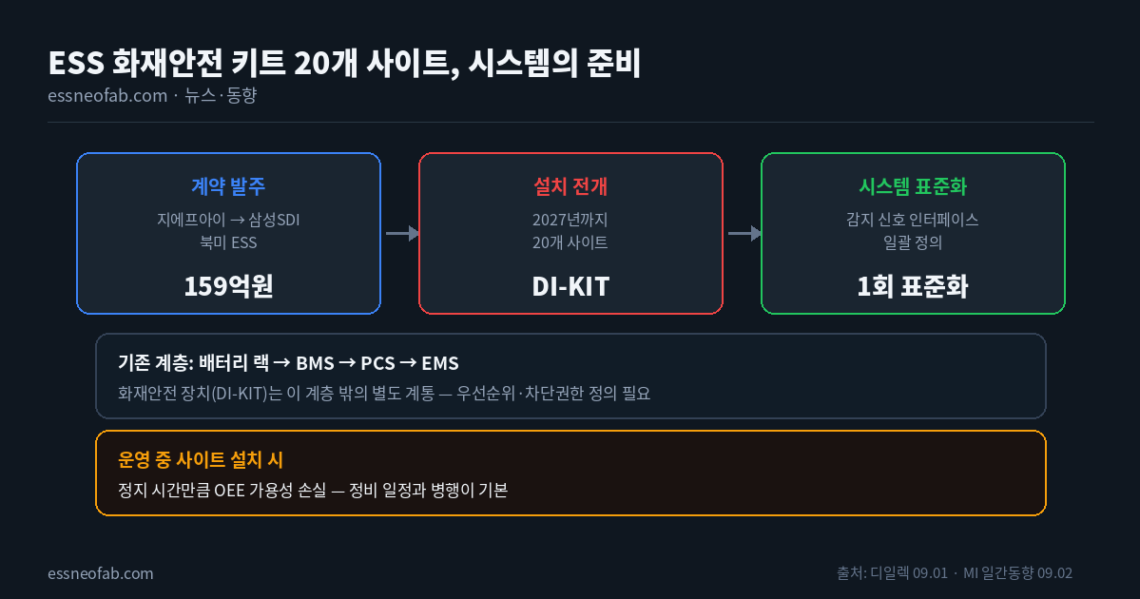
ESS Fire-Safety Kits Across 20 Sites — What the System Must Prepare
GFI has won a KRW 15.9 billion contract for Samsung SDI's North American ESS fire-safety solution. It will install DI-KIT at 20 sites by 2027. This contract shows that fire-safety devices are being ordered not as a cell-level option but as a site-level system line item. On the operations side, what is needed first is defining the installation sequence across the 20 sites and the interface with existing systems. 1. What Happened To state the conclusion first: ESS fire-safety solutions have moved into a phase of being applied in bulk across multiple sites. Until now, the general approach for North American ESS was to address site-specific safety requirements individually. Bundling…
You May Also Like
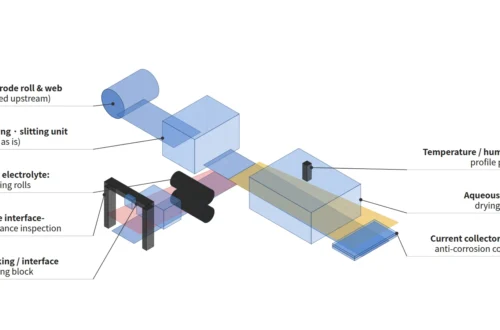
Solid Electrolyte and Aqueous Zinc Batteries: Investment Is Up — Is the Line Ready?
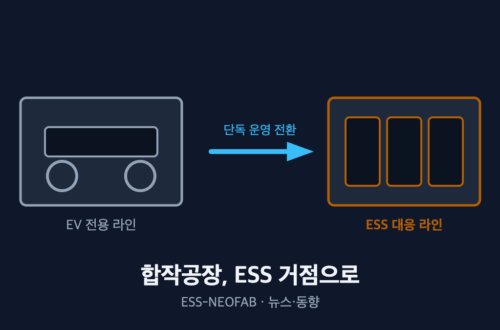
Samsung SDI Turns Its GM Joint-Venture Plant Into an ESS Hub
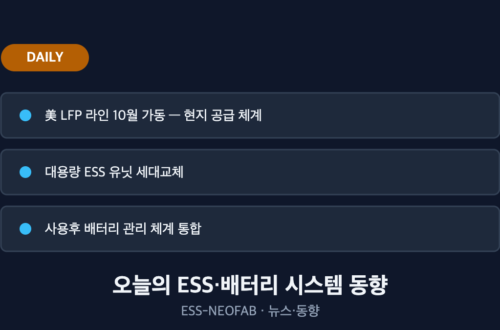
Today’s ESS/Battery System Trends — U.S. LFP Mass Production Imminent, Megapack 3 Launched, Used-Battery Platform Integration (2026.08.11)
-
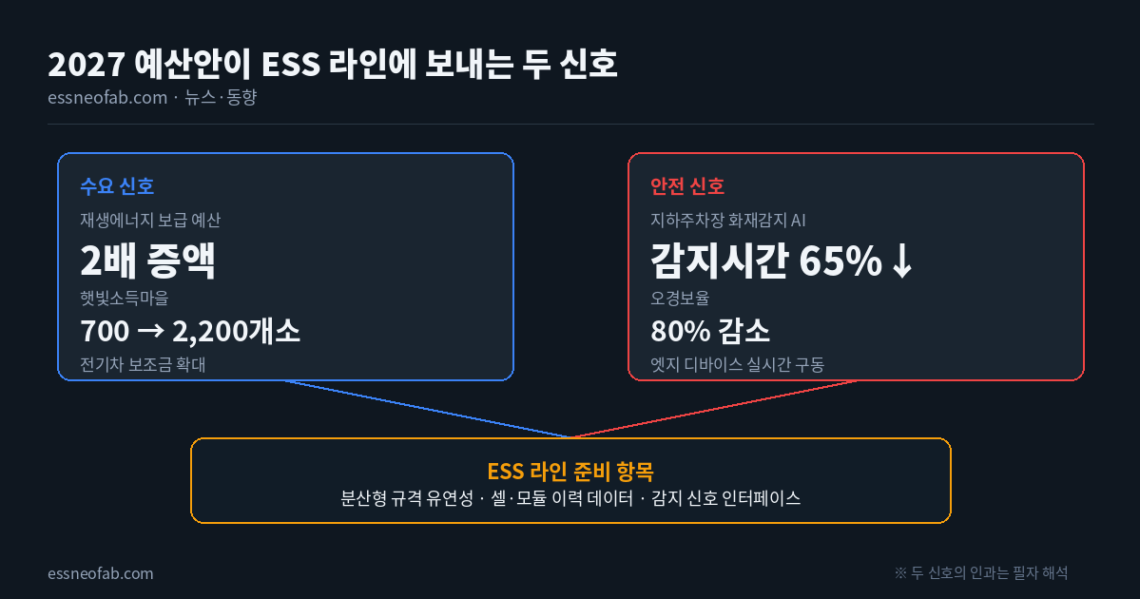
Doubling the Renewable-Energy Budget and Underground-Parking EV Fire-Detection AI — Two Signals the 2027 Budget Sends to the ESS Line
The 2027 government budget doubles the renewable-energy deployment budget, expands "Sunlight Income Villages" from 700 to 2,200 sites, and expands EV subsidies (Source 1). During the same period, an AI model for early detection of EV fires in underground parking garages has been developed domestically to the point of running in real time on edge devices (Source 2). This article reads the two items from an ESS¹ line/system perspective — as a demand signal and a safety signal, respectively — and sets out what the line side should prepare. The conclusion is that "as distributed generation increases, ESS demand increases, but expanded installation is accompanied by tightening fire-safety standards"; this…
You May Also Like
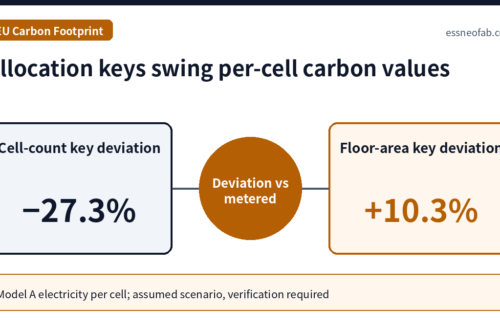
EU Battery Carbon Footprint Methodology Still Pending: How Line Energy Metering Resolution and Allocation Choice Shift Per-Cell Values
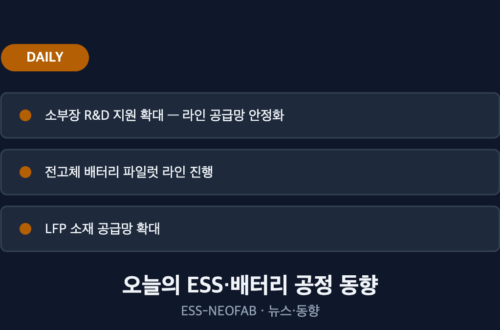
Today’s ESS/Battery Process Trends — Expanded Support for Materials/Parts/Equipment Lines, Solid-State/LFP Pilot Lines Launch (2026.08.07)
Today’s ESS/Battery System Trends — U.S. LFP Mass Production Imminent, Megapack 3 Launched, Used-Battery Platform Integration (2026.08.11)