-
The Equipment Maker’s Line-Ownership Shift — OEE and Takt-Time Design During the ESS-LFP New-Line Mass-Production Ramp-Up
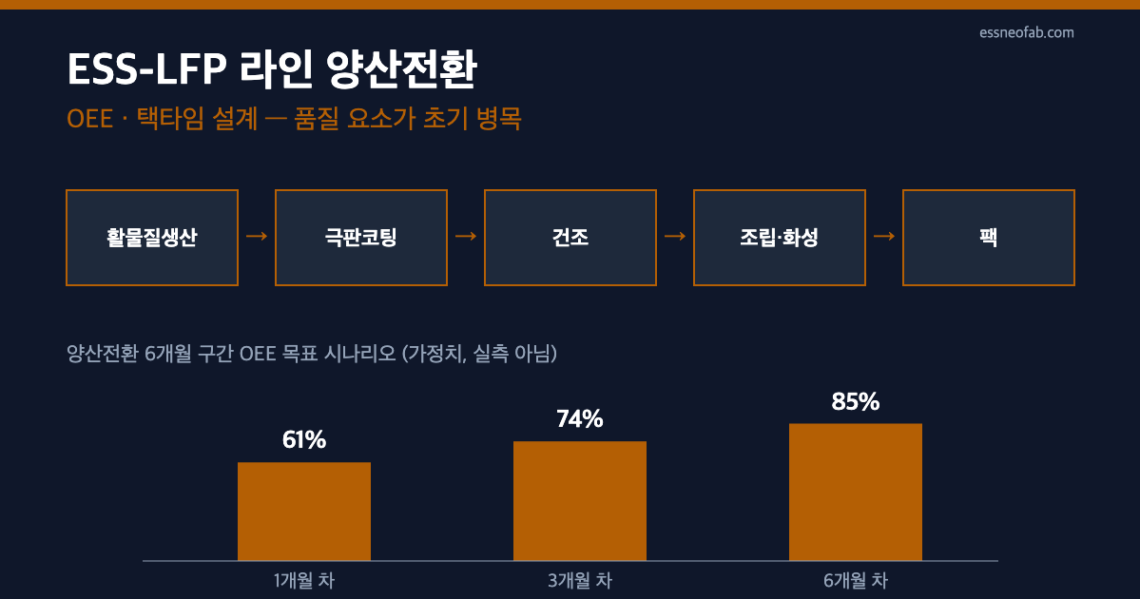
As more equipment suppliers directly operate their own ESS-LFP lines, a need has emerged to review line balancing and OEE management during the mass-production ramp-up separately from equipment-buyer-owned lines. Prompted by domestic equipment maker PNT's May 2026 earnings announcement, in which it stated it is focusing on yield stabilization for its Plant 4 ESS-LFP battery/cathode-active-material production line with a target of mass-production conversion in the second half of 2026, this article designs and verifies a target scenario for the order in which the three OEE factors — Availability, Performance, and Quality — improve during a ramp-up phase in which both new materials and a new line are introduced simultaneously. It…
You May Also Like
CATL Starts Trial Production in Debrecen — The Digits of the Defect-Rate Target, Not the Equipment, Set the Length of a Trial Run
Five million ACC cells equal 2.7 to 3.6 months of nameplate output
45 Days from Pohang to Georgia — Safety Stock at an Intercontinental Cathode Interface Is Driven by Lead-Time Variability, Not Demand
-
Embedding an AI Vision Inspection Gate in the Line: Redefining OEE and Takt-Time Design Variables
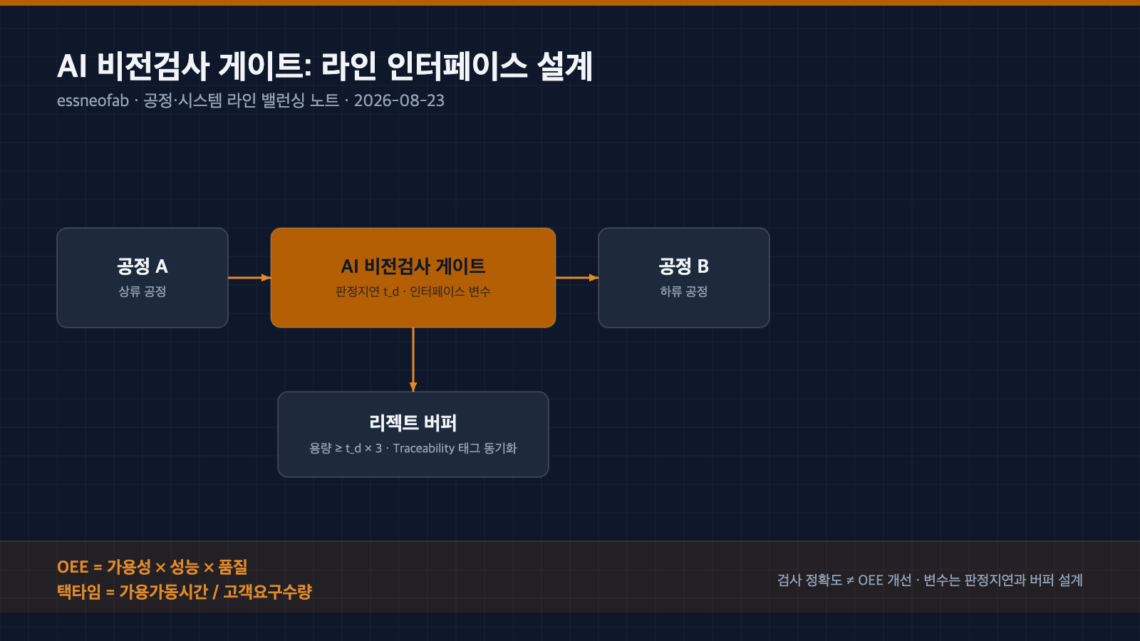
Across battery-line procurement specifications from 2024 to 2026, a trend is confirmed in which the Cognex, Keyence, ISRA, and MVTec deep-learning vision-inspection platforms have effectively become standard fixtures. However, only inspection-accuracy specs are typically stated, while the effect an AI vision-inspection gate has on the line's overall OEE performance rate and takt-time variance is often not treated as a separate design item. This article redefines the AI vision-inspection gate as two interface variables — judgment delay and reject-merge point — and addresses the procedure for incorporating them into line-balancing calculations. To state the conclusion first, it is not the accuracy of the AI vision inspection itself, but the buffer-capacity design…
You May Also Like
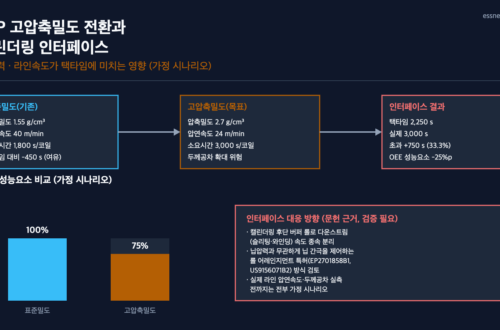
LFP High-Compaction-Density Conversion and the Calendering Interface: How Nip Pressure and Line Speed Affect Takt Time
45 Days from Pohang to Georgia — Safety Stock at an Intercontinental Cathode Interface Is Driven by Lead-Time Variability, Not Demand
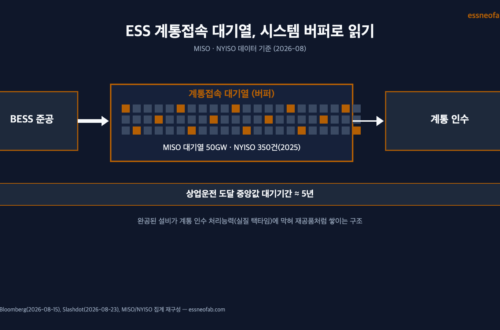
Re-Reading the ESS Grid-Interconnection Queue in the Language of Line Balancing
-
ESS Assembly Line: Why Immersion Cooling Becomes a Bottleneck
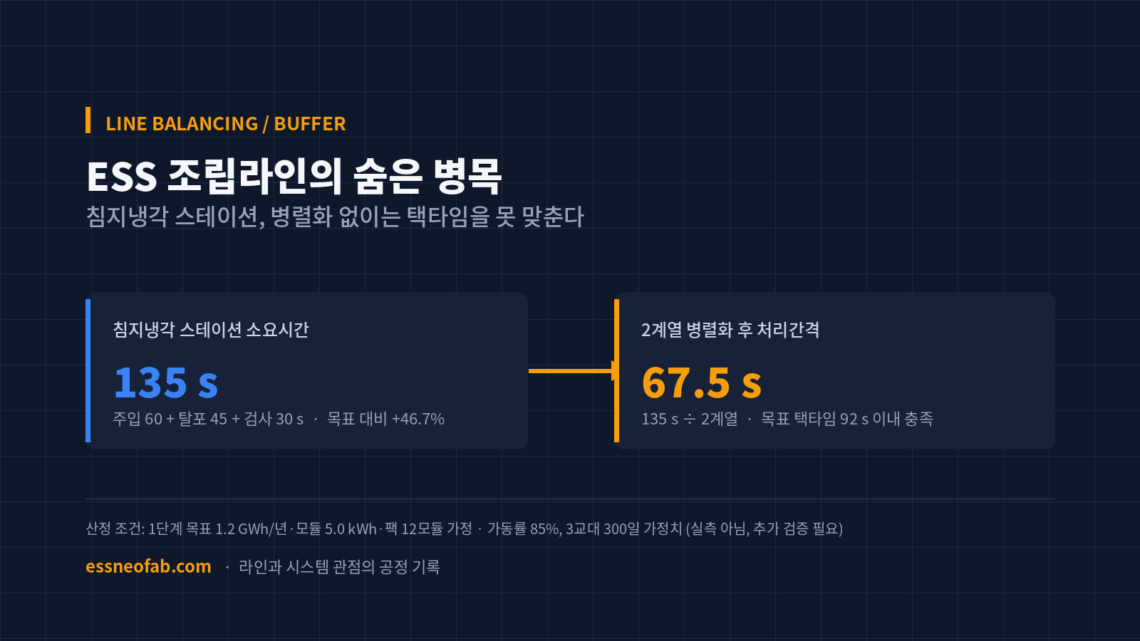
This article addresses the line-balancing problem that arises when immersion cooling and AI cell monitoring are simultaneously integrated in-line into an ESS module-pack assembly line. Under the estimation scenario, the immersion-cooling station's process time is 135 s, exceeding the target module takt time of 92 s by 46.7%, making a bottleneck unavoidable with a single-station configuration. Parallelizing into 2 lines lowers the effective processing interval to 67.5 s, satisfying the takt-time condition, but this in turn raises the FIFO buffer size at the point where the two lines merge, and the module-serial tagging of AI monitoring data, as new interface risks. This estimation is a scenario based on assumed values…
You May Also Like
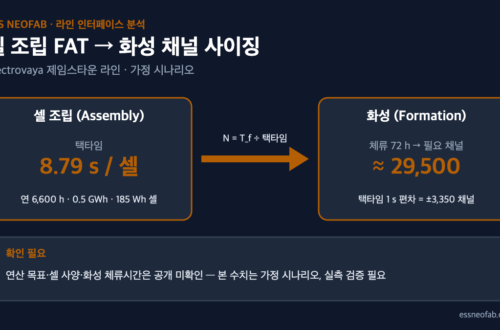
Formation Channel Sizing Read from a Cell Assembly Equipment FAT — How 1 Second of Takt Time Moves 3,350 Channels
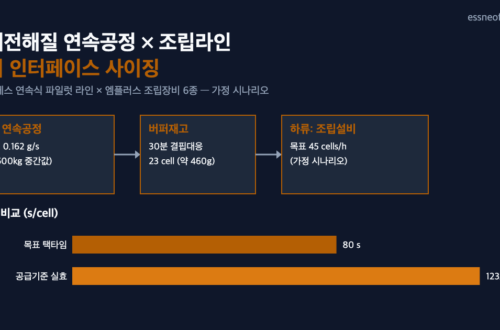
Between the Continuous Solid-Electrolyte Process and the Assembly Line: How Should the Buffer Interface Be Designed?
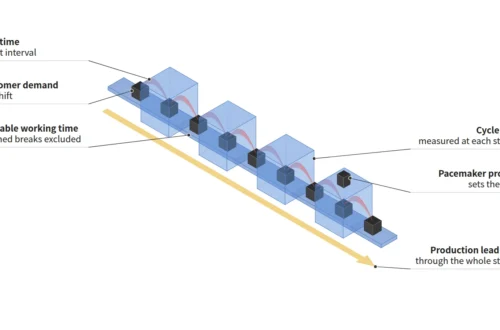
Don’t Subtract Breakdowns When Calculating Takt Time — Takt Time vs. Cycle Time vs. Lead Time
-
Converting EV Lines to ESS: Where Does OEE Break Down?
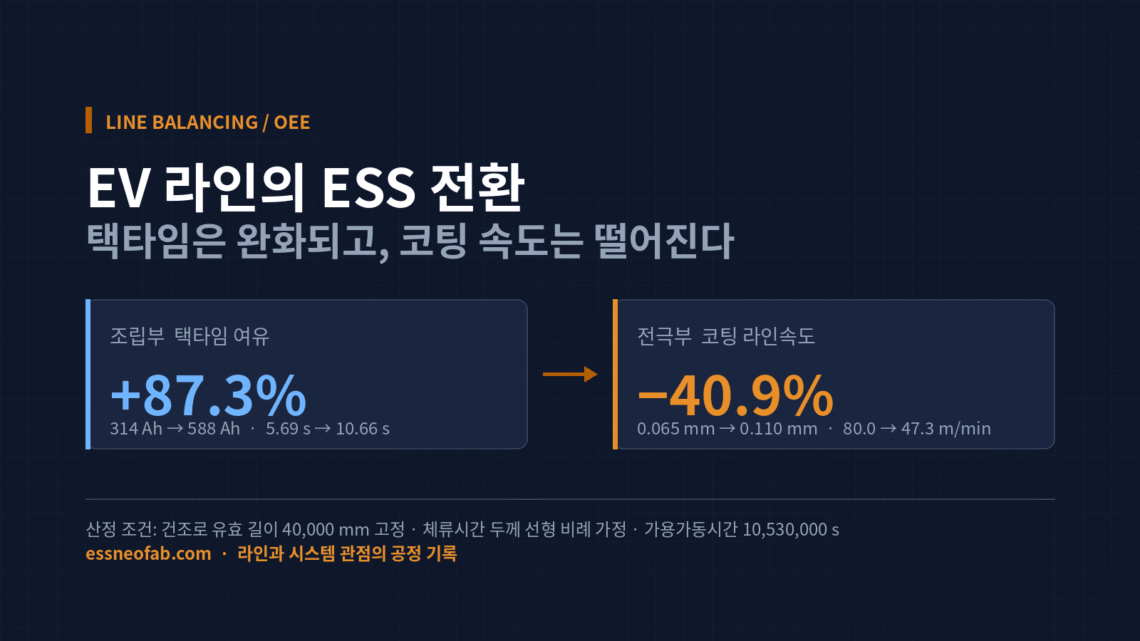
When converting an EV cell line for ESS use, retrofit effort and budget tend to concentrate on the assembly process. However, when a thick-film electrode and a large prismatic cell format are applied simultaneously while the drying-oven length remains fixed, the takt-time margin in the assembly section increases by 87.3% while the coating-section line speed drops by 40.9%. The conversion bottleneck shifts from assembly to the electrode section, and CAPEX priority should be reallocated accordingly. Furthermore, failing to update the abnormal-cycle-time baseline by part number books up to 36.3 percentage points of phantom performance loss into OEE, causing the improvement organization to chase a loss that does not exist. 1.…
You May Also Like
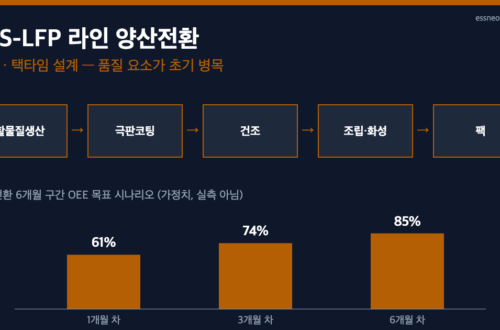
The Equipment Maker’s Line-Ownership Shift — OEE and Takt-Time Design During the ESS-LFP New-Line Mass-Production Ramp-Up
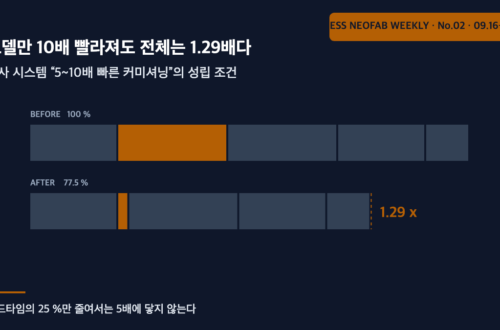
Even a tenfold faster model moves the whole by 1.29x — what “5 to 10 times faster commissioning” actually requires
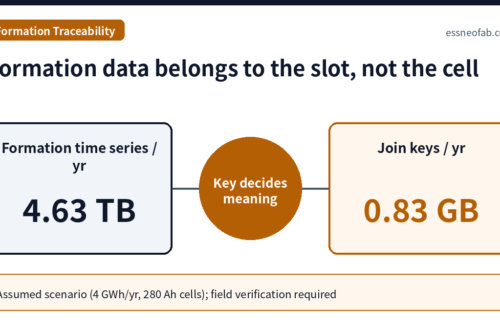
Linking Cell History in Formation and Aging: History Contamination from Tray ID + Slot Mapping
-
Converting EV Lines to ESS: What the H1 Utilization Gap Reveals About Line-Conversion Speed
In H1 2026, utilization rates at the three major domestic battery makers' plants diverged based on how quickly each converted its lines to ESS use amid weak EV demand. LG Energy Solution and Samsung SDI sharply raised utilization through faster conversion and by securing new demand outlets (ESS, BBU), while SK On's utilization actually declined due to delayed conversion. This is not a matter of individual equipment performance, but of the speed of line-level decision-making. This article compares the three companies' utilization changes from a line-reconfiguration perspective. 1. What Happened U.S. EV demand is weak. The three battery makers all faced the same market environment. So why did their utilization…
-
Dry Electrode: Where Does the Line Bottleneck Move?
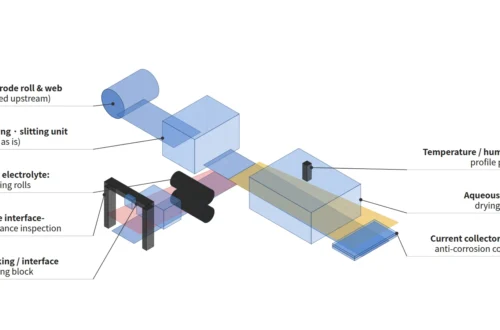
Converting to a dry electrode process eliminates the drying-oven section of a wet-coating line, but the claim that this improvement, by itself, shortens line takt time does not hold. When both the physical length and the time buffer that the drying oven provided disappear at once, the bottleneck shifts to the electrode-formation/lamination section and the quality-inspection section, and the degrees of freedom available for buffer design actually shrink. Separately, an industrial-park zoning deregulation announced in August 2026 adds battery-recycling businesses to the eligible occupants of the Gumi and Pohang national industrial complexes, changing the logistics-interface conditions outside the line. This article examines both changes together at the line/system level, and…
You May Also Like
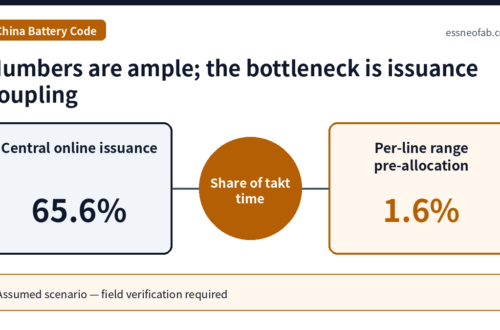
China’s GB/T 34014 24-Character Battery Code: How Code Structure Fixes Issuance Timing and Authority on the Line
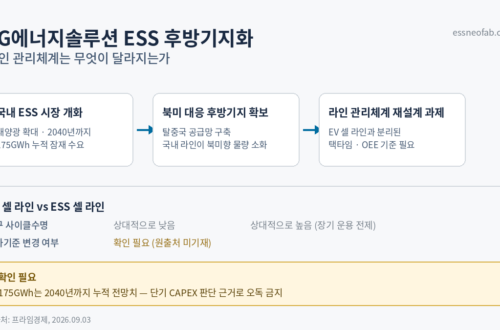
LG Energy Solution’s ESS Rear-Base Positioning — What Changes in Line Management
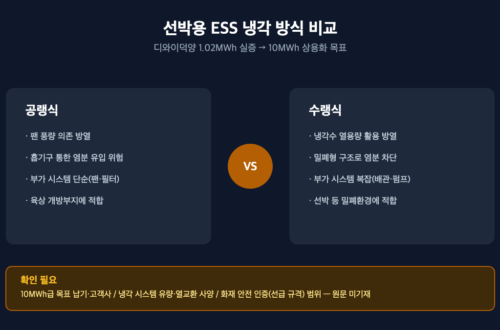
DY Duckyang’s 10 MWh-Class Marine ESS — What the Water-Cooled Demonstration Means for System Design
-
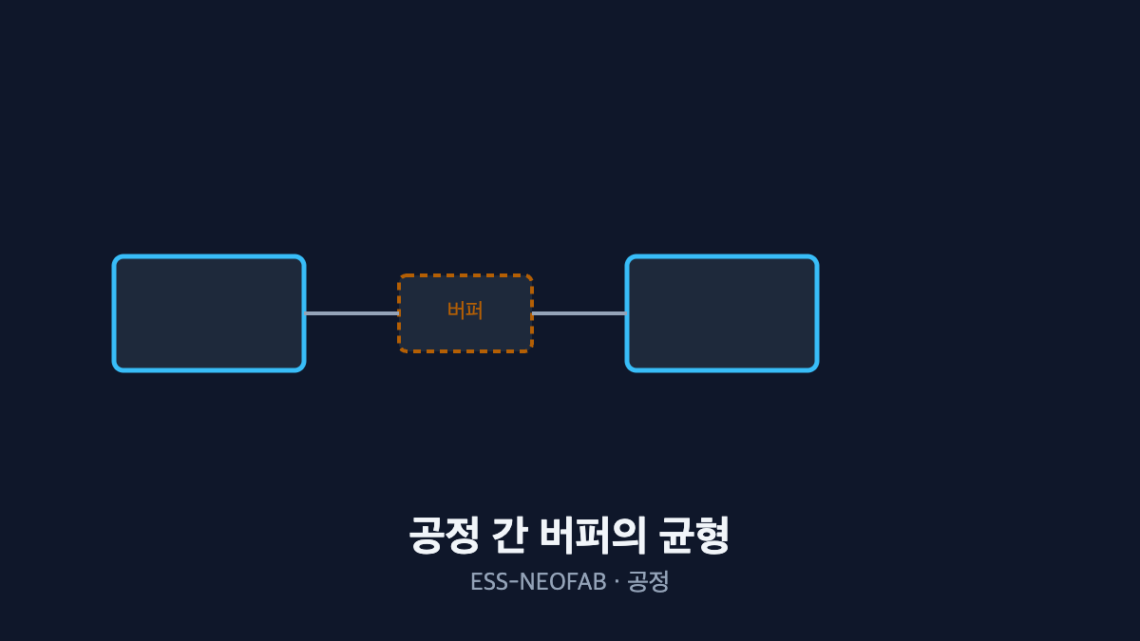
Inter-Process Buffers: Bigger Isn’t Always Better
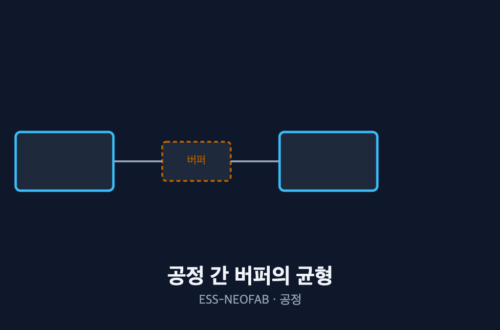
An inter-process buffer (work-in-process inventory) is not a device that gets safer as it grows. It is a range problem, bounded below by what availability demands and above by what quality tolerates. Under the assumed line conditions below, the availability-driven minimum is 2 coils while the quality-driven maximum is 1 coil — the two bounds conflict. That conflict is not resolved by enlarging or shrinking the buffer; it is resolved by reducing upstream MTTR (Mean Time To Repair) or by moving the defect-detection point ahead of the buffer. Every figure below is an assumed value set for illustration, and applying it 1:1 to a mass-production line requires separate verification. 1.…
You May Also Like
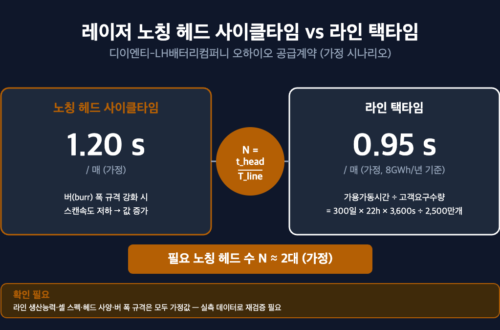
The Interface Between Laser Notching Cycle Time and Line Takt Time — The Head-Count Sizing Problem Revealed by DI ENT’s Ohio Supply Contract
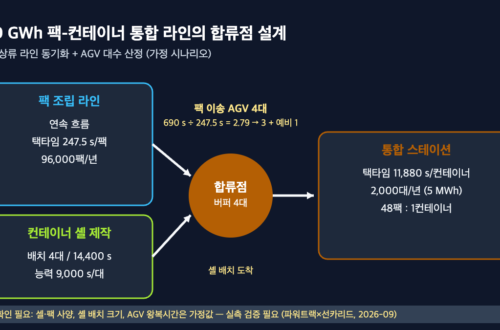
Designing the Merge Point in a 10 GWh Pack-Container Integration Line: Synchronizing Two Upstream Lines and Sizing AGV Fleet from the Powertrac × Sunka Lead Order
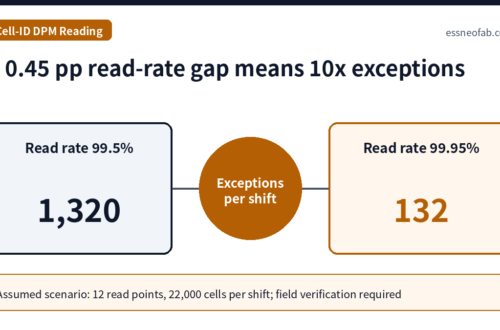
Cell-ID Laser DPM Read Rate 99.5% vs 99.95%: How No-Reads Drive Exceptions per Shift and OEE