-
StarPlus Energy’s Indiana Plant — The Blended-OEE Illusion Created by Sequential NCA/LFP Commissioning
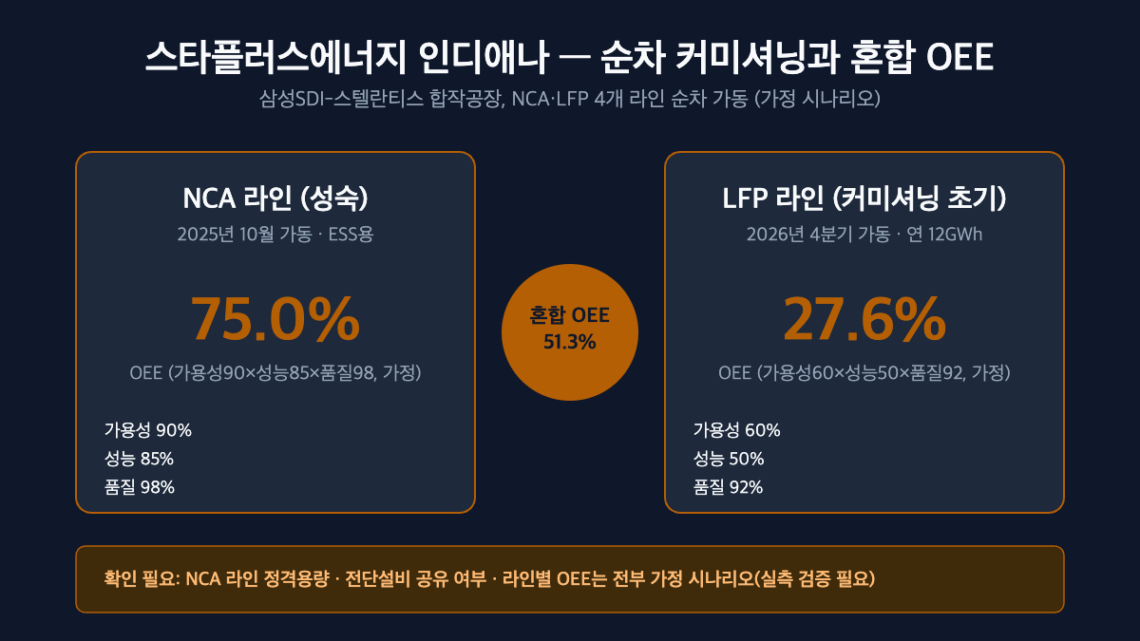
The Samsung SDI–Stellantis joint venture StarPlus Energy's Indiana (Kokomo) plant is bringing four lines online in sequence over 18 months: an NCA line starting October 2025, an LFP line (12 GWh/year) in Q4 2026, and additional NCA and LFP lines in Q1 2027. When lines of different chemistries (NCA, LFP) and end uses (EV, ESS) are commissioned at different times within a single site, a “Blended OEE” that sums the entire site into one number creates an illusion that obscures the actual performance of mature lines. This article back-calculates Takt Time from the publicly disclosed line-startup schedule and compares site-level blended metrics against line-level OEE under an assumed scenario. The…
You May Also Like
46-Phi Cylindrical Cell Line Conversion: The Pressure-Sensor–BMS Interface Determines Takt Time
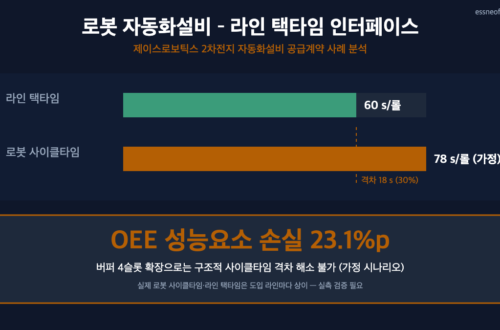
Introducing Robotic Automation Equipment — Where Does the Interface with Line Takt Time Break Down
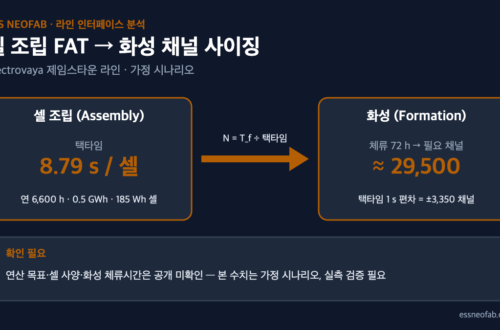
Formation Channel Sizing Read from a Cell Assembly Equipment FAT — How 1 Second of Takt Time Moves 3,350 Channels
-
128 MW of Distribution-Grid ESS Volume Allocated — Can the Battery Pack Assembly Line Absorb the Takt Time?
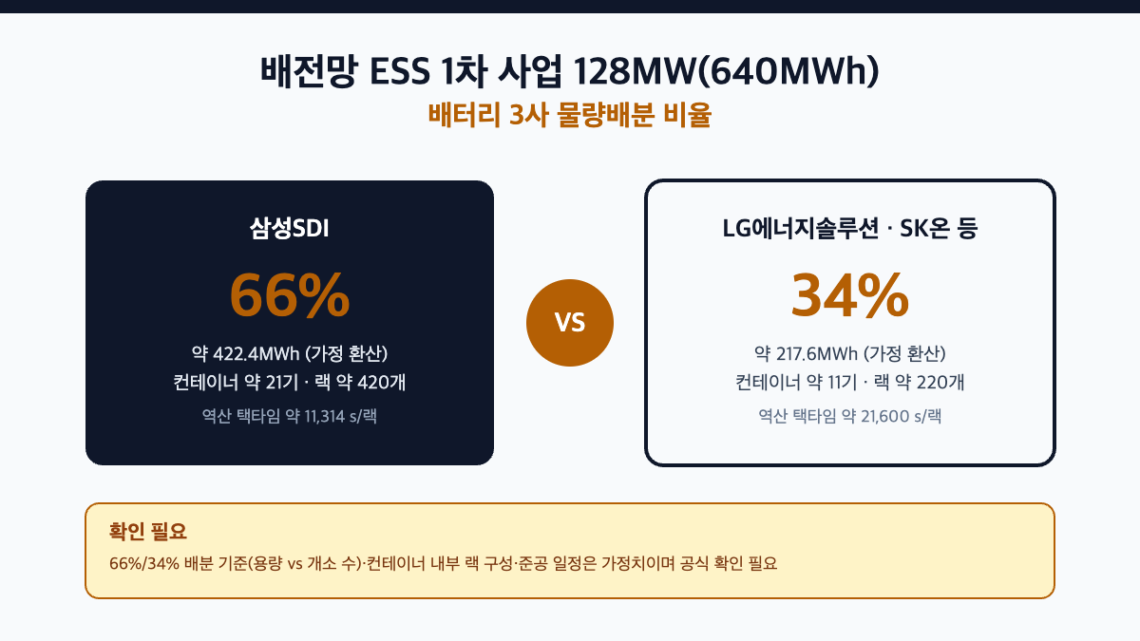
The Ministry of Climate, Energy and Environment’s Phase 1 distribution-grid ESS project — linked to additional renewable-energy interconnection — confirmed 9 operators and allocated a combined 128 MW (640 MWh) across 32 distribution feeders. Samsung SDI recorded the largest award at 66%, with LG Energy Solution and SK On splitting the remainder. This article converts that volume-allocation ratio into a load distribution across battery-pack assembly lines, and back-calculates, under an assumed scenario, how far the takt time diverges between operators. The conclusion is that a difference in procurement-volume ratio is carried straight through into a load imbalance at the production-line design stage, so Line Balancing review must be conducted together,…
You May Also Like
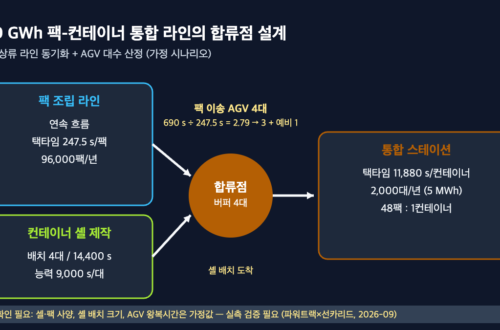
Designing the Merge Point in a 10 GWh Pack-Container Integration Line: Synchronizing Two Upstream Lines and Sizing AGV Fleet from the Powertrac × Sunka Lead Order
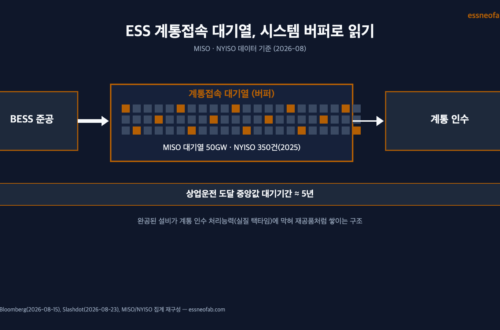
Re-Reading the ESS Grid-Interconnection Queue in the Language of Line Balancing
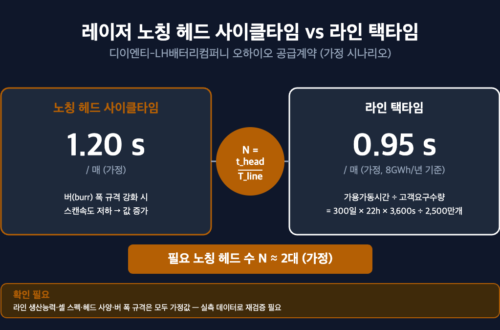
The Interface Between Laser Notching Cycle Time and Line Takt Time — The Head-Count Sizing Problem Revealed by DI ENT’s Ohio Supply Contract
-
SK On’s Dual-Site ESS Production Bases — Where Fixed Contracts and Variable Bidding Split Takt Time Design
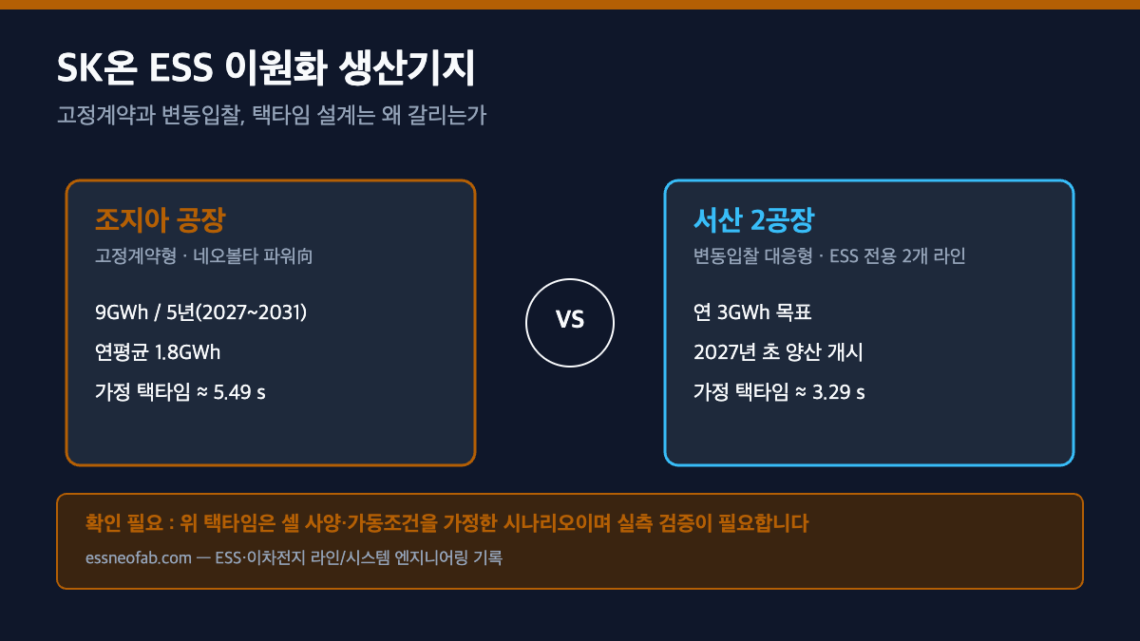
As of the second half of 2026, SK On is simultaneously pursuing two capacity-allocation efforts that look similar on the surface but differ sharply in character: a long-term fixed-contract ESS supply obligation from its Georgia, USA plant (9 GWh over 2027-2031 to NeoVolta Power), and a variable-bid-responsive capacity build at its domestic Seosan Plant 2, where 2 of 4 production lines are being converted to dedicated ESS-LFP pouch-cell lines. Both sites represent "ESS expansion" on paper, but the takt time (Takt Time) character each demands is different. Using publicly disclosed contract and conversion volumes, this article constructs an assumed scenario showing quantitatively that the fixed-contract site is better served by…
You May Also Like
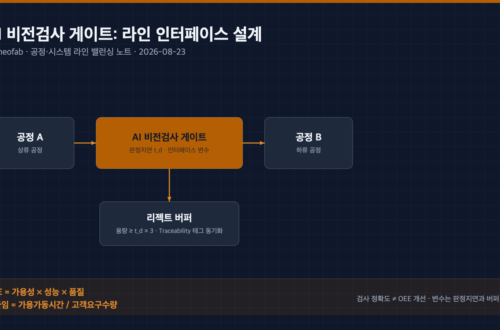
Embedding an AI Vision Inspection Gate in the Line: Redefining OEE and Takt-Time Design Variables
Re-Reading the ESS Grid-Interconnection Queue in the Language of Line Balancing
The Interface Between Laser Notching Cycle Time and Line Takt Time — The Head-Count Sizing Problem Revealed by DI ENT’s Ohio Supply Contract
-
LG Energy Solution’s ESS Rear-Base Positioning — What Changes in Line Management
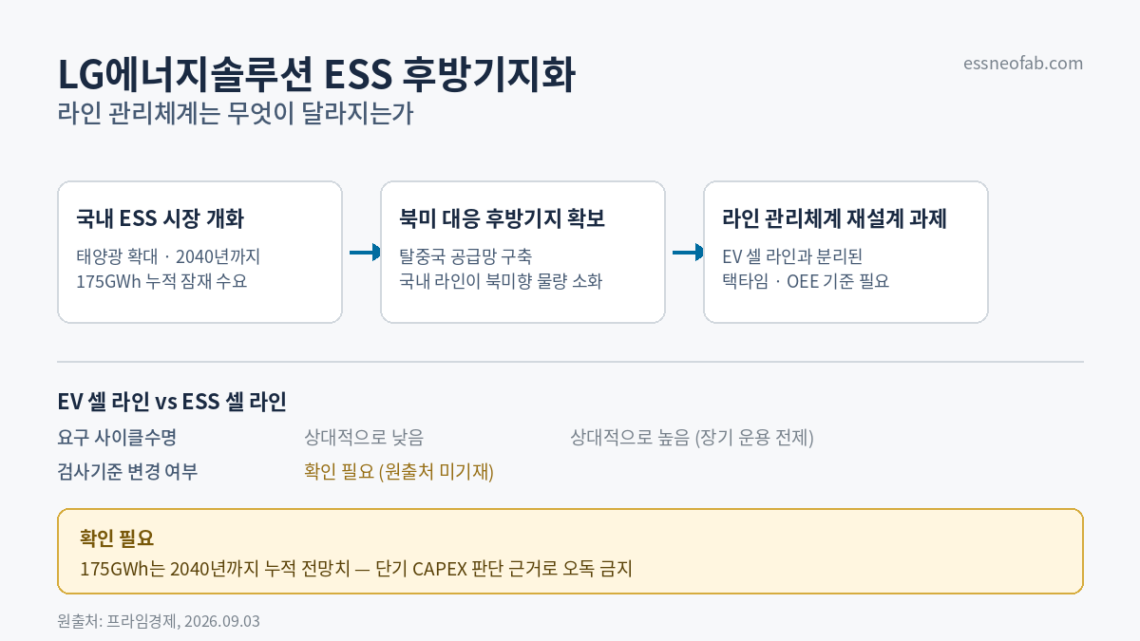
As Korea's domestic ESS market opens up, a trend is forming in which LG Energy Solution secures a role as a rear base responding to North American demand. Driven by solar power expansion, potential cumulative ESS battery demand of 175 GWh is projected through 2040, alongside attention to the effect of building a China-independent supply chain. However, absorbing this volume in domestic lines requires a takt time (Takt Time)¹ and OEE (Overall Equipment Effectiveness)² management system separate from existing EV cell lines, and the relevant detailed criteria are not given in the original source and require separate verification. 1. Situation and Challenge The opening of Korea's domestic ESS market is…
-
Doubling the Renewable-Energy Budget and Underground-Parking EV Fire-Detection AI — Two Signals the 2027 Budget Sends to the ESS Line
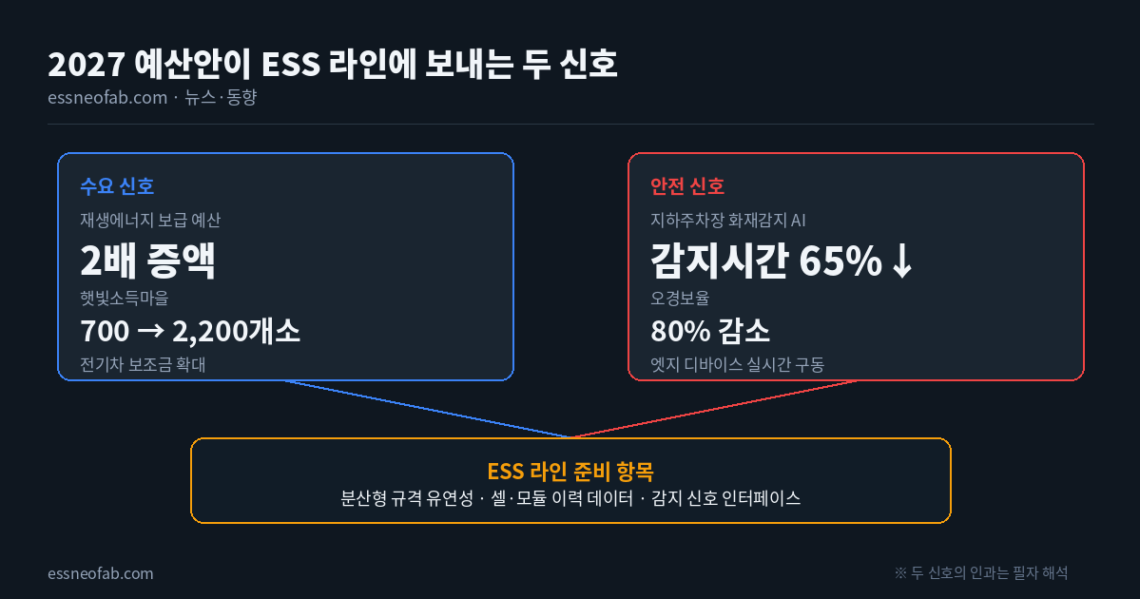
The 2027 government budget doubles the renewable-energy deployment budget, expands "Sunlight Income Villages" from 700 to 2,200 sites, and expands EV subsidies (Source 1). During the same period, an AI model for early detection of EV fires in underground parking garages has been developed domestically to the point of running in real time on edge devices (Source 2). This article reads the two items from an ESS¹ line/system perspective — as a demand signal and a safety signal, respectively — and sets out what the line side should prepare. The conclusion is that "as distributed generation increases, ESS demand increases, but expanded installation is accompanied by tightening fire-safety standards"; this…
-
Grid-Forming PCS Mandate Redesigns FAT Takt Time and the BMS-PCS-EMS Interface
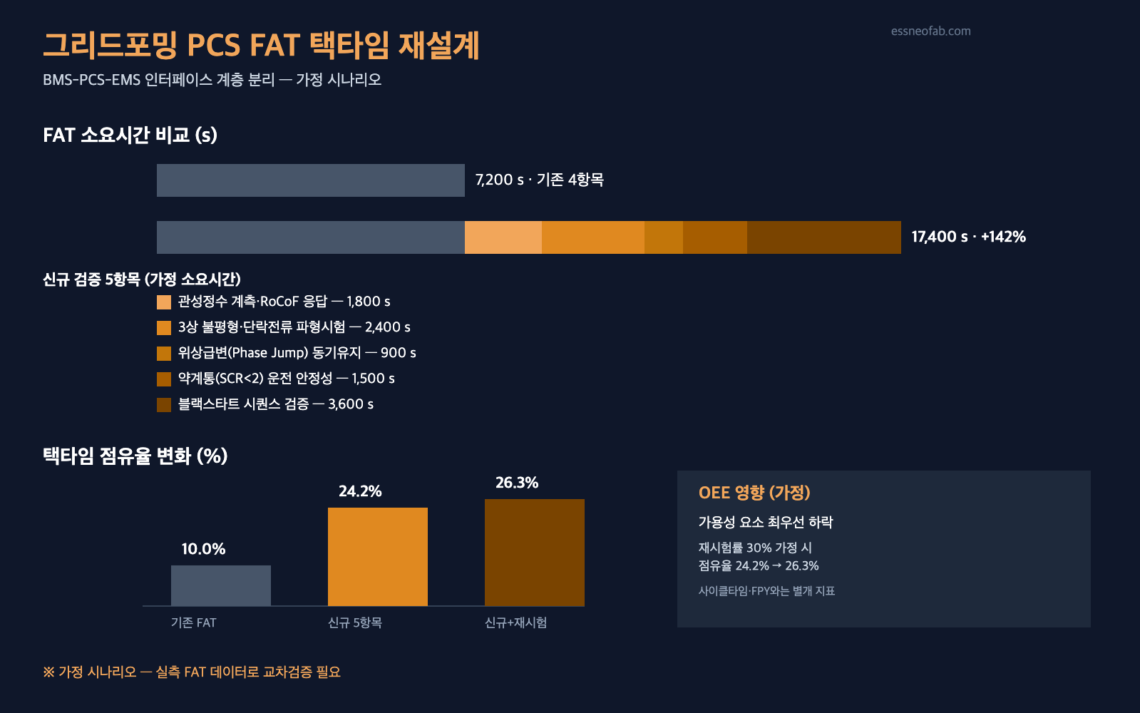
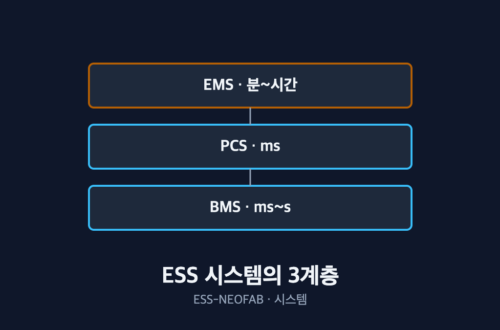
As grid-forming (GFM) inverter performance requirements become mandatory starting with long-duration BESS (Battery Energy Storage System) in the centralized-contract market scheduled for commercial operation in December 2027, five new verification stages are added to PCS (Power Conversion System) manufacturers' Factory Acceptance Test (FAT) lines. In an assumed-scenario calculation, per-unit FAT time increases by approximately 142% over the existing baseline, pushing the takt-time share from the 10% range to the 24% range, and if retests recur, the Availability factor of OEE (Overall Equipment Effectiveness) is the first to be shaken. At the same time, a design challenge emerges: a layer separation is needed between the grid-forming control loop, which requires sub-cycle…
You May Also Like
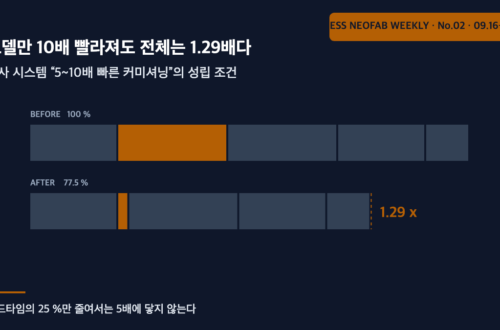
Even a tenfold faster model moves the whole by 1.29x — what “5 to 10 times faster commissioning” actually requires
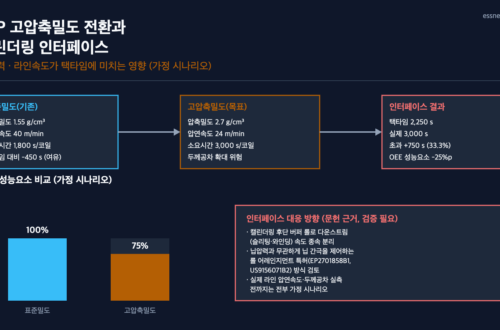
LFP High-Compaction-Density Conversion and the Calendering Interface: How Nip Pressure and Line Speed Affect Takt Time
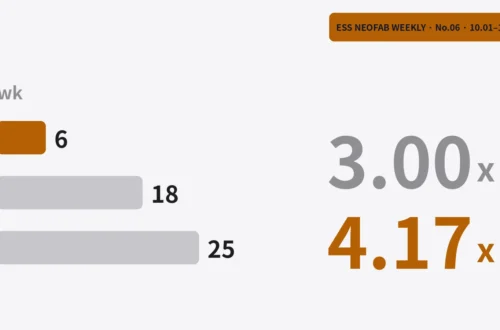
A 160 MW battery’s six-week commissioning has two baselines
-
46-Phi Cylindrical Cell Line Conversion: The Pressure-Sensor–BMS Interface Determines Takt Time
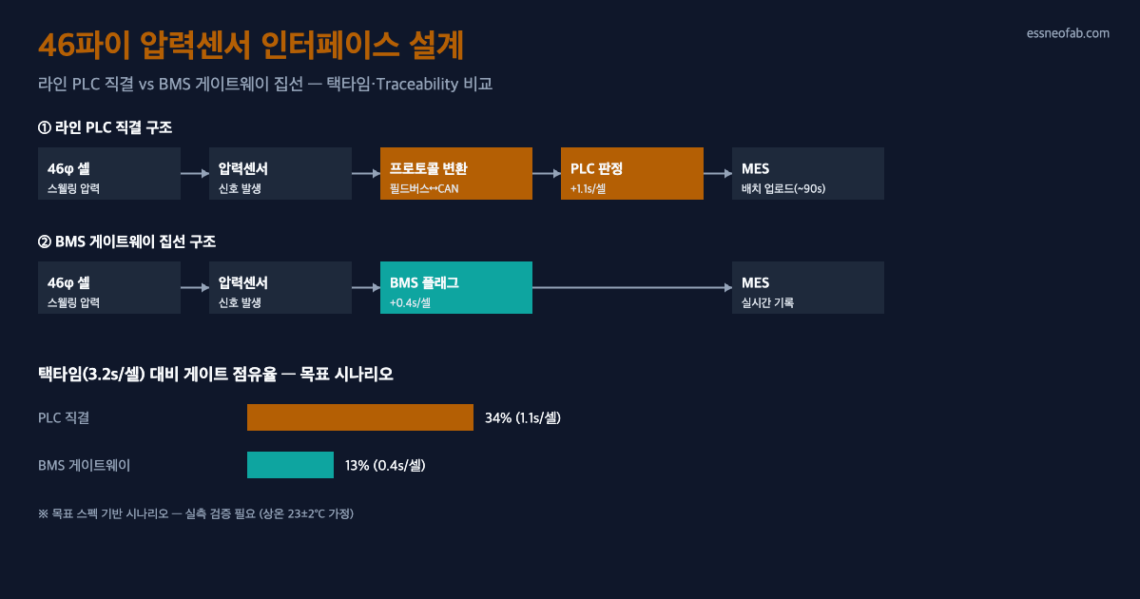
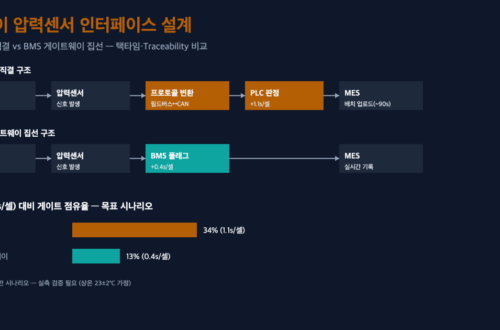
As the transition to 46-series (46-phi) cylindrical cell mass production approaches, how much more finely the swelling-pressure behavior specific to the 46 mm-diameter cell must be measured compared to the 21700 has emerged as a practical line-design variable. As Korea's ESS Round-3 centralized-contract market bid size is under review for expansion to over 1 GW and new ESS orders for AI data centers surge, pressure to expand or convert 46-phi lines is expected to grow further. This article presents the proposition that an interface structure in which pressure-sensor data is first aggregated at the BMS gateway layer — rather than at the line PLC — absorbs per-gate judgment delay within…
You May Also Like
Re-Reading the ESS Grid-Interconnection Queue in the Language of Line Balancing
Designing the Merge Point in a 10 GWh Pack-Container Integration Line: Synchronizing Two Upstream Lines and Sizing AGV Fleet from the Powertrac × Sunka Lead Order
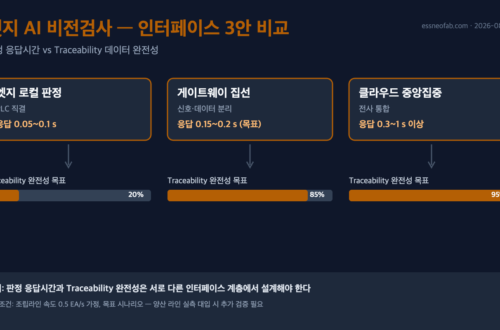
Edge AI Vision Inspection and Battery-Pack Leak Testing: How Gateway Aggregation Affects Traceability Completeness
-
Serial Genealogy in ESS Operation: Where Module Swaps, Refurbishment and BMS Board Replacements Break Parent-Child Links
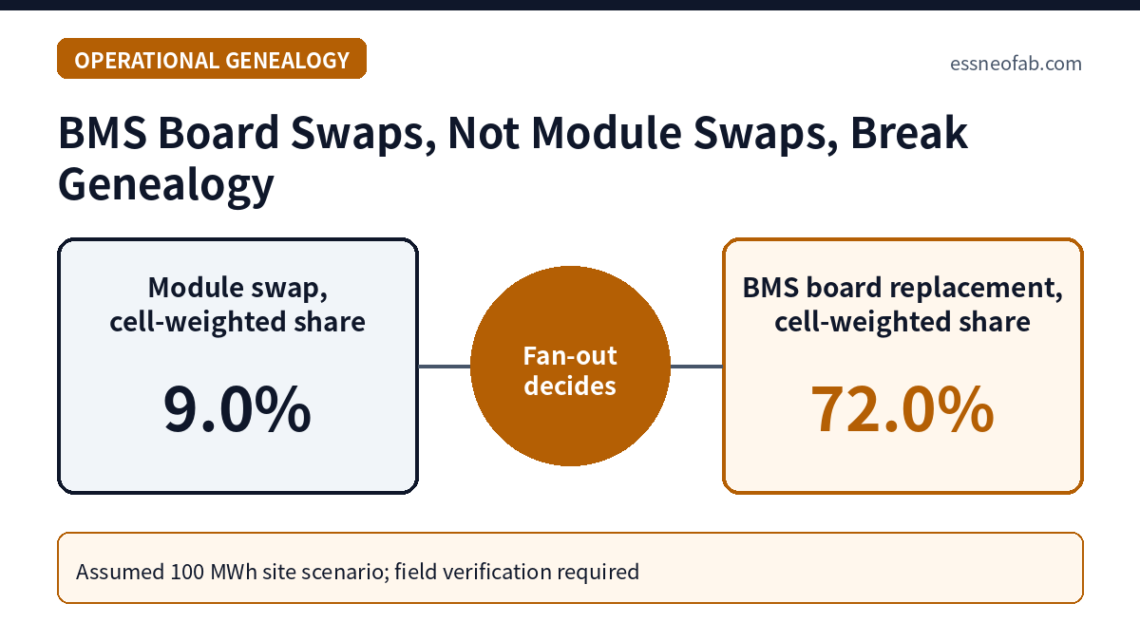
After shipment, genealogy mismatches at an ESS site accumulate less from module swaps, which are managed as genealogy events, than from BMS board (BMU/BCU) replacements, which are not recognized as genealogy events at all. Assuming annual replacement rates and record-omission rates for a 100 MWh site (99,840 cells, 1,920 modules, 240 racks), cells whose parent chain cannot be verified accumulate at 554 per year and 5,541 over 10 years (5.55% of the total), with 72.0% originating from board replacements. Module swaps account for 25.3% by event count but only 9.0% when weighted by cells. Since Article 77(7) of the EU Batteries Regulation requires repurposed and remanufactured batteries to carry a…