-
46-Phi Cylindrical Cell Line Conversion: The Pressure-Sensor–BMS Interface Determines Takt Time
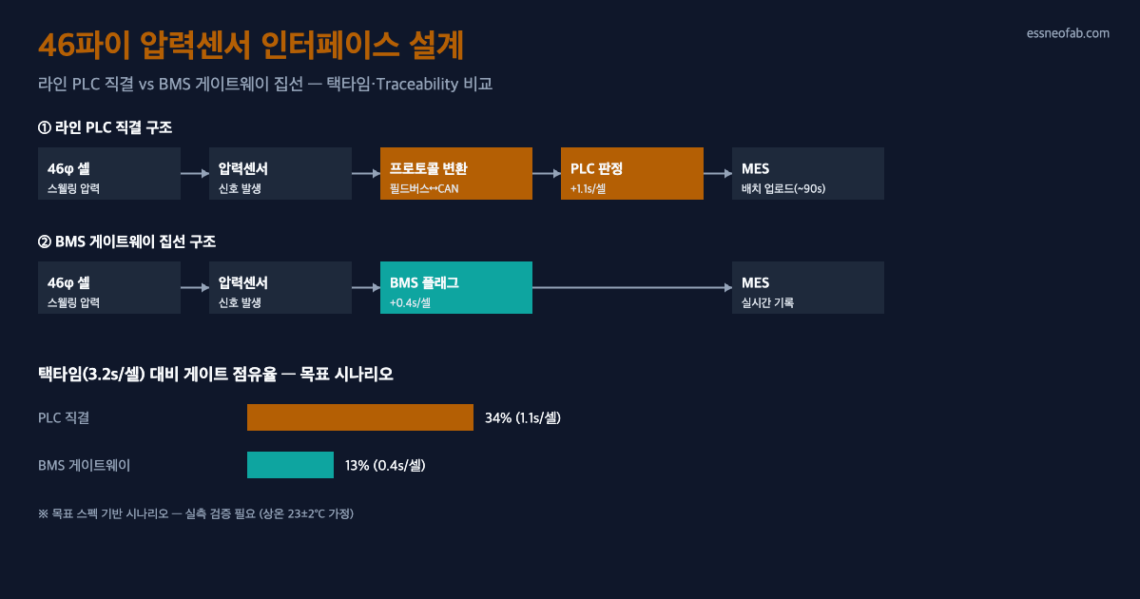
As the transition to 46-series (46-phi) cylindrical cell mass production approaches, how much more finely the swelling-pressure behavior specific to the 46 mm-diameter cell must be measured compared to the 21700 has emerged as a practical line-design variable. As Korea's ESS Round-3 centralized-contract market bid size is under review for expansion to over 1 GW and new ESS orders for AI data centers surge, pressure to expand or convert 46-phi lines is expected to grow further. This article presents the proposition that an interface structure in which pressure-sensor data is first aggregated at the BMS gateway layer — rather than at the line PLC — absorbs per-gate judgment delay within…
You May Also Like
LFP High-Compaction-Density Conversion and the Calendering Interface: How Nip Pressure and Line Speed Affect Takt Time
The 2026 Edition of NFPA 855 Changes ESS Rack Design and Traceability Documentation at the Same Time
Re-Reading the ESS Grid-Interconnection Queue in the Language of Line Balancing
-
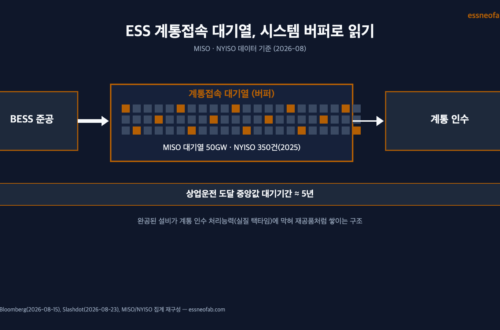
Re-Reading the ESS Grid-Interconnection Queue in the Language of Line Balancing
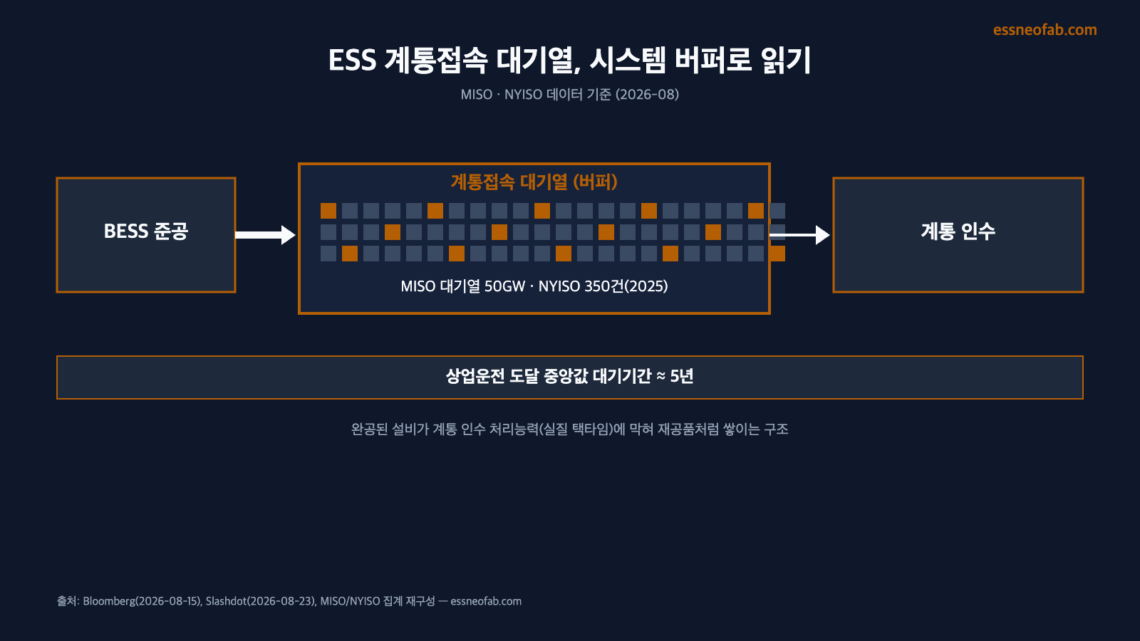
The stalled BESS (Battery Energy Storage System) commissioning cases in the US, reported successively by Bloomberg and Slashdot in August 2026, show that even after equipment is completed, delays recur at a separate bottleneck section called the grid-interconnection queue. BESS accounts for about 50 GW of MISO's total 650 GW queue, the number of NYISO's queued projects grew from 176 in 2018 to 350 in 2025, and the median wait time to reach commercial operation approaches 5 years. This article redefines this phenomenon using the line-engineering concepts of buffer, interface, and takt time, analyzing it as a work-in-process inventory structure in which completed equipment piles up without being able to…
You May Also Like
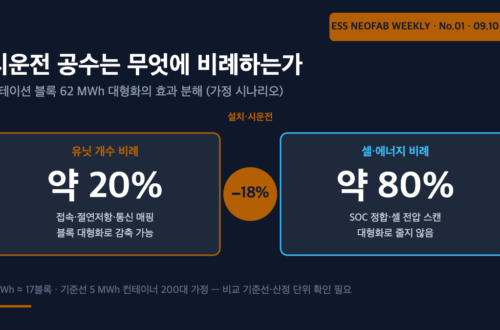
When the Station Block Grows to 62 MWh, What Actually Shrinks Is Commissioning Labor, Not Cell Count
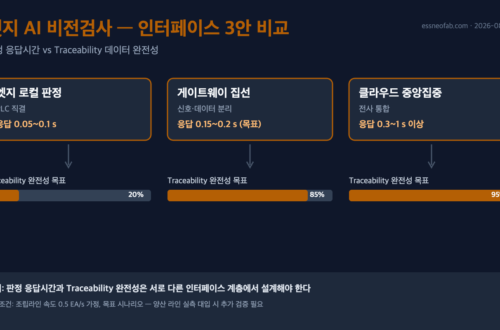
Edge AI Vision Inspection and Battery-Pack Leak Testing: How Gateway Aggregation Affects Traceability Completeness
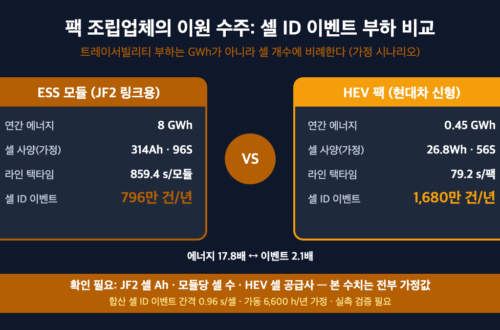
Sebang Lithium Battery’s Simultaneous HEV Pack and ESS Module Orders — Analyzing the Cell-Inbound Interface and Cell-ID Traceability Load
-
The Equipment Maker’s Line-Ownership Shift — OEE and Takt-Time Design During the ESS-LFP New-Line Mass-Production Ramp-Up
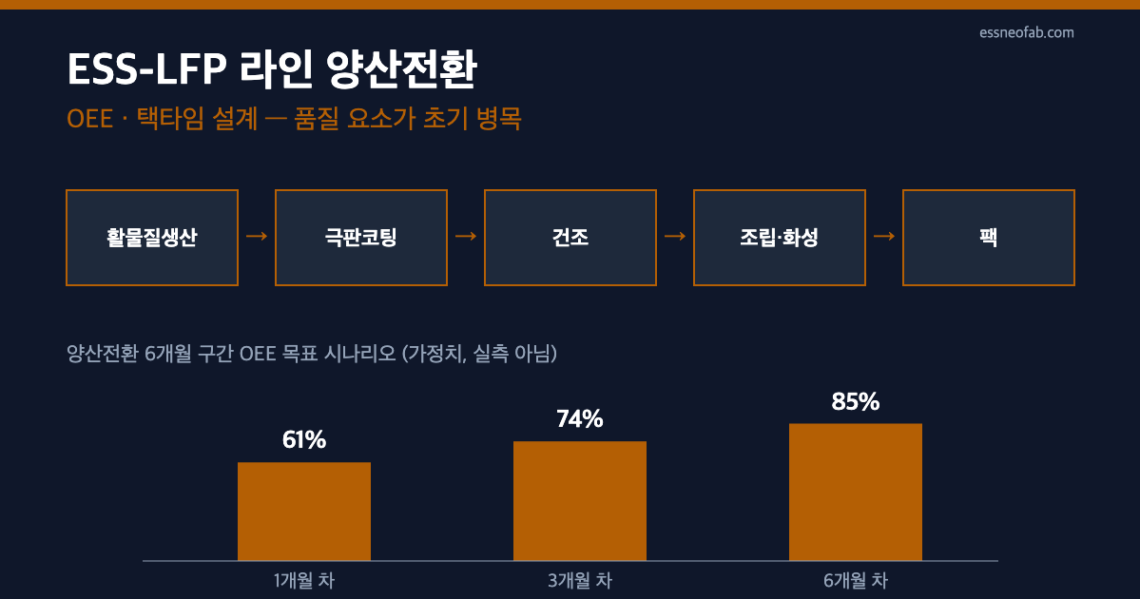
As more equipment suppliers directly operate their own ESS-LFP lines, a need has emerged to review line balancing and OEE management during the mass-production ramp-up separately from equipment-buyer-owned lines. Prompted by domestic equipment maker PNT's May 2026 earnings announcement, in which it stated it is focusing on yield stabilization for its Plant 4 ESS-LFP battery/cathode-active-material production line with a target of mass-production conversion in the second half of 2026, this article designs and verifies a target scenario for the order in which the three OEE factors — Availability, Performance, and Quality — improve during a ramp-up phase in which both new materials and a new line are introduced simultaneously. It…
You May Also Like
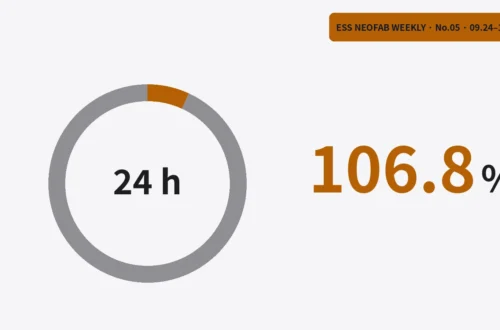
Two Cycles a Day Take 106.8 % of a Day, and the Retention Tier Shifts Cell Volume by 1.47 GWh
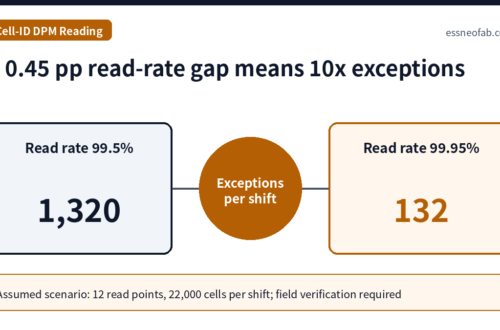
Cell-ID Laser DPM Read Rate 99.5% vs 99.95%: How No-Reads Drive Exceptions per Shift and OEE
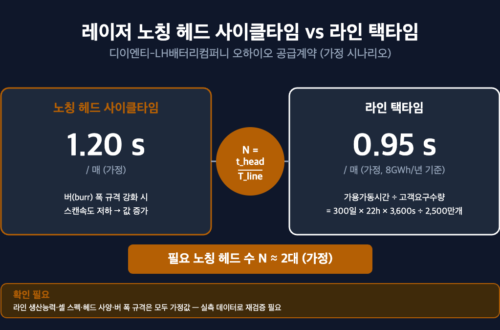
The Interface Between Laser Notching Cycle Time and Line Takt Time — The Head-Count Sizing Problem Revealed by DI ENT’s Ohio Supply Contract
-
Embedding an AI Vision Inspection Gate in the Line: Redefining OEE and Takt-Time Design Variables
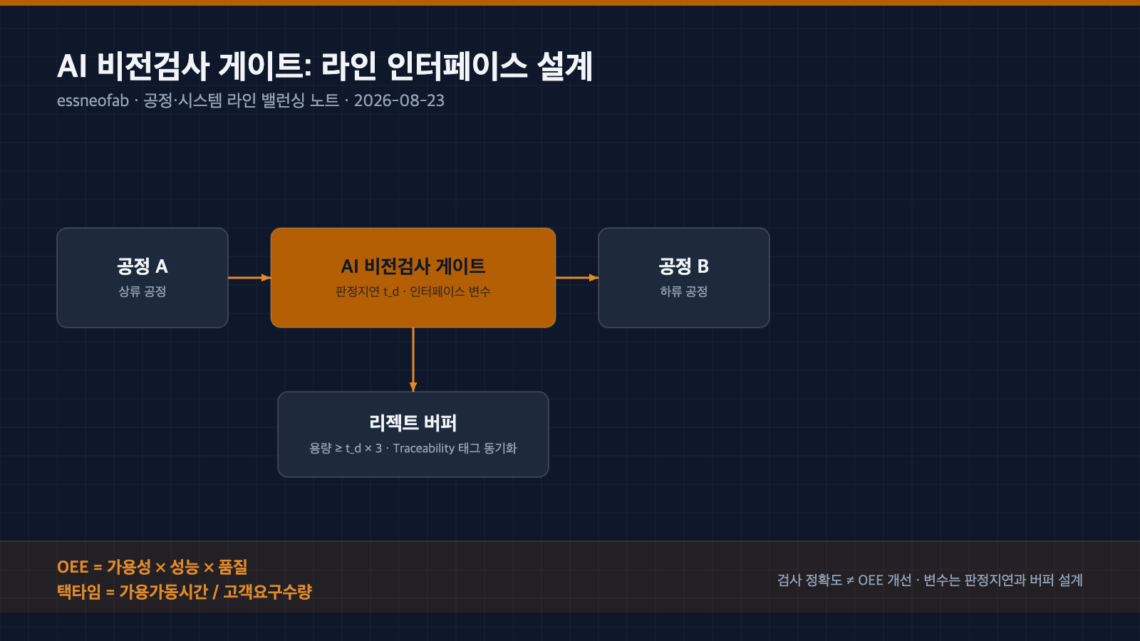
Across battery-line procurement specifications from 2024 to 2026, a trend is confirmed in which the Cognex, Keyence, ISRA, and MVTec deep-learning vision-inspection platforms have effectively become standard fixtures. However, only inspection-accuracy specs are typically stated, while the effect an AI vision-inspection gate has on the line's overall OEE performance rate and takt-time variance is often not treated as a separate design item. This article redefines the AI vision-inspection gate as two interface variables — judgment delay and reject-merge point — and addresses the procedure for incorporating them into line-balancing calculations. To state the conclusion first, it is not the accuracy of the AI vision inspection itself, but the buffer-capacity design…
-
ESS Assembly Line: Why Immersion Cooling Becomes a Bottleneck
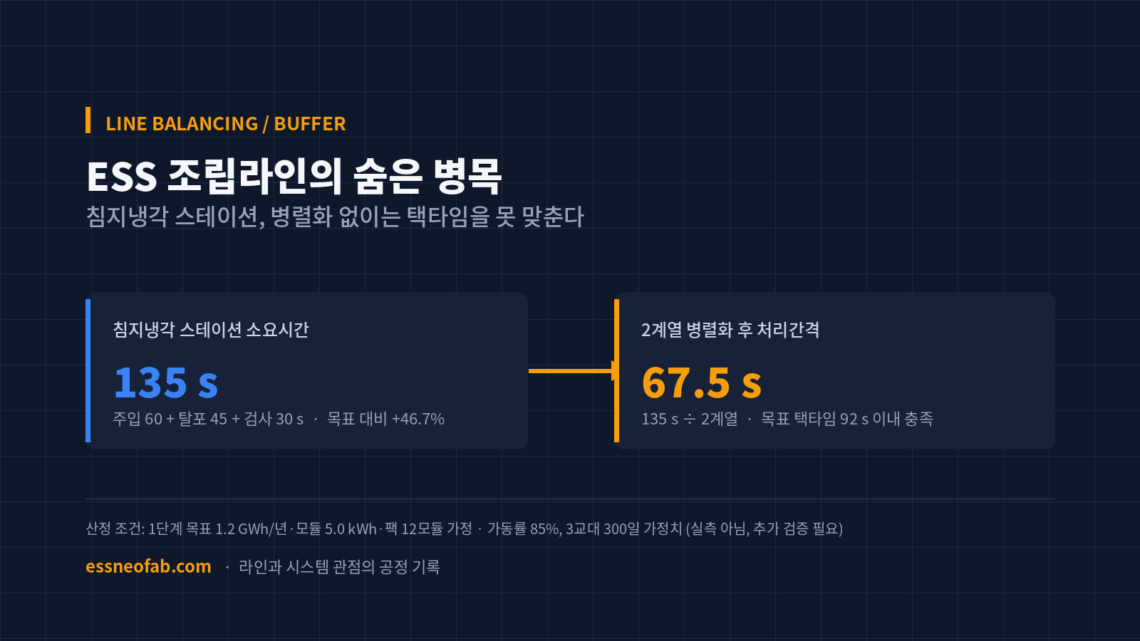
This article addresses the line-balancing problem that arises when immersion cooling and AI cell monitoring are simultaneously integrated in-line into an ESS module-pack assembly line. Under the estimation scenario, the immersion-cooling station's process time is 135 s, exceeding the target module takt time of 92 s by 46.7%, making a bottleneck unavoidable with a single-station configuration. Parallelizing into 2 lines lowers the effective processing interval to 67.5 s, satisfying the takt-time condition, but this in turn raises the FIFO buffer size at the point where the two lines merge, and the module-serial tagging of AI monitoring data, as new interface risks. This estimation is a scenario based on assumed values…
You May Also Like
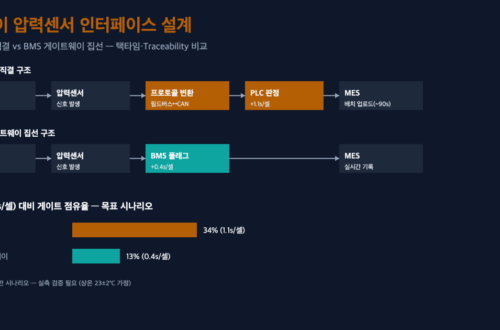
46-Phi Cylindrical Cell Line Conversion: The Pressure-Sensor–BMS Interface Determines Takt Time
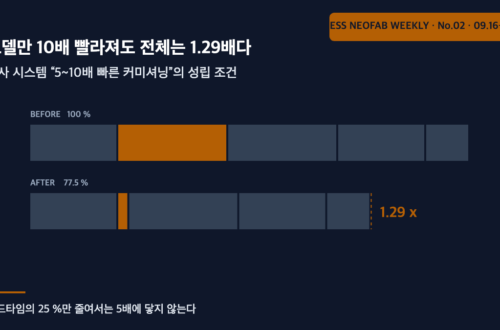
Even a tenfold faster model moves the whole by 1.29x — what “5 to 10 times faster commissioning” actually requires
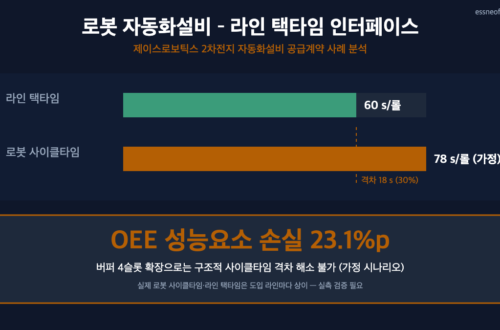
Introducing Robotic Automation Equipment — Where Does the Interface with Line Takt Time Break Down
-
Converting EV Lines to ESS: Where Does OEE Break Down?
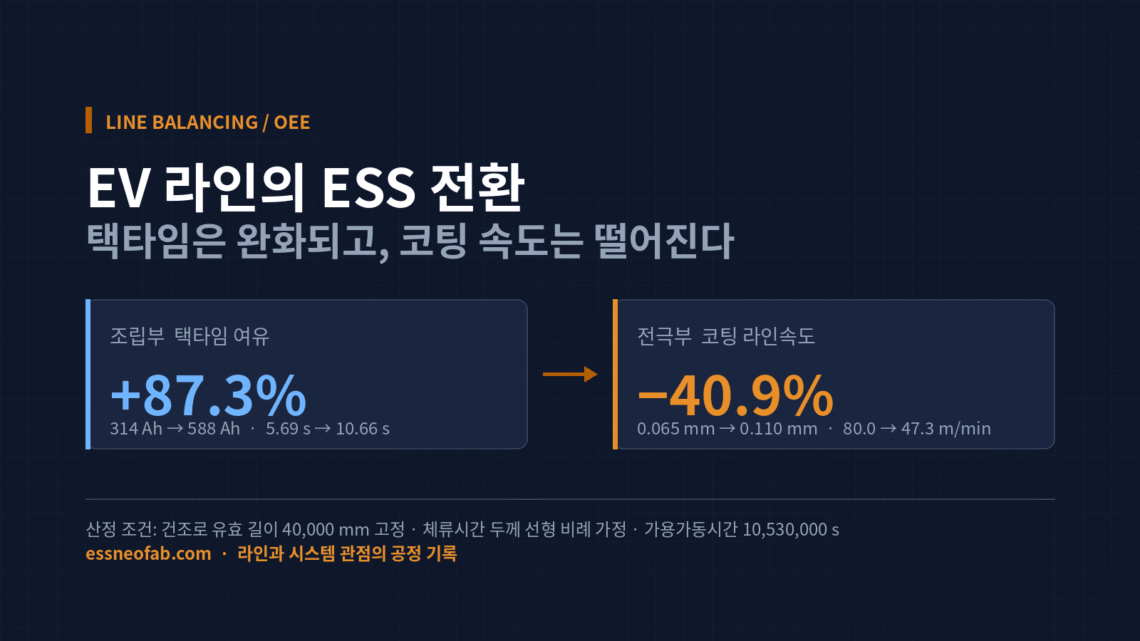
When converting an EV cell line for ESS use, retrofit effort and budget tend to concentrate on the assembly process. However, when a thick-film electrode and a large prismatic cell format are applied simultaneously while the drying-oven length remains fixed, the takt-time margin in the assembly section increases by 87.3% while the coating-section line speed drops by 40.9%. The conversion bottleneck shifts from assembly to the electrode section, and CAPEX priority should be reallocated accordingly. Furthermore, failing to update the abnormal-cycle-time baseline by part number books up to 36.3 percentage points of phantom performance loss into OEE, causing the improvement organization to chase a loss that does not exist. 1.…
You May Also Like
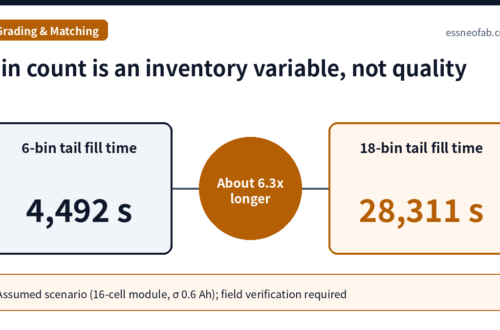
Cell Grading Bin Count and Grade-Specific WIP: What Module Matching History Must Retain
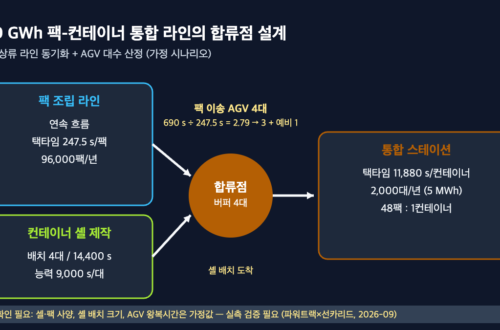
Designing the Merge Point in a 10 GWh Pack-Container Integration Line: Synchronizing Two Upstream Lines and Sizing AGV Fleet from the Powertrac × Sunka Lead Order
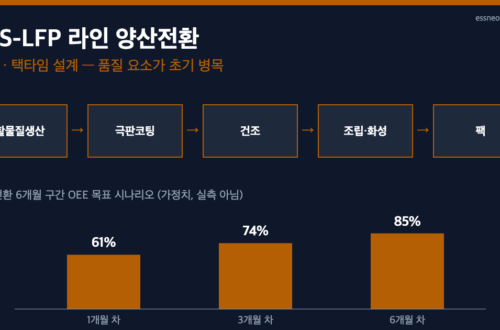
The Equipment Maker’s Line-Ownership Shift — OEE and Takt-Time Design During the ESS-LFP New-Line Mass-Production Ramp-Up
-
Dry Electrode: Where Does the Line Bottleneck Move?
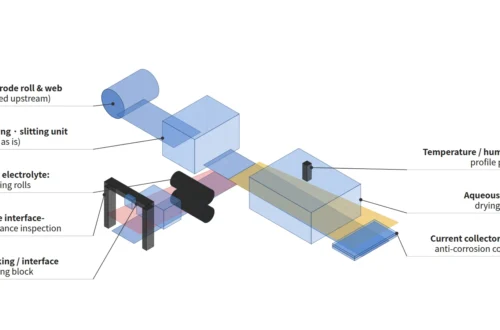
Converting to a dry electrode process eliminates the drying-oven section of a wet-coating line, but the claim that this improvement, by itself, shortens line takt time does not hold. When both the physical length and the time buffer that the drying oven provided disappear at once, the bottleneck shifts to the electrode-formation/lamination section and the quality-inspection section, and the degrees of freedom available for buffer design actually shrink. Separately, an industrial-park zoning deregulation announced in August 2026 adds battery-recycling businesses to the eligible occupants of the Gumi and Pohang national industrial complexes, changing the logistics-interface conditions outside the line. This article examines both changes together at the line/system level, and…
-
Inter-Process Buffers: Bigger Isn’t Always Better
An inter-process buffer (work-in-process inventory) is not a device that gets safer as it grows. It is a range problem, bounded below by what availability demands and above by what quality tolerates. Under the assumed line conditions below, the availability-driven minimum is 2 coils while the quality-driven maximum is 1 coil — the two bounds conflict. That conflict is not resolved by enlarging or shrinking the buffer; it is resolved by reducing upstream MTTR (Mean Time To Repair) or by moving the defect-detection point ahead of the buffer. Every figure below is an assumed value set for illustration, and applying it 1:1 to a mass-production line requires separate verification. 1.…
You May Also Like
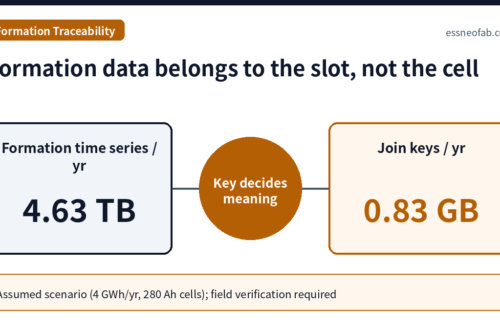
Linking Cell History in Formation and Aging: History Contamination from Tray ID + Slot Mapping
LFP High-Compaction-Density Conversion and the Calendering Interface: How Nip Pressure and Line Speed Affect Takt Time
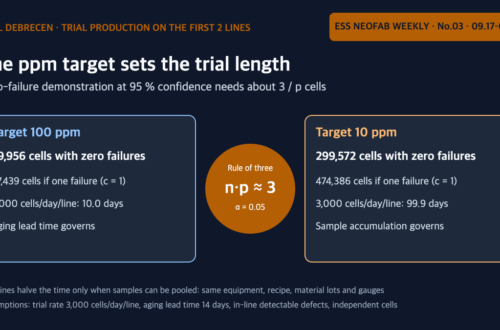
CATL Starts Trial Production in Debrecen — The Digits of the Defect-Rate Target, Not the Equipment, Set the Length of a Trial Run
-
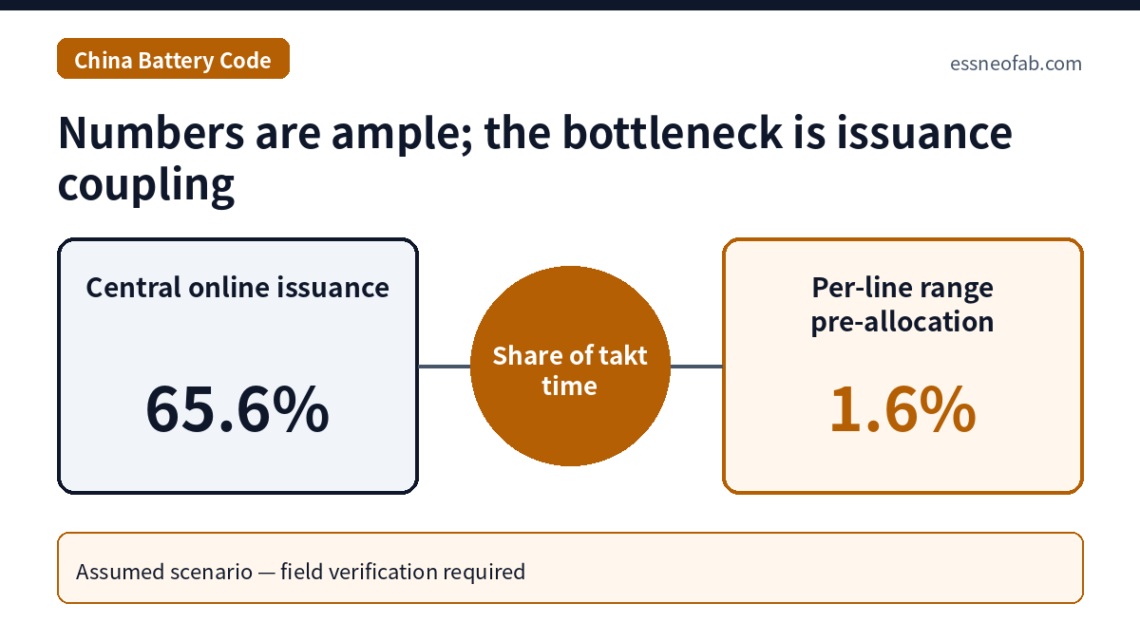
China’s GB/T 34014 24-Character Battery Code: How Code Structure Fixes Issuance Timing and Authority on the Line
China's "Interim Measures for the Administration of Recycling and Comprehensive Utilization of Waste Power Batteries from New Energy Vehicles" (MIIT and five other departments, Order No. 73), effective 1 April 2026, made power battery coding under GB/T 34014 and labeling of cells, modules and packs an explicit mandatory provision, and in August 2026 the rollout of a "power battery digital identity card" system built on the 24-character code was made official. Because the 24-character code contains a manufacture date (3 characters) and a serial number unique within "the same specification on the same day" (7 characters), the line must fix the code on the day of production and issue, mark…
-
Traceability Events at the ISA-95 L2→L3 Boundary: How OPC UA Polling, Subscriptions and MES Handshakes Erode Takt Time
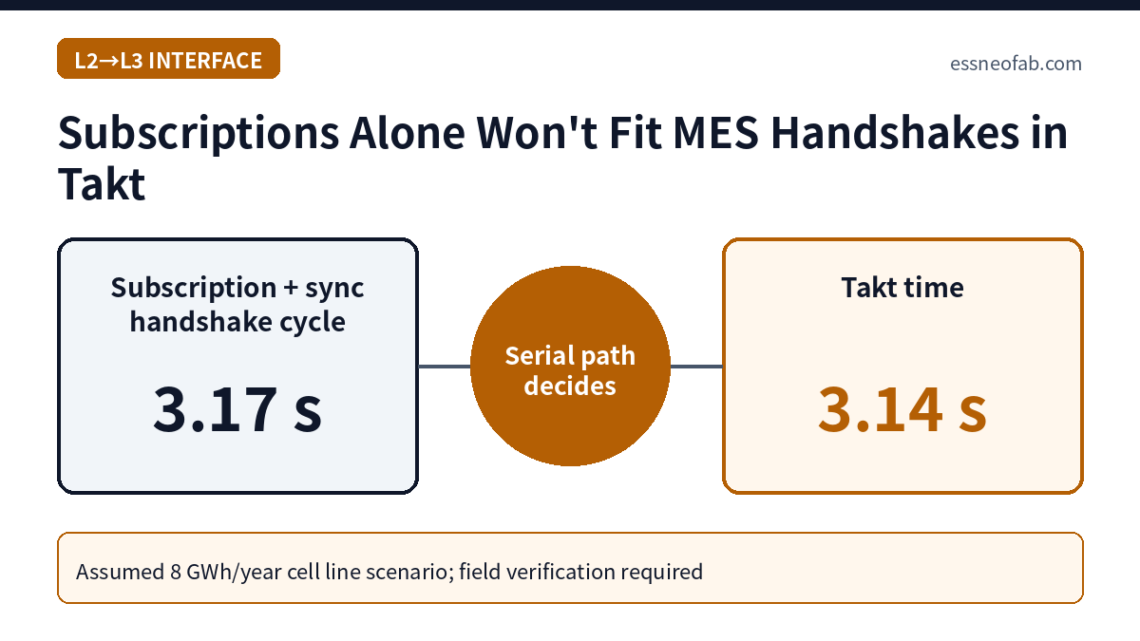
At the boundary between equipment (ISA-95 Level 2) and MES (Level 3), the main reason traceability events erode takt time is not the transport method (polling vs. subscription) but a structure in which the MES acknowledgement (handshake) sits serially on the critical path of the station cycle. On an 8 GWh/year cell line (assumed takt time 3.14 s, net station processing 2.80 s), 1.0 s polling with a synchronous handshake adds an average of 0.72 s, stretching the cycle to 3.52 s and creating a shortfall of about 10.9% against required quantity; switching to a 0.1 s/0.2 s subscription still adds 0.37 s on average and still exceeds takt time.…
You May Also Like
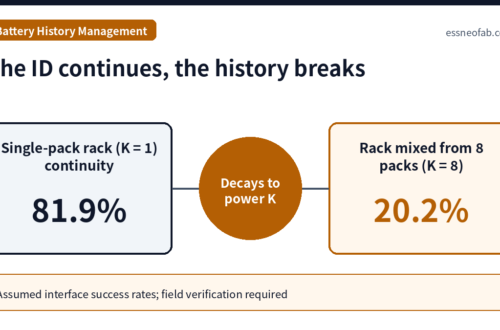
After Korea’s Battery History Management System: IDs Continue, Operating History Breaks — History Continuity of ESS Reuse Racks
Two Cycles a Day Take 106.8 % of a Day, and the Retention Tier Shifts Cell Volume by 1.47 GWh
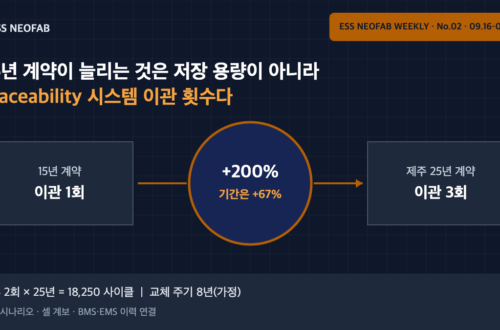
A 25-Year Contract Increases Migrations, Not Storage — Traceability Design for Jeju Long-Term ESS Contracts